MAPS OF HISTORY · THE QUESTIONS · Why did Song China — richer, more populous and…
The Mongol Empire, 1206–1294 · 1279
Why did Song China — richer, more populous and more technologically advanced than any Mongol enemy — fall, when far weaker Japan and Vietnam did not?
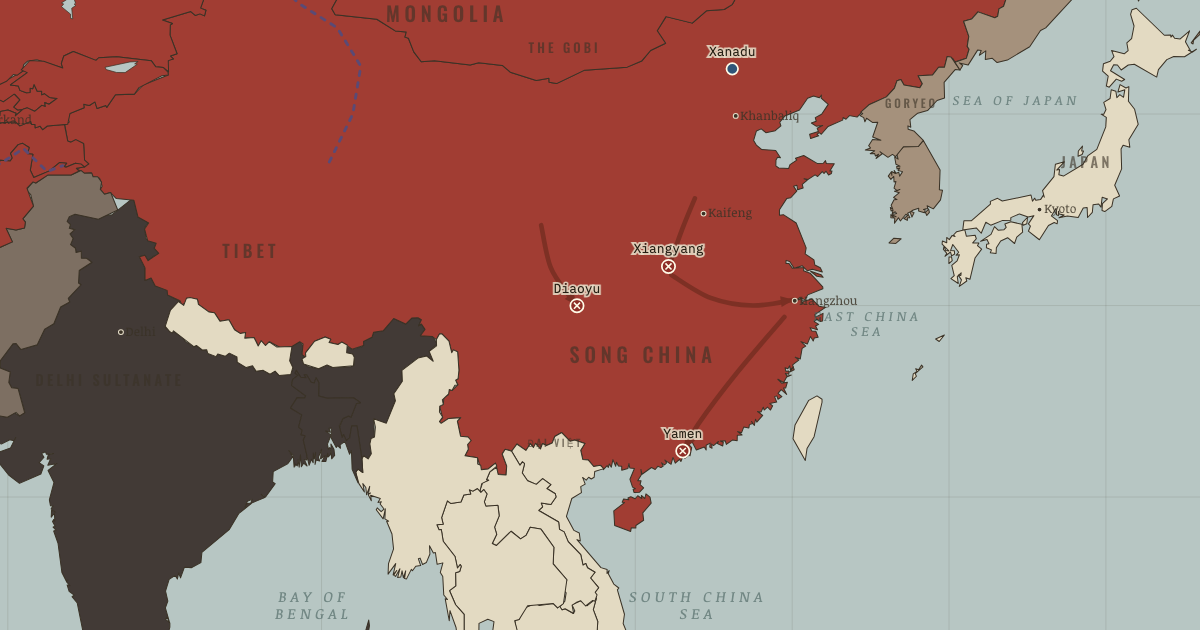
The Song war lasted far longer than any earlier campaign because southern China denied the Mongols everything their method relied on. There was little pasture, and the country was laced with rivers, rice fields and fortified cities supplied by water, so cavalry could win battles without ever controlling that network. Möngke’s three-front offensive collapsed when he died near Diaoyu in 1259, and Khubilai then changed the approach. He took the dynastic name Yuan, moved his political centre toward Beijing, governed through Chinese administrators, and expanded fleets built by Korean and surrendered Song specialists.
THE SHORT ANSWER
- The longest war on the map, explained by water. Cavalry superiority ends at the paddy line: horses founder in wet fields, pasture is nil, and the Song supplied every fortress by river while Mongol columns marched around them. Conquest required fleets, siege parks and rice logistics — capabilities the empire had to hire, capture and build over decades. The 45-year timeline is not Mongol weakness; it is the measured cost of converting a land power into an amphibious one. (File the lesson: it is also why Japan, next chapter, was a different problem entirely.)
- A state too rich to knock out, too divided to win. Song depth was real: losses replaced, armies paid from commerce, gunpowder weapons on the walls. But the court fought itself harder than the enemy — chancellor Jia Sidao concealed the true state of the war, defected commanders (the navy’s architects among them) were driven out by faction, and the child-emperor endgame was managed by exiles. The dynasty did not so much fall as leak talent to a rival who paid better — the atlas’s oldest mechanism (Chs. 2, 3), now at civilizational scale.
- Legitimacy as a weapon system. Khubilai’s sinicization was strategy, not sentiment: by ruling as a Chinese emperor he offered gentry and generals continuity instead of apocalypse — surrendering to the Yuan became a career move, not a betrayal of civilization. Hangzhou’s peaceful surrender (spared, garrisoned, taxed) was worth more than ten stormings; compare Merv and mark how far the playbook has traveled. Terror conquered the north in 1220; accounting and ritual conquered the south in 1276.
- One empire’s parts, one project. Even divided by the family war, the khanates functioned as a single military-technical market: Persian trebuchets at Xiangyang, Korean hulls at the Yangzi mouth, Central Asian finance behind the campaigns. Kaidu’s revolt (Ch. 9) taxed the effort but never severed the network. The Song faced not a country but a continent’s supply chain.
THE TURN
Xiangyang, 1268–1273. Five years for two fortresses — and the whole war inside them. When the Persian counterweight engines breached what Chinese ones could not, the Yangzi basin was unlocked and the Song heartland lay open by water; every subsequent arrow on this map flows from that breach. It is also the era’s cleanest demonstration of what the Pax Mongolica actually was: not peace, but a transmission belt — the same integration that moved silk and astronomers moved siege engineers to whichever wall the family needed broken.
WHAT IT CHANGED
China whole, under the Yuan. Khubilai reunifies China after three centuries of partition — the frame the Ming and Qing inherit, with Beijing as capital and Yunnan (Dali’s old kingdom) and Tibet’s incorporation on the Yuan’s books. Chinese historiography counts the Yuan a legitimate dynasty in the orthodox succession: the conquerors are, in the record that matters locally, emperors. Sit with how strange and how consequential that absorption is.
The steppe capital is abandoned. Moving the throne from Karakorum to Beijing tilts the Yuan decisively toward its Chinese tax base — and severs the dynasty from the pastures and politics that made it. Steppe traditionalists never forgive Khubilai (Kaidu’s war runs on the grievance), and when the Yuan fall in 1368 the family simply rides home. Where a capital sits is a decision about who you are; this one decided it forever.
A navy with momentum. The fleet built for the Yangzi and crewed by surrendered Song and conscripted Koreans now exists — and unemployed capability is dangerous to its owner. Within two years of Yamen it is pointed at Japan, then Vietnam, then Java: Chapter 11 is, among other things, what a hammer does when everything must become a nail.
THE FULL ANSWER, ARGUED
Song strength made conquest difficult, but its wealth also made a long campaign worth funding. A shared land frontier and connected rivers eventually let Yuan forces apply sustained pressure after building a navy and capturing Xiangyang. Japan required an exposed sea crossing; Vietnam could trade space for heat, disease and supply failure. The difference was not simply stronger versus weaker defenders. It was the relationship between the prize’s value, the routes available to reach it and the invader’s ability to adapt.
AN INTERESTING FACT
Shangdu, the summer capital where Khubilai’s officers acclaimed him in 1260, has the strangest afterlife of any site on this map. Marco Polo’s account of its gilded cane palace passed into Samuel Purchas’s 1613 travel anthology; in 1797 Samuel Taylor Coleridge fell asleep over that very page — by his own telling, under opium — and woke with “Kubla Khan”: In Xanadu did Kubla Khan / A stately pleasure-dome decree. The poem made a ruined Mongol city English shorthand for unreachable splendor; the real Xanadu is a grass-covered ruin in Inner Mongolia, a World Heritage Site since 2012.
This is the study layer of Chapter 10 — Khubilai and the Song in The Mongol Empire, 1206–1294; the full index of the atlas is here.
SEE IT MOVE ON THE INTERACTIVE MAP →New here? Chapters 1–2 of every atlas are free to sample, and the WW2 atlas is free in full. One membership opens all thirteen — the Cartographer’s Circle.
MORE QUESTIONS FROM THE MONGOL EMPIRE
THE DISPATCH
One short letter when a new atlas opens — and the printable study guide for The Mongol Empire is yours now, free.
NO TRACKING · YOUR ADDRESS IS USED FOR THE DISPATCH AND NOTHING ELSE · UNSUBSCRIBE ANYTIME