MAPS OF HISTORY · THE QUESTIONS · Jamukha had the better birth, the bigger…
The Mongol Empire, 1206–1294 · 1207
Jamukha had the better birth, the bigger coalition, and won several of their battles. Why did Temüjin win the war?
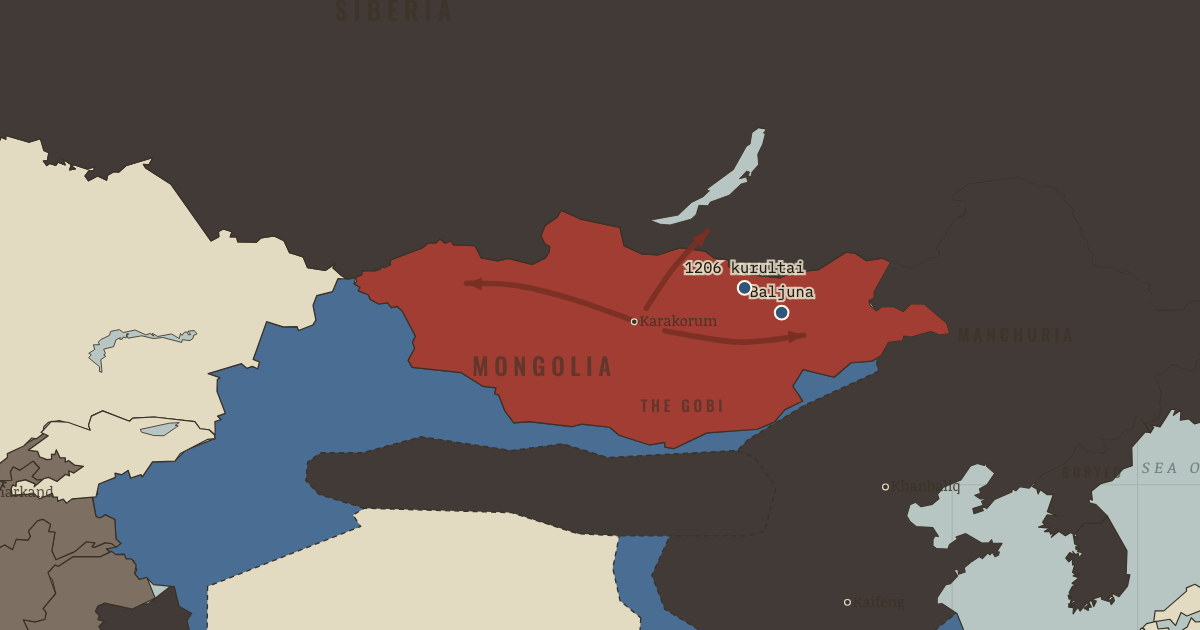
The campaigns against the Naimans, Merkits and Tatars closed a long civil war whose real stake was how followers would be governed. Temüjin’s coalition kept growing because outsiders could earn command through service to him: Jebe had once shot Temüjin’s horse in battle, and Subötai was a blacksmith’s son, yet both rose to the highest ranks because skill mattered more than birth to the new ruler. Jamukha, Temüjin’s former anda, or sworn brother, led the rival cause, a looser alliance that protected inherited rank. The war was therefore an argument about who would rule and on what terms talent would be paid.
THE SHORT ANSWER
- Merit against lineage. Steppe society ran on aristocratic blood — “white bone” over “black bone.” Temüjin, a nobody twice over, had no stake in that system and built its replacement: his greatest generals, Jebe and Subötai, were an enemy archer who had shot his horse and a blacksmith’s son. Talent flowed to him because he was the only employer paying for it. Jamukha kept the aristocrats — and kept losing captains to his rival.
- Loyalty made calculable. His rules were brutally legible: absolute faith rewarded, betrayal punished symmetrically. Enemies who fought loyally for their own lords were recruited; allies who betrayed their lords for him were killed. Once every ambitious man on the steppe could predict the payoff matrix, defection to Temüjin became the rational strategy — a slow landslide you can date follower by follower in the sources.
- Institutions that outlive charisma. The keshig bound every commander’s family to the center; decimal units broke clan blocs; the yam relay (Ch. 7) would bind distance itself. Compare every previous steppe confederation, which dissolved at its founder’s death: Genghis’s empire survives his death, doubles, and is inherited twice — because 1206 built structure, not just victory.
- The sacred mandate. Victory itself became theology: Eternal Heaven (Tengri) had given the khan the earth, so rebellion was blasphemy and world-conquest mere collection of what was owed. The claim sounds like propaganda and functioned like grand strategy — it is cited in Mongol ultimatums from Korea to Hungary, and it made every peace merely a receipt for submission.
THE TURN
The kurultai at the Onon, spring 1206. Steppe unifications had happened before; this one is different because it abolishes its own raw material. By dissolving tribes into numbered units and chiefly retinues into the keshig, 1206 removes the fracture lines every earlier confederation had died along. The settled world notices nothing — a change of management among barbarians. It is the most consequential administrative reform of the millennium.
WHAT IT CHANGED
An army with no off switch. Unity ends the raiding economy the steppe ran on — warriors can no longer rob each other. The new state must direct that energy outward or be consumed by it; plunder becomes fiscal policy. The Jin, the nearest and richest target, have perhaps five years of peace left.
A general staff is born. The nerge hunt becomes doctrine: converging columns hundreds of kilometers apart, coordinated by riders and signal protocols, closing on schedule. Watch it executed against Khwarazm (Ch. 4) and Hungary (Ch. 6) — the same choreography at continental scale.
Religious pluralism as statecraft. The Baljuna oath-takers included Muslims and Christians; the yassa exempts clergy of all faiths from tax and conscription. This is not tolerance as virtue but as policy — every conquered population’s priests become stakeholders. It will make the empire startlingly easy to administer and startlingly hard to unite against.
THE FULL ANSWER, ARGUED
Jamukha could win battles, but his coalition offered talented outsiders less room to rise. Temüjin made rewards and punishments more predictable, promoted useful followers and absorbed defeated groups into a larger organization. Each defection then strengthened his system and weakened his rival’s. Birth and charisma still mattered, but the decisive mechanism was institutional: Temüjin could turn new followers into commanders and units instead of leaving them as temporary allies.
AN INTERESTING FACT
The Secret History itself survived by one of the strangest routes in world literature. The Mongolian original was lost; what remains is a Ming-era transcription in which Chinese clerks spelled out the Mongol sounds syllable by syllable in Chinese characters — a phonetic crib made to train interpreters after the Yuan fell. Modern scholars had to reverse-engineer the lost text from that crib, which means our primary source for Genghis Khan’s childhood reads today through the filing system of the dynasty that expelled his descendants from China.
This is the study layer of Chapter 2 — Temüjin Becomes Genghis Khan in The Mongol Empire, 1206–1294; the full index of the atlas is here.
SEE IT MOVE ON THE INTERACTIVE MAP →New here? Chapters 1–2 of every atlas are free to sample, and the WW2 atlas is free in full. One membership opens all thirteen — the Cartographer’s Circle.
MORE QUESTIONS FROM THE MONGOL EMPIRE
THE DISPATCH
One short letter when a new atlas opens — and the printable study guide for The Mongol Empire is yours now, free.
NO TRACKING · YOUR ADDRESS IS USED FOR THE DISPATCH AND NOTHING ELSE · UNSUBSCRIBE ANYTIME