Age of Revolutions · JUN 1815
Was the Congress of Vienna a masterpiece or a conspiracy?
The seminar question: “Was the Congress of Vienna a masterpiece of statecraft or a conspiracy against the future?”
After 1812 Napoleon’s enemies finally coordinated: at Leipzig in October 1813 they broke French control of Germany, and allied troops entered Paris in 1814. Napoleon returned from Elba but lost at Waterloo on 18 June 1815, while the Congress of Vienna built a balance that helped prevent a continent-wide war until 1914.
Chapter 9 is included with every paid plan. WW2 is free in full, and chapter 1 of every atlas is free. A free account opens 3 more chapters a day. Starter, at $9 a month, opens all 21 with no daily limit — see the plans.
Free printable Age of Revolutions study guide, sent by email ↓
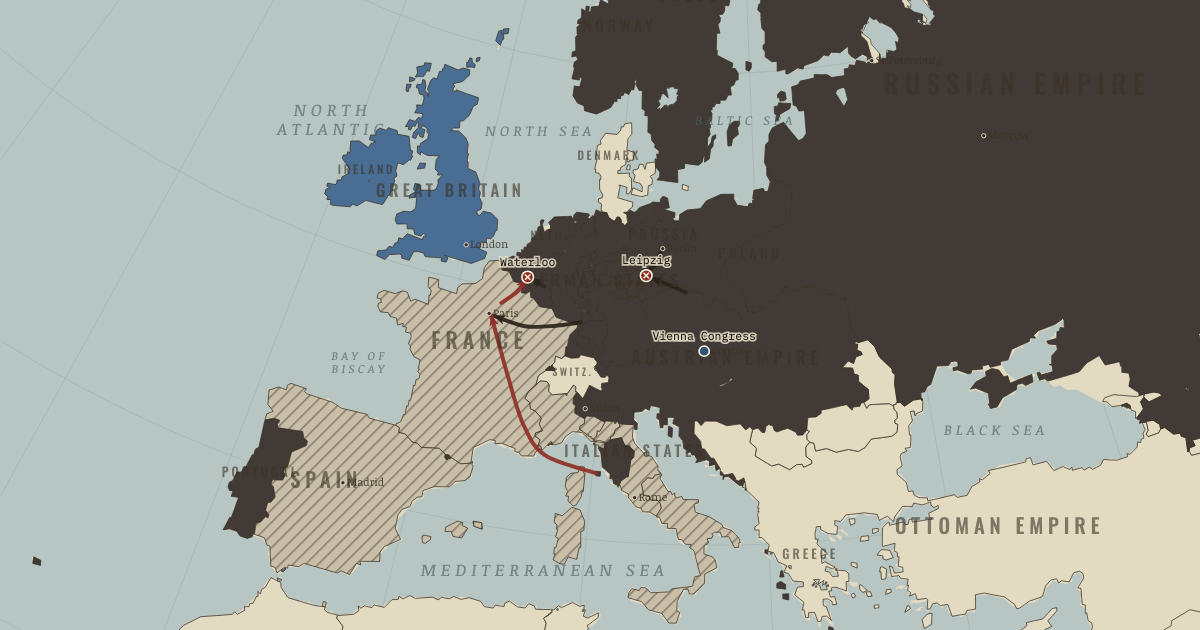
The powers fighting Napoleon had repeatedly discovered how dangerous it was to act separately. By 1813 Russia, Prussia, Austria and Sweden were bringing their armies into a common effort, sustained in part by British finance. At Leipzig in October their forces converged on Napoleon and outnumbered him. They continued the battle despite local setbacks, while several of his German allies changed sides. The retreat that followed destroyed the French satellite system east of the Rhine.
The short answer
- The coalition learned to cooperate. Napoleon had profited when his opponents fought and made peace separately: he could turn against one before another was ready. By 1813 the powers had reason to keep their disagreements from breaking the alliance. Schwarzenberg commanded their principal army, British subsidies supported continental forces (£11 million in 1813 alone), and at Chaumont in 1814 the allies pledged not to make a separate peace. Under the Trachenberg Plan, commanders were to avoid Napoleon himself and attack his marshals. Rivalry and uneven execution remained, but a local defeat no longer had to end cooperation. This learning worked alongside the pressure on France’s resources.
- Mobilization against Napoleon. French conquest helped awaken loyalties that could be turned against French rule. German students and other volunteers, the Prussian Landwehr and Russian serf-militia joined armies fighting for rulers and fatherlands. The War of Liberation drew on mass mobilization and appeals to the nation associated with revolutionary France. Methods spread by the Revolution had become means of resisting Napoleon.
- France’s resources ran down. France had spent a quarter-century at war, at a cost of roughly 1.4 million French lives. Conscription classes were called up years early; in 1813 cavalrymen rode requisitioned farm horses. The state could still raise armies, but it had fewer resources with which to replace its losses. When the allies crossed the frontier, there was no general rising like that of 1792. In April 1814 Napoleon’s marshals refused to fight on.
THE TURNING POINT
Leipzig, 16–19 October 1813. Waterloo ended Napoleon’s return, but Leipzig had already broken the system that protected his empire. On 16–19 October 1813 he faced forces roughly five to three greater than his own, and some allies defected during the battle. His retreat depended on a bridge that was blown prematurely, trapping a rearguard; a marshal drowned. With Germany and its satellite network lost, the coalition could advance into France. Napoleon could still fight brilliantly in 1814, and his return would require another defeat in 1815, but the protection and supplies once furnished by that network were gone.
What it changed
Consultation and intervention. Meetings of the Concert at Aix-la-Chapelle, Troppau and Verona gave the powers a way to consult. Cooperation could serve another purpose too. Some rulers regarded revolution inside a state as a danger to the established order beyond it; at Troppau in 1820, some powers asserted a principle of intervention against revolutionary states. An arrangement that helped governments preserve peace among themselves could also help rulers resist their subjects.
A harsher peace after the Hundred Days. Napoleon’s rapid return showed the victors how quickly France could change course. The second Treaty of Paris imposed an indemnity and occupation, and the powers remained watchful. The restored Bourbons also faced pressure from returning ultras. White Terror and reactionary politics marked the years leading to 1830.
Britain’s overseas advantage. Maritime supremacy and possessions including Malta, the Cape and Ceylon gave Britain advantages far beyond Europe. Its industrial strength supported its work as banker, carrier and insurer. Trade became an important instrument of British influence in Latin America as elsewhere, alongside the colonies Britain held and expanded.
Veterans carried ideas home. Officers on half pay and demobilized volunteers returned to a Europe whose rulers hoped to contain revolution. They had seen armies raised in the name of nations and constitutions. Carbonari, Decembrists and Greek klephts belonged to different movements, but their struggles showed that revolutionary politics survived the Restoration. Wartime experience and surplus muskets could find new uses.
The full answer, argued
The answer depends on what we ask the settlement to accomplish. Vienna’s negotiators wanted to restrain rivalry among the great powers. They balanced states, eventually reintegrated France and encouraged consultation, helping prevent general war for decades. On that measure their work was successful. But many national and constitutional demands received little weight, and later intervention protected rulers against their subjects. Peace among governments left the question of who should govern within them unresolved.
An interesting fact
The Congress of Vienna spent nine months at work without holding a single plenary session. Delegates redrew Europe’s map through committees, meetings and social gatherings. The Prince de Ligne observed that “the Congress dances, but it does not march.” He died in December 1814, having joked that his funeral would offer the delegates another entertainment: the funeral of a field marshal. The Final Act was signed on 9 June 1815, nine days before Waterloo, as Napoleon prepared the campaign that ended his return.
This is the study layer of Fall of Napoleon, chapter 9 of The Age of Revolutions, 1775–1848; the full index of the atlas is here.
Related questions
THE FREE PRINTABLE STUDY GUIDE
Get the printable study guide for The Age of Revolutions free. I’ll send you a few short letters, then one when a new atlas opens. That’s all. — Paul
NO TRACKING · YOUR ADDRESS IS USED FOR THE DISPATCH AND NOTHING ELSE · UNSUBSCRIBE ANYTIME