MAPS OF HISTORY · THE QUESTIONS · Tens of millions dead; Eurasia connected. Can…
The Mongol Empire, 1206–1294 · 1295
Tens of millions dead; Eurasia connected. Can one honestly speak of the Mongol Empire’s “achievements” — and how should a student weigh creation against destruction?
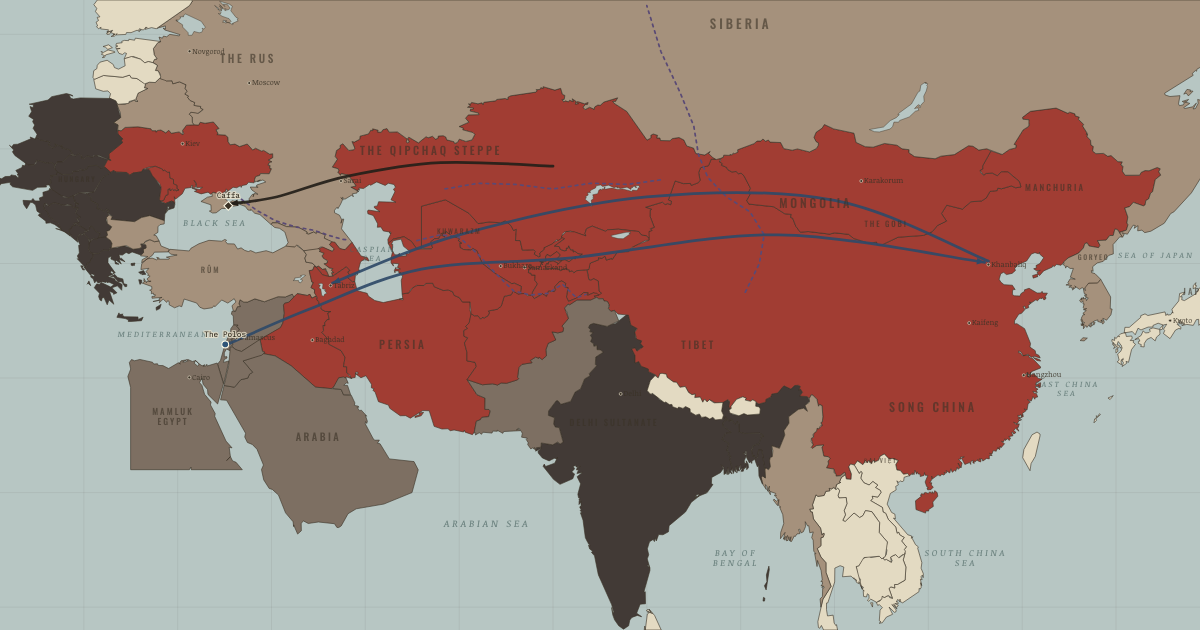
The final map shows a red field divided by dashed borders that family ties and roads still crossed. Marco Polo travelled east and later described his service at Khubilai’s court, while Rabban Sauma, a Christian monk born near Khanbaliq, travelled west as an envoy of the Ilkhanate. Merchants, diplomats, physicians, astronomers and whole technologies moved along routes protected by imperial passes and agreements. This period is often called the Pax Mongolica, meaning the Mongol peace, although that peace was uneven and rested on the earlier conquests.
THE SHORT ANSWER
- Why the peace worked while it worked. The Pax was not law but monopoly: one family owned every toll gate from the Crimea to Korea, so banditry was tax evasion and war between provinces was fratricide — briefly, both were suppressed. Merchants’ manuals (Pegolotti’s, c. 1340) could call the road to China “perfectly safe, whether by day or by night.” The mechanism’s corollary explains its end: as the khanates diverged (Ch. 9) and fought, the monopoly dissolved, tolls multiplied, and the sea routes — safer per mile precisely because no one owned them — began the slow victory that would carry Vasco da Gama around the toll gates altogether.
- Exchange without a customs officer for ideas. The empire moved specialists the way it moved trebuchets (Ch. 10): Chinese physicians and engineers to Tabriz, Persian astronomers to Beijing’s observatory, Rashid al-Din compiling in the Ilkhanate the first genuine world history — with Chinese informants beside Frankish envoys. Europe, the backwater of this map, may have gained most: the technologies that later armed its rise — gunpowder, printing’s idea, the compass — all traveled west along Mongol-secured roads. None of this was policy; all of it was plumbing. Infrastructure’s effects, again, outrun its owners’ intentions.
- The pathogen rides the post-roads. Yersinia pestis lived in Central Asian marmot and gerbil colonies for millennia; what changed in the fourteenth century was traffic. Caravans, grain shipments and armies stitched the reservoirs to the ports (the Caffa siege story — corpses over the walls — is dramatic but the grain-and-rat route matters more). The Black Death is not a Mongol crime; it is a Mongol consequence — the first demonstration that a connected world shares its diseases as efficiently as its inventions. The lesson has not aged a day.
THE TURN
Caffa, 1347 — the exchange’s dark rider. Choose this as the era’s final hinge because it inverts every earlier one: no khan orders it, no army wins it, and its casualties dwarf the conquests’. The same integration celebrated in this chapter’s first paragraph delivers, at Caffa’s docks, the century’s greatest catastrophe to three civilizations at once. History rarely hands you a cleaner demonstration that systems produce outcomes no actor intends — and that every connectivity has a shadow ledger. Judge the Mongol century whole: roads and plague, observatories and mass graves, one map.
WHAT IT CHANGED
Successor states inherit the frame. The Yuan fall in 1368 but leave China its size and its capital. Muscovy grows inside the Horde’s tax system until it swallows the steppe itself, a Russian empire ruling Sarai’s ashes. The Mughals carry the dynasty’s name and legitimacy into India. Chinggisid descent remains the steppe’s gold standard of kingship into the 1700s. Empires end, but their filing systems, borders and pretensions get recycled. Most of the map’s modern shapes have Mongol fingerprints somewhere in the provenance.
The world turns to the sea. Plague, khanate wars and rising tolls close the overland century; Europe’s appetite for the East — whetted by exactly the reports the Pax allowed — survives the road’s closure and goes looking for a water route. Columbus sails with Polo’s book aboard, hunting the Great Khan’s Cathay a century and a half after the last Great Khan could have received him. The Mongol road ends, in the long run, at the Atlantic: the era this atlas closes helped cause the one your other maps open.
Your map, your questions. Switch to Free Explore and interrogate the century yourself. Watch Hungary flash red and recover, then watch Syria snap back at Ain Jalut. Find the only borders that never changed — Japan, Delhi and Egypt — and ask what they shared: water, heat and mirrors of the Mongol army itself. Then click Mongolia, where it all began, and consider the strangest fact on the map. The homeland ends the era as its least changed place; the empire happened everywhere else.
THE FULL ANSWER, ARGUED
Use a double-entry method without pretending the columns cancel. State mass killing, displacement and long regional damage with honest ranges and source limits. Then state separately the consequences: political reunification, trade protection, specialist movement and successor institutions. Achievements do not justify atrocities, and condemnation does not make documented exchange disappear. Finally identify perspective: Persian, Rus, Arab, Chinese, Mongolian and modern historians inherit different archives and memories. The goal is not one moral score but a precise account of mechanisms, experiences and consequences.
AN INTERESTING FACT
In 2003 geneticists reported a Y-chromosome lineage carried by roughly one man in twelve across the former empire’s lands — on the order of sixteen million living men, near one in two hundred worldwide — radiating from Mongolia about a thousand years ago. Linking it to Genghis Khan’s male line is an inference, and the paper said so: his grave has never been found, and no verified remains exist to test. But something spread that lineage at a pace ordinary demography struggles to explain, along the very corridors this map draws — a reminder that empires leave their records in archives, in borders, and sometimes in blood.
This is the study layer of Chapter 12 — The Long Shadow in The Mongol Empire, 1206–1294; the full index of the atlas is here.
SEE IT MOVE ON THE INTERACTIVE MAP →New here? Chapters 1–2 of every atlas are free to sample, and the WW2 atlas is free in full. One membership opens all thirteen — the Cartographer’s Circle.
MORE QUESTIONS FROM THE MONGOL EMPIRE
THE DISPATCH
One short letter when a new atlas opens — and the printable study guide for The Mongol Empire is yours now, free.
NO TRACKING · YOUR ADDRESS IS USED FOR THE DISPATCH AND NOTHING ELSE · UNSUBSCRIBE ANYTIME