Age of Revolutions · AUG 1830
Was repression the price of peace in Metternich’s Europe?
The seminar question: “Metternich called his system the “repose” Europe needed. It helped preserve peace among the great powers for a generation. Did that peace require repression?”
After 1815 the great powers fought revolution with censorship, surveillance and intervention, from the Carlsbad Decrees to France’s 1823 invasion of Spain and Russia’s defeat of the Decembrists. Greek independence exposed the system’s limits, and in 1830 revolutions in France and Belgium succeeded without a general intervention.
Chapter 11 is included with every paid plan. WW2 is free in full, and chapter 1 of every atlas is free. A free account opens 3 more chapters a day. Starter, at $9 a month, opens all 21 with no daily limit — see the plans.
Free printable Age of Revolutions study guide, sent by email ↓
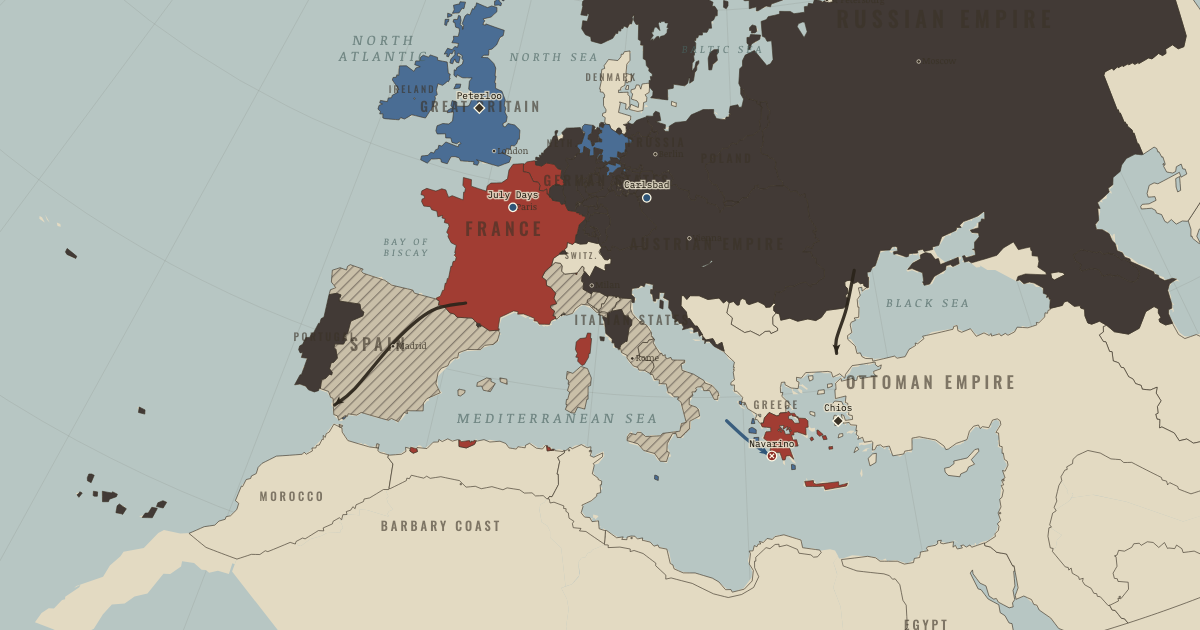
The rulers who gathered after Napoleon’s defeat knew that a revolution could travel. France’s upheaval had led to years of war and the overthrow of monarchies, so Metternich and his allies treated opposition within one state as a danger to its neighbors. After a political murder, the Carlsbad Decrees censored German universities and newspapers. Austria suppressed constitutional movements in Naples and Piedmont, France invaded Spain in 1823 to restore Ferdinand VII’s full power, and Russia crushed the Decembrist officers in 1825. Governments gained protection, but moderate opponents lost legal ways to seek change.
The short answer
- The fear behind restoration. At Vienna, rulers remembered how the French Revolution had been followed by war and the fall of monarchies. Censorship and policing seemed a modest cost if they could prevent another upheaval. Yet arresting conspirators did not remove the reasons for opposition. Literacy, railways and factory towns were changing society, while the settlement treated political agitation chiefly as a danger to control.
- A changing economy. Restoring a monarch did not restore the society over which that monarch ruled. Between 1815 and 1848, steam power, cotton manufacturing and railways transformed towns; a growing middle class read, traded and lent money, and workers crowded into industrial districts. Handloom weavers were among the crowd at Peterloo. The Lyon silk workers’ risings of 1831 and 1834 brought wages and work into politics, raising questions that a settlement concerned with dynasties had left unanswered.
- National movements in exile. National movements could be driven out of public life without disappearing. Activists organized through Carbonari lodges, Mazzini’s Young Italy, German gymnastic societies and student Burschenschaften. After the Polish rising of 1830–31 was crushed, exiles carried its cause abroad. Secrecy protected some organizers; emigration also carried their arguments and contacts between European capitals.
- Why Greece was different. European sympathy for Greek rebels drew on Christian solidarity and memories of ancient Greece. The Eastern Question gave governments reasons of their own to act: Russia sought influence at Ottoman expense, while Britain wanted to contain Russian gains. Each could prefer a Greek settlement in which it had influence to one dominated by its rival. Sympathy for rebels and strategic interest thus came together, despite the powers’ usual defense of established rulers.
THE TURNING POINT
Paris, 27–29 July 1830. Charles X’s July Ordinances restricted the press, dissolved the chamber and reduced the franchise. Parisians fought back on 27–29 July 1830; the troops failed to suppress them, and the Bourbon dynasty fell. The other powers faced troubles including Belgium and Poland and had to consider opinion at home. They let the new French government stand. A change of dynasty in a great power had survived where earlier revolts had met force. The settlement of 1815 could be revised; the question was whether further change would come through reform or barricades.
What it changed
Different political paths. The settlement left different kinds of government on either side of the Rhine. In France, the “citizen king” ruled under a constitution, but the pays légal was narrow: roughly one man in 170 could vote. Farther east, Metternich’s influence remained strong. Russia crushed Poland’s 1830–31 rising with an army reported at 250,000 and abolished its constitution. Demands met by restricted constitutional government in the west and repression in the east would return in 1848.
Reform in Britain. After two years of intense crisis, the 1832 Reform Act removed many rotten boroughs and enlarged Britain’s electorate by roughly 50 percent. Some supporters hoped to preserve the system by making a concession; others wanted to change it. Many people still could not vote. Slavery abolition followed in 1833, as did factory legislation. Britain passed through 1848 without the continental wave of barricades, having given some grievances a parliamentary outlet.
Belgium and the powers. Belgium’s revolution became a new state through negotiation as well as fighting. It acquired an invited king and a constitution in 1831 that liberals elsewhere admired and copied. The powers negotiated its place in Europe and guaranteed its neutrality, later described in 1914 as a “scrap of paper”. Together with Greece, Belgium showed that diplomacy could accommodate a new state without a general European war.
Workers and the social question. The July barricade fighters helped bring a monarchy associated with bankers to power. Lyon’s silk workers raised a different demand in 1831, under the banner “Live working or die fighting.” Constitutions and nations mattered to opponents of the old order, but so did food, wages and the right to work. Political and social demands would meet, and sometimes conflict, in 1848.
The full answer, argued
The peace was real, but its preservation and the security of individual rulers were different tasks. Balance, consultation and restraint helped the great powers manage disputes; censorship and armed intervention directly protected governments against their subjects. Leaders who remembered the wars after 1792 had good reason to connect revolution with international danger. Yet Britain supported the European balance while resisting a general right of intervention and later reforming at home, and the powers managed Greek and Belgian independence without a general war. These comparisons give us reason to question whether repression was necessary for peace. It could secure a regime for a time while closing legal routes to reform and encouraging underground opposition.
An interesting fact
At Navarino, the last great battle fought entirely under sail, British, French and Russian ships fired close-range broadsides in a crowded bay. In about two hours they destroyed some sixty Ottoman and Egyptian vessels and thousands of their crews, without losing an allied ship. London was embarrassed by this victory over a friendly power’s navy: the King’s Speech of 1828 called it “an untoward event”, and Admiral Codrington was recalled to explain himself.
This is the study layer of Age of Metternich, chapter 11 of The Age of Revolutions, 1775–1848; the full index of the atlas is here.
Related questions
THE FREE PRINTABLE STUDY GUIDE
Get the printable study guide for The Age of Revolutions free. I’ll send you a few short letters, then one when a new atlas opens. That’s all. — Paul
NO TRACKING · YOUR ADDRESS IS USED FOR THE DISPATCH AND NOTHING ELSE · UNSUBSCRIBE ANYTIME