Age of Revolutions · MAR 1848
Was 1848 the turning point where history failed to turn?
The seminar question: ““1848: the turning point at which modern history failed to turn.” How far is that verdict justified?”
Harvest failure, unemployment and blocked reform set off revolutions in 1848 from Palermo and Paris to Vienna, Berlin, Milan and Budapest. Monarchies conceded constitutions, Metternich fled and the Habsburgs abolished serfdom, but the revolutionaries divided, loyal armies recovered and Russia helped defeat Hungary in 1849.
Chapter 12 is included with every paid plan. WW2 is free in full, and chapter 1 of every atlas is free. A free account opens 3 more chapters a day. Starter, at $9 a month, opens all 21 with no daily limit — see the plans.
Free printable Age of Revolutions study guide, sent by email ↓
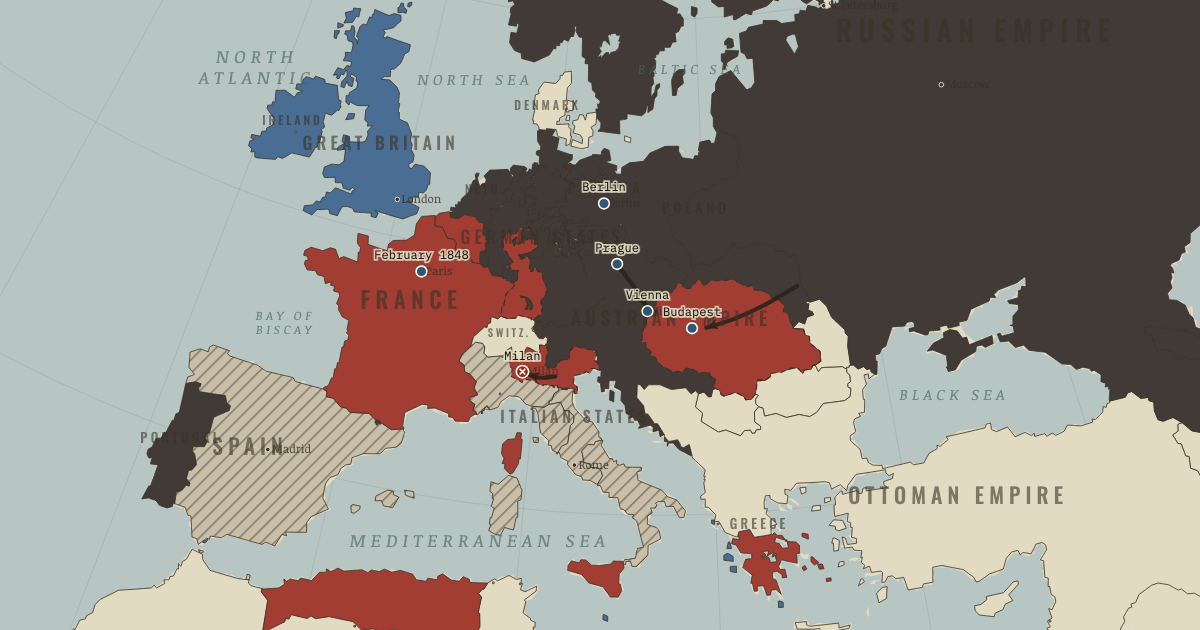
By 1848, failed harvests and high food prices had joined a credit crisis and urban unemployment to put Europeans under severe strain. In February Parisians overthrew the July Monarchy, and the new republic established universal male suffrage. The news traveled quickly. Within weeks Vienna had risen and Metternich had fled; Budapest had won the April Laws; Berlin’s king had conceded after street fighting; and Milan had driven out its Austrian garrison. At Frankfurt, delegates began drafting a constitution for a united Germany that did not yet exist. Habsburg authorities abolished serfdom, relieving more than forty million people of feudal obligations.
The short answer
- Hunger and unemployment. Potato blight and failed harvests in 1845–47 drove food prices sharply upward, in some places to around twice their earlier level. A credit crisis and urban unemployment followed. Families faced a subsistence crisis in a society already being changed by industry. Ideas about constitutions and nations gave opposition its political aims; expensive bread helped bring desperate people into the streets. The revolutions ebbed as the 1848 harvest improved, although better crops alone did not defeat them.
- Demands left unresolved. Arguments over constitutions, press freedom, national unification and the emancipation of serfs and Jews had occupied Europeans since 1815. Governments suppressed many movements, although opportunities for legal reform varied between countries. In 1848 people with different demands could unite against a common regime. Their agreement on removing an obstacle did not settle what ought to take its place.
- News travels quickly. News of victory gave opponents elsewhere a reason to think action possible. Reports of the February revolution in Paris reached Vienna within days, carried through a network of railways, steamships, telegraph lines and cheap newspapers linking growing cities. A monarch who had seemed immovable had conceded; perhaps another could be made to do so. This helped synchronize the risings, though news could not supply a common program or resolve the disputes among them.
- The armies regroup. Concessions made under pressure left monarchies with a means of recovery: organized troops. Radetzky and Windischgrätz had forces available to suppress revolution, as did Nicholas I, who sent Russian troops. Many soldiers came from rural communities and could be deployed against urban movements; some belonged to national groups different from those they confronted. Their loyalty and organization mattered greatly, though willingness to fire alone cannot explain every revolution’s course.
THE TURNING POINT
Paris, 22–24 February 1848. The Paris authorities banned a reform banquet. Troops then fired on the Boulevard des Capucines, and protesters carried the dead through the streets by torchlight. By the morning of 24 February the July Monarchy, established after the revolution of 1830, had fallen. Within weeks uprisings and concessions followed from the German states to the Habsburg lands. No army had marched from Paris to bring them about: news of its victory encouraged action elsewhere. Paris also showed how difficult agreement after victory could be. In June the republic suppressed workers; later that year voters chose an emperor’s nephew as president by more than five million votes. A people able to bring down a government had not agreed on how its successor should act.
What it changed
Changes that endured. Restored rulers recovered authority without reversing everything that had happened. The abolition of serfdom affected more than forty million people across much of Central Europe. Piedmont and Prussia kept constitutions, while Denmark, the Netherlands and Switzerland retained constitutional changes; Switzerland’s 1848 federal constitution continued in amended form. France retained universal male suffrage, and several states kept parliaments. Rulers could recover powers they had conceded while preserving reforms that weakened feudal obligations or changed administration.
Unification by other means. Frankfurt’s delegates had tried to unite Germany through constitutional deliberation. Their failure left the national ambition alive, but others would pursue it differently. Within 23 years Cavour and Bismarck helped build Italy and Germany through monarchy, diplomacy and war. Bismarck had opposed the revolution as a young Prussian conservative in 1848. National unification answered one revolutionary demand; whether it was a delayed victory or a defeat also depends on the importance given to the liberals’ hopes for how it should be achieved.
Exiles carry the arguments abroad. Revolutionaries carried their arguments into exile. Kossuth toured the United States, Mazzini continued to plot, and Carl Schurz became a Union general. An estimated quarter-million Forty-Eighters reached the United States, though the size of that migration is disputed. Marx, a German journalist, worked in London and the British Museum; his interpretation of bourgeois revolution would influence later movements. Defeat scattered these people, but did not end their political work.
The age in the balance. From Lexington to Világos, the conflicts in this atlas cost several million lives. They also helped leave republics as an established form of government, slavery abolished or challenged across much of the hemisphere, declarations of rights as a constitutional model, and national statehood as a goal for peoples without a state. These gains and the deaths belong in the same account. How should we weigh them against the violence through which they emerged?
The full answer, argued
The verdict captures the immediate outcome: revolutionary governments fell, liberal national unification by consent failed, and restored armies prevailed. But the rulers who recovered power did not recover an unchanged society. Serfdom ended across much of Central Europe, several constitutions survived, and mass electoral politics remained in France. Within a generation, rulers and armies pursued Italian and German unification by methods very different from those envisaged at Frankfurt. The revolutionaries lost control of states, yet governments still had to answer questions about nations, constitutions and social provision.
An interesting fact
Around 21 February 1848, an émigré press in Bishopsgate, London, printed the Communist Manifesto in German. Paris rose about a day later. The coincidence was striking, but the first printing numbered only a few hundred copies and its small early circulation gave it no significant role in the revolutions. Its much wider political career developed later, especially from the 1870s.
This is the study layer of Revolutions of 1848, chapter 12 of The Age of Revolutions, 1775–1848; the full index of the atlas is here.
Related questions
THE FREE PRINTABLE STUDY GUIDE
Get the printable study guide for The Age of Revolutions free. I’ll send you a few short letters, then one when a new atlas opens. That’s all. — Paul
NO TRACKING · YOUR ADDRESS IS USED FOR THE DISPATCH AND NOTHING ELSE · UNSUBSCRIBE ANYTIME