MAPS OF HISTORY · WW2 · ALL CHAPTERS · CHAPTER 1
CHAPTER 1 · 1936–1938 · SEP 1938
The Gathering Storm
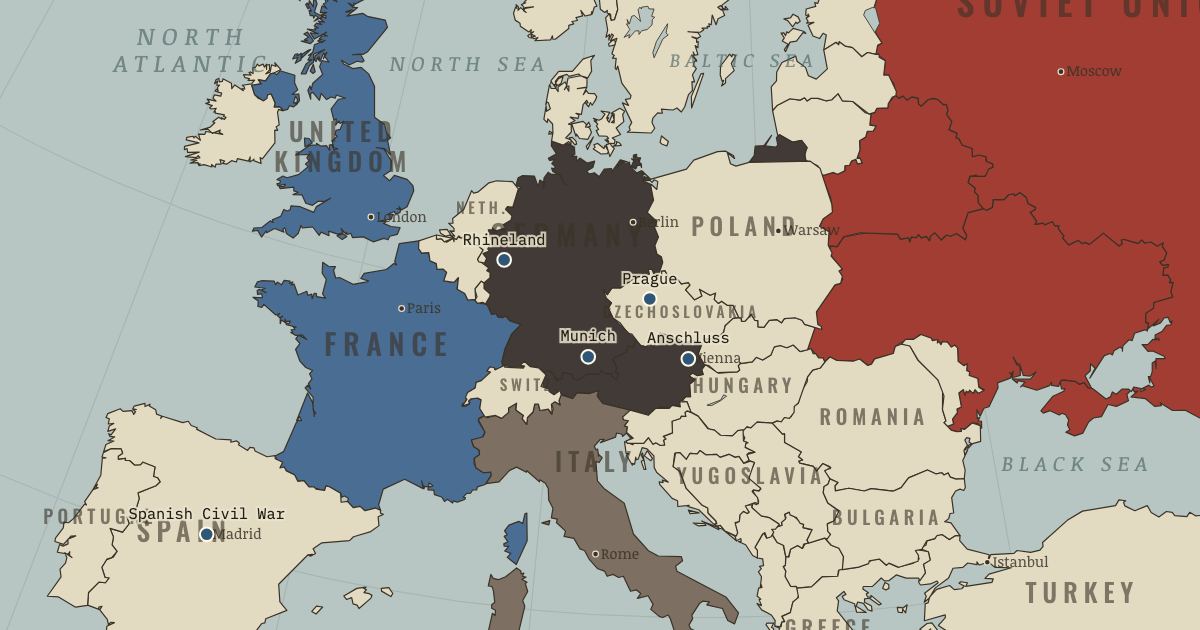
The map above is the world of MAR 1938 — The Anschluss.
BRIEF EXPLANATION — THE ESSENTIAL ARGUMENT
This atlas asks how a continent at peace in 1936 arrived at general war within three years, and the answer begins with a discovery that Germany made about its opponents. Adolf Hitler set out to overturn the settlement imposed on Germany after the First World War, and he found that he could do so one piece at a time without anyone using force to stop him. He sent troops back into the demilitarized Rhineland in 1936, backed Francisco Franco in the Spanish Civil War, annexed Austria in early 1938, and then demanded the German-speaking borderlands of Czechoslovakia. Each gain that went unopposed made the next gamble look safer, so German power spread across the map before any formal war had begun.
Britain and France answered with a policy known as appeasement, which meant offering negotiated concessions in the hope of preventing war and gaining time to rearm. At the Munich conference in September 1938 they agreed to hand Germany the Sudetenland, Czechoslovakia’s fortified border region, without the Czechoslovak government present to consent. Their reasoning was that satisfying a limited grievance would remove the cause of conflict. That assumption collapsed in March 1939, when Germany occupied Prague and seized the rest of a country that had no German majority at all. The occupation proved that Hitler’s aims reached beyond uniting German speakers, and Britain responded by guaranteeing Poland.
GUIDED EXPLANATION
The path to war worked as a repeated experiment, in which Germany broke part of the postwar order and then waited to see whether anyone would answer with force. When German troops reoccupied the demilitarized Rhineland in 1936, France and Britain protested but did not fight, even though France had the strength nearby to intervene. Hitler drew a lesson that shaped everything after, which was that a limited and rapid move could change the facts on the ground before hesitant democracies agreed how to respond. German intervention in the Spanish Civil War taught related lessons, since it let the Luftwaffe test aircraft, crews, and tactics while presenting expansion as a crusade against communism.
The Munich crisis of 1938 shows both why concession seemed reasonable and why it failed. After Germany absorbed Austria in March, Hitler demanded the Sudetenland, and Britain and France chose to grant it rather than risk war over a border they judged defensible on ethnic grounds. They hoped that a single concession would satisfy a limited claim and postpone a wider conflict for which they were not ready. The price fell entirely on Czechoslovakia, which lost its mountain fortifications, much of its industry, and any say in its own fate. When Germany then seized Prague in March 1939, the claim that Hitler wanted only German-speaking land was exposed as false, appeasement lost its credibility, and Britain guaranteed Polish independence.
Several deeper pressures explain why leaders acted with such caution rather than confronting Germany early. The Depression had weakened democratic governments and helped the Nazis convert resentment of the 1919 settlement into political power. The memory of the industrial slaughter of 1914–18 made another general war almost unthinkable to voters and statesmen alike. Britain was still rearming, France was unwilling to act without Britain, and the League of Nations had already failed to halt Japanese aggression in Manchuria and Italian aggression in Abyssinia. These constraints explain the caution, though they do not remove the element of choice, because each unopposed revision left Germany stronger and collective security weaker. By 1939 the question itself had changed. Negotiation had once concerned the adjustment of a single disputed border; now it concerned whether any further conquest would finally be met with armed resistance.
DEEP EXPLANATION — EVIDENCE & INTERPRETATION
Appeasement as a genuine strategy
Appeasement is easy to dismiss as cowardice, yet it grew from real constraints that any British leader of the time would have weighed. Britain had weak air defences, a global empire to protect, uncertain support from its self-governing Dominions, and a public still haunted by the First World War, while France depended on Britain and on its own fragile domestic stability. Buying time genuinely helped, because British fighter production, radar coverage, and army readiness all improved between 1938 and 1940. The failure lay in the mechanism rather than the motive, since every concession increased Germany’s resources, weakened potential allies, and taught Hitler that threats produced results. Historians therefore separate the rational case for delay from the flawed assumption behind it, which was that Hitler was a conventional statesman with limited and negotiable aims. The seizure of Prague revealed instead a programme of racial expansion. The balanced judgment is conditional: appeasement addressed genuine problems, but Munich imposed its costs on Czechoslovakia and left the later balance of power worse than before.
Deterrence, information, and credibility
Deterrence works only when a threat is capable, clearly communicated, and believed, and each of those conditions failed in turn during the 1930s. In 1936 France held clear military superiority near the Rhineland, yet German leaders correctly doubted that France would act without British support. In 1938 the Western powers threatened far less than their formal strength implied, because divided cabinets and anxious publics undercut their resolve. Hitler read this restraint as permanent weakness, an inference that became mistaken only after Prague, when Britain guaranteed Poland, though his earlier successes made the change easy to dismiss. This exposes a non-obvious rule of crisis diplomacy, which is that a state cannot instantly rebuild credibility with a single declaration once its past behaviour has taught an opponent to expect surrender. Stalin drew his own conclusion from the same events, because the Soviet Union had been excluded from Munich and now doubted that collective security could ever protect it. One conference thus bred opposite fears, as the West braced for immediate war while Moscow braced to face Germany alone.
The WW2 atlas is free in full — no sign-up.
THE SITES
ON THIS DAY
WHY IT HAPPENED
Versailles and Nazi revisionism. The 1919 settlement reduced German territory and armed strength. Nazi propaganda converted widespread resentment into support for expansion and falsely presented each breach as a limited correction.
Depression and political weakness. Economic crisis discredited moderate parties and helped the Nazis reach power. It also constrained British and French military spending and made another major war politically difficult.
Memory of 1914–18. Leaders and voters feared another industrial slaughter. They accepted risk now to delay war, partly because they believed additional time would improve rearmament.
Failed collective security. Weak responses to Japan in Manchuria and Italy in Abyssinia showed that League of Nations sanctions lacked enforcement. Germany learned that rapid action could outrun collective decisions.
THE TURN
Munich, 30 September 1938. Munich changed expectations. Hitler concluded that pressure would bring further concessions. Stalin concluded that the Western powers might not form a reliable anti-German front. Both readings helped make the Nazi–Soviet Pact possible.
WHAT IT CHANGED
Czechoslovakia becomes vulnerable. The Sudetenland contained major border defenses. Its loss exposed the state and helped Germany seize the rest in March 1939, together with the Škoda arms works.
Stalin considers a German agreement. Soviet exclusion from Munich deepened distrust of Britain and France. A temporary bargain with Berlin now appeared to offer time and a security buffer.
Britain guarantees Poland. After Prague, Britain made a clearer commitment to resist further expansion. Hitler misread it as another bluff, making the next crisis far more dangerous.
FIELD QUESTION — Britain and France could probably have stopped Hitler cheaply in 1936–38. Why didn’t they?
Several constraints combined: fear of another mass war, limited readiness, economic pressure, divided public opinion, and the mistaken belief that Hitler had limited aims. Appeasement also bought useful rearmament time. Its central failure was diagnostic: leaders negotiated as if the dispute concerned specific borders, while Hitler treated each concession as a step toward a larger racial empire.
AN INTERESTING FACT
Only about 3,000 German soldiers actually crossed the Rhine bridges in March 1936 — and the famous story that they carried orders to retreat at the first French shot, retold ever since, is one historians now doubt. What is documented is the perception gap: French intelligence credited Germany with nearly 300,000 men in and behind the zone, roughly ten times the reality. Hitler later called the forty-eight hours after the march the most nerve-racking of his life. Inflated numbers and weak nerves reinforced each other — they usually do.
THE DISPATCH
One short letter when a new atlas opens — and the printable study guide for WW2 is yours now, free.
NO TRACKING · YOUR ADDRESS IS USED FOR THE DISPATCH AND NOTHING ELSE · UNSUBSCRIBE ANYTIME