MAPS OF HISTORY · WW2 · ALL CHAPTERS · CHAPTER 12
CHAPTER 12 · JUN–AUG 1944 · JUN 1944
Overlord and Bagration: The Vice Closes
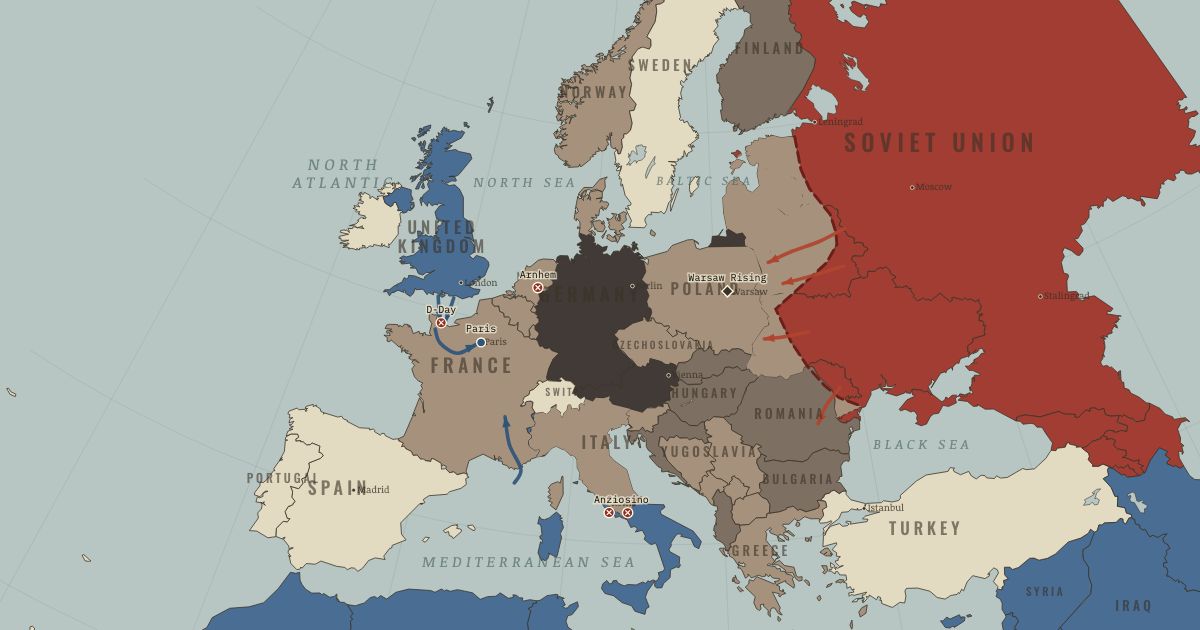
The map above is the world of JUN 1944 — The vice closes.
BRIEF EXPLANATION — THE ESSENTIAL ARGUMENT
The summer of 1944 closed a vice on Germany from both directions at once, and its two jaws were the Western landings in France and a far larger Soviet offensive in the east. On 6 June the Western Allies came ashore in Normandy, and their beachhead held because of air superiority, naval gunfire, elaborate deception, and years of preparation rather than a simple clash of numbers. Operation Fortitude, a vast campaign of false information, had convinced German commanders that the real invasion would still fall farther north at Calais, so they held back the reserves that might have thrown the landings into the sea.
The second and heavier blow fell in the east. On 22 June the Red Army launched Operation Bagration in Belarus and destroyed Army Group Centre, one of the greatest defeats in German military history. With both offensives striking at once, Germany could no longer shuttle reserves from one front to plug gaps in the other. France was liberated over the following weeks, yet the liberation also exposed a widening political conflict, because the Warsaw Uprising raised the bitter question of who would actually rule the countries of Eastern Europe once the Germans were driven out.
GUIDED EXPLANATION
Operation Overlord opened a new front in the west on 6 June 1944, when about 156,000 troops landed on five Normandy beaches. The assault succeeded because of everything that stood behind it, including air and naval superiority, specialized landing craft, an immense logistical effort, and a deception plan. Operation Fortitude used false radio traffic, double agents, and dummy armies to sustain the belief that a larger landing would follow at Calais, which delayed the movement of German reserves toward Normandy at the decisive moment.
Operation Bagration opened in Belarus on 22 June, timed to match the Western offensive as the Allies had agreed at the Tehran conference. Soviet forces destroyed Army Group Centre, so that twenty-eight German divisions ceased to exist as effective formations and the front lurched about 500 kilometres toward the Vistula. With disaster unfolding on both sides, Germany could no longer move reserves freely between its fronts. Paris was liberated on 25 August. In Warsaw, the Polish Home Army rose before the Soviets arrived, hoping to seize political authority for itself, but Soviet forces halted east of the Vistula while the uprising was crushed, and historians still debate how far this reflected exhaustion and logistics and how far it reflected Stalin’s political calculation.
Both offensives rested on preparation that the arrows on the map cannot show. Overlord required victory in the Battle of the Atlantic, command of the air, purpose-built landing craft, artificial harbours, and a deception plan that pinned German formations near Calais, while Bagration relied on concealment, partisan attacks, massed artillery, and mobile exploitation to break a front that Germany had been ordered to hold at all costs. Their shared timing denied Germany any easy way to shift reserves. Yet the two liberations carried very different political meanings, because Western forces restored allied governments in France and Belgium, whereas the Soviet advance destroyed Nazi occupation while also bringing the power to impose Moscow’s preferred order. Warsaw made that tension visible, as the military vice closed on Germany at the very moment the political division of Europe began to open.
DEEP EXPLANATION — EVIDENCE & INTERPRETATION
D-Day as a system
The landing was only the visible tip of a far larger system, and reading it that way explains the victory better than courage or technology alone. Command of the Atlantic protected the movement of troops and supplies, strategic and tactical air campaigns crippled German movement across France, and Mulberry harbours, fuel pipelines, landing ships, engineering units, and months of stockpiling sustained the beachhead once it was won. Deception had already shaped German deployment before the first craft touched the sand. At Omaha the detailed plan failed on the spot, because the preparatory bombing missed, currents scattered the units, and many amphibious tanks sank, so that junior leadership and close naval gunfire barely prevented defeat. Material advantages created options, but contingency still ruled at the waterline. An amphibious failure would have been very hard to repeat quickly, which gives D-Day a strategic weight beyond the number of German divisions it destroyed.
Bagration, scale, and historical memory
Bagration destroyed far more German formations than the Normandy campaign did over the same weeks, yet Western public memory usually grants D-Day the larger place, and the reasons are worth examining. Soviet deception concealed the coming concentrations and encouraged Germany to expect the main attack elsewhere, after which multiple breakthroughs, mobile exploitation, and partisan disruption collapsed Army Group Centre. Western memory tilts toward Normandy because of national commemoration, film, accessible sources, and Cold War politics. Correcting that imbalance does not require crowning one “decisive battle” in place of another, because the real mechanism was convergence, as Germany faced an eastern land war of colossal scale and a western front that threatened its industrial heartland and denied it the freedom to concentrate. The two offensives were politically linked as well, since where the armies arrived would shape the postwar governments, and the map therefore records both coalition success and the approaching division of Europe.
The WW2 atlas is free in full — no sign-up.
THE SITES
ON THIS DAY
WHY IT HAPPENED
Three years of preparation. D-Day’s one day rested on three years of preparation. The Allies won the Battle of the Atlantic in 1943 and secured air supremacy over France in spring 1944, at terrible cost to bomber crews. They towed artificial Mulberry harbors across the Channel. Disastrous rehearsals at Dieppe in 1942 and Slapton Sands taught what would kill men on the real day.
Fortitude: the war’s greatest lie. Fake radio traffic, inflatable tanks, double agents (every German spy in Britain had been turned) built a fictional First US Army Group aimed at Calais. Long after 6 June, Hitler held his strongest panzers there awaiting the “real” invasion. Deception multiplied the landing’s force more cheaply than any weapon.
A genuinely allied timetable. At Tehran (Nov 1943) Stalin promised an eastern offensive synchronized with Overlord, so Germany could reinforce neither front from the other. The map you’re looking at — arrows east and west in the same month — is that promise, kept.
THE TURN
Omaha Beach, morning of 6 June. On four beaches the plan holds; on Omaha it nearly fails — bombs dropped long, amphibious tanks sunk, the first waves pinned under the bluffs. The landing is saved by junior officers improvising and destroyers scraping their keels to fire point-blank. Margin between foothold and catastrophe: a few hours and a few hundred men. Contingency, again.
WHAT IT CHANGED
France free, Germany encircled. Breakout (Cobra), a second landing on the Riviera (Dragoon), Paris on 25 August: scrub the timeline to September and watch France flip blue. Germany now fights the two-front war its every strategy since 1939 existed to avoid.
Bagration breaks the East. The destruction of Army Group Centre — barely known in Western memory — is the reason the Red Army stands in Warsaw’s suburbs by August and Berlin’s by January. Weigh it whenever you hear D-Day called the war’s decisive blow: the vice needed both jaws.
Warsaw: the postwar world previewed. The Home Army rose to liberate Poland’s capital before the Soviets arrived — precisely because it feared its liberators. Stalin’s halt (exhaustion? calculation? historians still argue) let the SS raze the city. The Cold War’s first chill is visible here, nine months before the war ends.
20 July: the regime devours itself. German officers detonate a bomb under Hitler’s table; he survives, and the terror that follows welds army to regime for the final, most destructive year. No German surrender will come from within.
FIELD QUESTION — Bagration destroyed four times more German divisions than Normandy, yet D-Day dominates Western memory. Why — and does it matter?
Western commemoration, films, archives, and Cold War politics privilege Normandy. D-Day also had unique risk because a failed amphibious invasion could not be repeated quickly. The imbalance matters when memory hides the Eastern Front’s scale or the experience of states between Germany and the USSR. A balanced judgment treats both offensives as interdependent.
AN INTERESTING FACT
The double agent at Fortitude’s heart was Juan Pujol García — GARBO to London, ARABEL to Berlin — a Spanish former poultry farmer who fed Germany the reports of 27 sub-agents, every one of them invented. Berlin trusted him so completely that it awarded him the Iron Cross for his D-Day reporting; Britain quietly appointed him MBE months later — perhaps the only man decorated by both sides for the same work. After the war he faked his own death and kept a bookshop in Venezuela until a historian tracked him down in 1984.
THE DISPATCH
One short letter when a new atlas opens — and the printable study guide for WW2 is yours now, free.
NO TRACKING · YOUR ADDRESS IS USED FOR THE DISPATCH AND NOTHING ELSE · UNSUBSCRIBE ANYTIME