MAPS OF HISTORY · The Russian Revolution · ALL CHAPTERS · CHAPTER 1
CHAPTER 1 · 1894–1906 · NOV 1905
The Brittle Giant
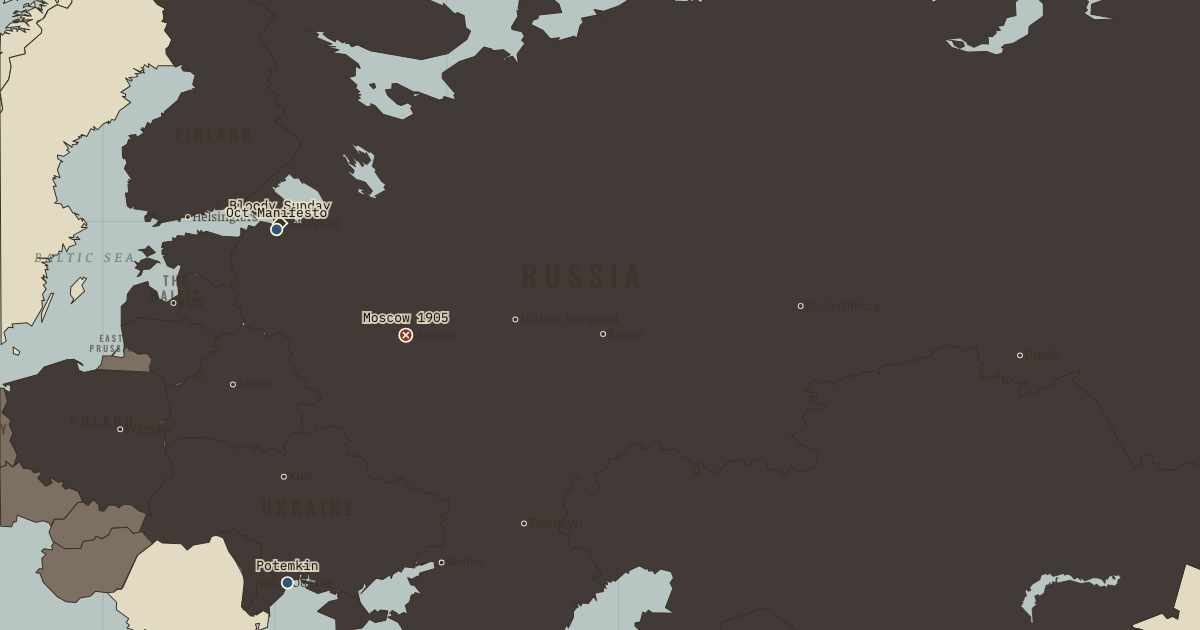
The map above is the world of DEC 1905 — The rising put down.
BRIEF EXPLANATION — THE ESSENTIAL ARGUMENT
The question behind this whole atlas is why the largest empire on earth broke apart within a single generation, and the answer begins with a state that had modernized its economy without modernizing its politics. Russia entered the twentieth century as an autocracy, a system in which one ruler, Tsar Nicholas II, held absolute power with no constitution and no elected parliament to share the blame for hard times. State-driven industrialization was meanwhile packing hundreds of thousands of workers into a few cities, while four in five Russians were peasants who wanted more land than the ending of serfdom in 1861 had left them. The machinery of government was built for a nation of scattered villages, and it was falling behind the country it was meant to rule.
The strain broke into the open in 1905, after a humiliating defeat by Japan and the shooting of peaceful petitioners on Bloody Sunday shattered the image of a protective Tsar. Strikes, a naval mutiny, and workers’ councils called soviets spread until a general strike stopped the trains. Nicholas answered with the October Manifesto, which promised civil liberties and an elected assembly, the Duma, and thereby split his enemies: liberals who wanted a parliament were satisfied, while radicals who wanted a republic were left isolated and were then crushed. The regime survived by conceding and then clawing the concessions back, but the land question stayed unanswered, and a generation of revolutionaries kept the lessons they had learned.
GUIDED EXPLANATION
Autocracy in Russia meant personal rule, and its central weakness was the absence of any institution that could take the responsibility when things went wrong. Nicholas II inherited a throne with no constitution, no responsible ministry, and no legal opposition, so every grievance, over wages, land, censorship or defeat, flowed directly to him. Every European monarchy that survived the century had learned to place a parliament between the crown and popular anger, and Russia had not, so a system with no way to release pressure eventually bursts under it.
The economy, meanwhile, was changing faster than the state that governed it. Count Witte’s program of industrialization had laid tens of thousands of miles of railway and thrown up huge factories in Petersburg and the Donbas, concentrating workers in exactly the places where a strike could paralyze the country. Underneath lay the deeper grievance, because the emancipation of the serfs in 1861 had freed the peasantry while burdening it with redemption payments and too little land, and hunger for land remained the strongest current in Russian life. Modernization had handed the autocracy new resources while creating the very classes it was least able to absorb.
These pressures broke to the surface in 1905. A war with Japan, begun partly to rally the country, ended in the loss of a fleet and stripped the regime of its aura of competence, and when troops fired on the petitioners of Bloody Sunday the belief in a caring Tsar collapsed. Strikes spread, sailors mutinied, and a workers’ soviet appeared in the capital before a general strike forced Nicholas to issue the October Manifesto. Its promise of a Duma and liberties divided the opposition and bought time; the Moscow rising was then put down by artillery, and the new parliament’s powers were steadily narrowed. Stolypin’s later attempt to build a class of prosperous independent farmers needed twenty years of peace to work, and it received nine. The settlement of 1905 was therefore brittle, because it raised expectations, restored fear, and left every underlying cause in place for the next shock to expose.
DEEP EXPLANATION — EVIDENCE & INTERPRETATION
Modernization without representation
Witte’s industrial policy expanded the railways, protected heavy industry and drew in foreign capital, and it worked on its own terms, giving the state more tax revenue and greater military capacity. The same policy concentrated workers in very large plants, where grievances and organization could spread far faster than in scattered workshops, and it built the rail lines that could carry a strike across the country in days. What the state did not build alongside these things was any representative institution able to bargain over wages, food or conditions, so the new pressures had nowhere to go but the throne. Workers were still a minority in a peasant empire, which is why industrialization alone did not cause a revolution; its importance was strategic rather than numerical, because a strike in Petersburg or Moscow could disrupt railways, printing and administration out of all proportion to the workers’ share of the population. Economic modernity and political autocracy did not simply sit side by side, then, because each made the other’s strains harder to manage.
What the “dress rehearsal” explains
Historians often call 1905 a dress rehearsal for 1917, and the phrase is useful, because the later revolution drew on the same instruments: mass strikes, mutiny, the soviet, and the split between liberals and radicals. It can also mislead, because it tempts us to read the participants as though they already knew a second revolution was coming. The 1905 revolution failed for concrete reasons rather than for want of anger. The army, returning from a small colonial war, stayed loyal and could be used to crush the cities, while the October Manifesto gave liberals enough of what they wanted to stop backing a general confrontation. Stolypin’s reforms then sought to create peasant proprietors who would defend order, but they had limited time and uneven reach. The decisive condition changed only in 1917, when years of mass war dissolved the discipline of an army made largely of peasants. The lesson is that organization matters most at the moment when the state’s coercive forces can no longer be relied upon.
New here? Chapters 1–2 of every atlas are free to sample, and the WW2 atlas is free in full. One membership opens all thirteen — the Cartographer’s Circle.
THE SITES
ON THIS DAY
WHY IT HAPPENED
Autocracy without a shock-absorber. Every European monarchy that survived the century had learned to share power with a parliament that could take the blame for hard times. Russia’s did not. With no legal way to channel discontent, every grievance. Wages, land, ethnic grievance, censorship. Flowed straight to the throne. A system with no valves eventually bursts.
Industrialization outran the state. Witte modernized the economy without modernizing the politics. He built the factories that concentrated hundreds of thousands of workers in a handful of cities, and the railways that could carry a strike nationwide in days. Then left them under a police regime designed for a nation of scattered villages. Modernization created the very class the autocracy could least control.
The unanswered land question. Freed in 1861 but land-hungry and debt-burdened, the peasantry. Four in five Russians. Wanted the gentry’s fields, full stop. No government dared give them away and none could survive refusing forever. This single unresolved demand would decide 1917, the civil war, and the fate of every army that promised or threatened the villages.
A war lost to Japan. The 1904–05 war with Japan. Undertaken partly for prestige, “a short victorious war” to calm unrest. Ended in the loss of a fleet at Tsushima and a humiliating peace. Defeat by an Asian power the regime had despised stripped away its last aura of competence at the exact moment the cities exploded.
THE TURN
The October Manifesto, 17/30 October 1905. The autocracy’s cleverest and most fateful act. By conceding a parliament and liberties under duress, Nicholas divided a united opposition into satisfied liberals and betrayed radicals. And then survived to revoke most of it. The lesson each side drew was lethal: the regime learned that force plus a paper concession would work again. The left learned that the bourgeoisie would settle, and that next time the workers must not stop at a Duma.
WHAT IT CHANGED
A pseudo-constitution. The Duma that met from 1906 was real enough to raise expectations and hollow enough to frustrate them: the Tsar could dissolve it, and Stolypin rigged the franchise until it was tame. Russia now had the forms of representative government without its substance. A grievance machine that taught a generation that reform inside the system was a dead end.
The soviet is invented. The 1905 Petersburg Soviet of Workers’ Deputies. A strike committee that became a rival authority. Was the template. Trotsky cut his teeth as its chairman. Twelve years later the word “soviet” would name the whole revolution. The institution was born here, in a dress rehearsal.
Stolypin’s wager on the peasant. The regime’s ablest servant tried to defuse the land bomb by creating a class of prosperous independent farmers out of the commune. “a wager on the strong.” It needed twenty years of peace. It got nine, and an assassin’s bullet in 1911. The land question rolled on, undefused, toward 1917.
The revolutionaries learn their trade. 1905 was a school. Lenin, Trotsky, the Mensheviks and the SRs all drew tactical conclusions. About soviets, about the army, about the peasantry, about not trusting liberal allies. That they would apply in 1917. A failed revolution that trains its survivors is more dangerous than one that never happened.
FIELD QUESTION — 1905 failed and 1917 succeeded. What was different — the regime, the revolutionaries, or the circumstances?
Mostly the circumstances, sharpened by learning. In 1905 the army stayed loyal and came home from a small colonial war to crush the cities. In 1917 the army was the revolution, millions of armed peasants broken by three years of industrial slaughter. The regime was no more flexible in 1917. Arguably less, with Nicholas at the front and Rasputin at court. And the revolutionaries were better organized and clearer-eyed. But the decisive variable was the World War, which did to the state in 1917 what a quick defeat by Japan could not do in 1905: dissolve its instrument of force. Note the pattern for every revolution you study. The question is rarely “are people angry?” (they usually are) but “does the state still command its soldiers?”
AN INTERESTING FACT
The priest who led the Bloody Sunday procession, Father Georgy Gapon, ran a workers’ assembly founded with the blessing of the Okhrana — “police socialism,” the regime’s scheme to keep unions loyal by sponsoring them itself. The state’s own tame organization thus delivered the crowd to the guns; Nicholas, for his part, was not even in the Winter Palace that day but out at Tsarskoe Selo. Gapon escaped abroad, was briefly the most famous man in revolutionary Europe, and in 1906 was hanged in an empty Finnish dacha by Socialist-Revolutionaries convinced he was informing for the police again.
THE DISPATCH
One short letter when a new atlas opens — and the printable study guide for The Russian Revolution is yours now, free.
NO TRACKING · YOUR ADDRESS IS USED FOR THE DISPATCH AND NOTHING ELSE · UNSUBSCRIBE ANYTIME