Ancient Rome · CHAPTER 1 ·
First Punic War
Chapter 1 of The Rise and Fall of Rome, 264 BC – AD 476: “The Republic and Its Rival”
The First Punic War began in 264 BC when mercenaries holding Messana, on the Sicilian strait facing Italy, appealed for protection and Rome’s assembly voted to intervene against Carthage. Rome’s manpower from its Italian allies met Carthage’s wealth and navy in a long war of endurance that ran until 241 BC.
WW2 is free in full, and chapter 1 of every atlas is free. A free account opens 3 more chapters a day. Starter, at $9 a month, opens all 21 with no daily limit — see the plans.
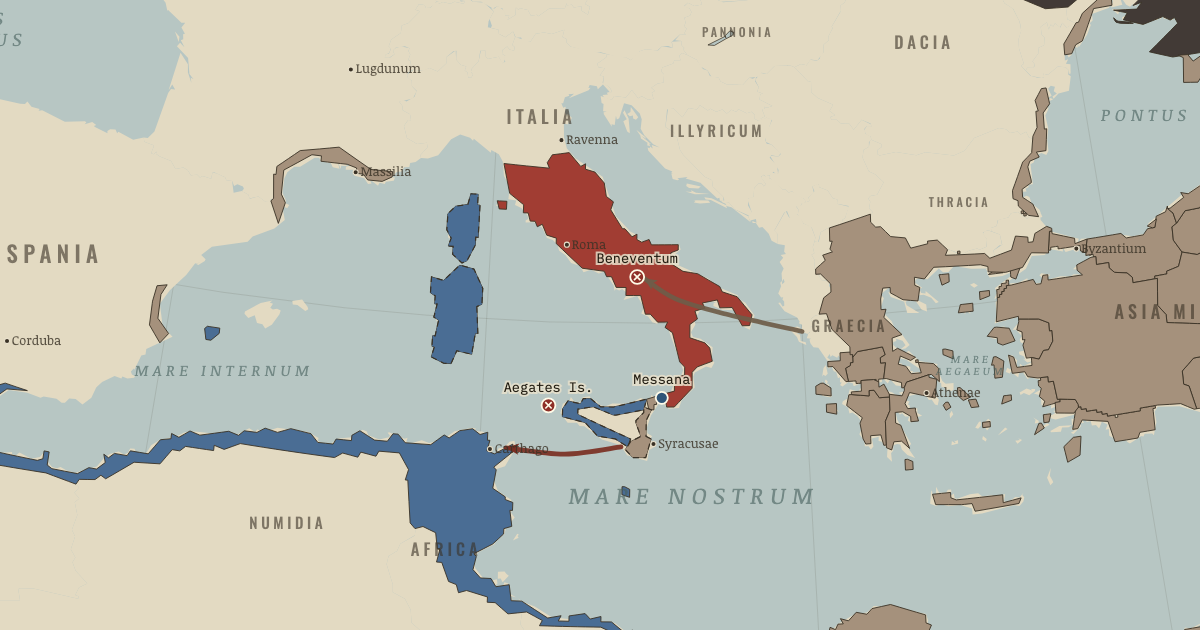
The map above is the world of The Roman Republic, 264 BC — One power among many.
SHORT EXPLANATION
Rome entered the 260s BC as the leading power in Italy, but it had a formidable neighbor across the sea. Carthage, a wealthy trading city on the North African coast, used its commerce to support a powerful navy and professional soldiers from many peoples. Rome drew strength from its Italian socii, or allies: communities that kept their laws and rulers while supplying troops in wartime. Each power could sustain a major war, though it drew on different resources to do so.
The First Punic War began in 264 BC over Messana, a Sicilian city commanding the narrow strait to Italy. Each side feared the other’s presence there, and a local dispute grew into twenty-three years of war. Rome lost hundreds of ships in battle and storms, but found the money and crews to rebuild. After Carthage’s defeat at the Aegates Islands in 241 BC, Rome acquired Sicily as its first province. It now governed and taxed an overseas possession directly, adding a new kind of power to its Italian alliances.
The full story
To understand why Rome could endure a long war, consider the way it had brought Italy under its control. Over the previous two centuries, defeated peoples became allies. They retained their governments, but when Rome called, they supplied troops. A generation after the war, the Greek historian Polybius reckoned that the network could field more than 700,000 men of fighting age. Rome could draw on far more soldiers than the population of the city itself.
Carthage had a different strength. Its trade financed a formidable fleet and paid professional soldiers from many nations. That wealth made it a dangerous opponent, especially at sea. But hired forces and their supplies depended on a continuing flow of money and on access to ports. Each state had to keep its own system working through years of losses.
The immediate dispute arose at Messana, on the strait facing Italy. Mercenaries who had seized the city appealed to both powers for protection. Rome’s assembly saw the prospect of spoils and voted to intervene; its legions crossed the sea for the first time. Neither power had planned a great war, but each had reason to fear a rival established at the crossing. What began as a local quarrel became twenty-three years of fighting, much of it on water where Carthage had the experience Rome lacked.
Rome first had to acquire a fleet. According to the ancient account, it copied a wrecked Carthaginian warship. It then had to replace fleets as well: enemy skill and Mediterranean storms destroyed hundreds of vessels and killed tens of thousands of men. Rome found crews and funds to continue, while Carthage could not match that rhythm of replacement. Defeat at the Aegates Islands in 241 BC brought Carthage to peace.
The settlement gave Rome Sicily, and the way it held the island marked a change. An Italian ally kept its community and supplied soldiers; Sicily became a province governed and taxed directly from Rome, rather like a distant colony ruled from a home capital. Roman conquest could now bring revenue and overseas territory as well as military allies. The machinery of empire was taking shape.
FULL EXPLANATION
Manpower as a Constitution
Rome’s reserve came from political choices as well as population. After defeating an Italian community, Rome usually left its local government in place and imposed a lasting duty to provide troops. Some communities also gained a route to citizenship. Men who had once fought Rome could therefore serve in its later armies. Modern historians debate Polybius’ estimate of more than 700,000 available men, but the alliance structure gave Rome resources beyond its own citizen body. Carthage, meanwhile, had to meet the continuing costs of hired forces from its revenues. The allies had expectations of their own. Service was supposed to bring protection and rewards, and many communities pressed for citizenship. Their unresolved claims helped bring them into rebellion in the Social War of 91–88 BC. The arrangement that made Rome’s expansion possible also created a conflict over who would share in its benefits.
Why a Small City Could Start a Great War
Messana stood only a few kilometres across the strait from Italy. Imagine the position from each side: a Carthaginian garrison could protect Carthaginian interests, yet place a rival close to Rome’s allies. Roman troops at the crossing could seem protective to Rome and threatening to Carthage. Political scientists call this a security dilemma: one power’s provision for its safety can make another feel less safe and prompt a response. The geography helps explain the danger; it does not make the war inevitable. Roman leaders could have declined the appeal, and a limited settlement was conceivable. Once ships, men and prestige had been committed, withdrawal became more costly politically. Leaders could point to what had already been spent as a reason to go on, and further commitments made the next decision harder still.
Key places on the map
On this day
Why it happened
The socii system: manpower as a constitution. Rome defeated Italian communities, but generally left their laws and local government intact. In return they supplied troops, and some gained citizenship. This arrangement gave Rome a continuing military network of former opponents; the advances shown over the next four centuries of this atlas depended on it.
Two ambitious magistrates a year. Two consuls were elected each year. For a Roman aristocrat, a short term of command offered a chance to win glory in battle, while assemblies could hope for spoils. Annual elections also meant that a defeat need not end the Republic’s war effort with the loss of one commander: another consul could take command.
Sicily: the strait with no owner. Messana lay about three miles from Italy. To Rome, a Carthaginian garrison placed a rival close to its allies. To Carthage, Roman troops there stood near its Sicilian positions. A move either side saw as protective could look threatening to the other.
What Pyrrhus taught everyone. Pyrrhus defeated Rome at Heraclea and Asculum with a highly capable hired army. Yet victory cost him men he found difficult to replace, while Rome could raise further forces. The saying attributed to him captures the problem: “Another such victory and we are undone.” Carthage would encounter Rome’s capacity to recover in a long war at sea.
THE TURNING POINT
The Mamertine appeal, 264 BC. The Mamertines had seized Messana by massacre, and the Senate was uneasy about helping them. It deadlocked and referred the appeal to the popular assembly. Voters chose intervention, attracted in part by the prospect of spoils. The legions’ crossing in 264 BC brought Rome into direct conflict with Carthage; the decisions made after that crossing would determine how long the war lasted.
What it changed
Rome becomes a naval power in five years. Rome adapted its land forces to fighting at sea. According to the ancient account, a wrecked Carthaginian quinquereme supplied the model for more than 100 warships. The corvus, a boarding bridge, allowed Roman infantry to fight on enemy decks. Within five years the Republic had acquired a new naval capacity.
The first provincia. Sicily was placed under a Roman governor and taxed as a possession. The provincial model would yield tribute and revenue through tax farming, while giving governors extensive power. It created opportunities for abuse that became a recurring problem for the Republic.
Carthage’s revenge takes root in Spain. After losing Sicily, Carthage surrendered Sardinia in 238 BC while occupied by a mercenary revolt; watch the islands change on the map. The Barcid family then built power in Hispania, drawing on resources that included silver. Ancient accounts say Hamilcar Barca made his nine-year-old son swear eternal enmity to Rome. His son was Hannibal.
DISCUSSION QUESTION — Rome and Carthage had been allies against Pyrrhus just fourteen years earlier. Why did a dispute over one Sicilian city lead to twenty-three years of war?
The Mamertines’ appeal placed the choice before two expanding powers with interests on opposite sides of a narrow sea. Each could fear the other’s garrison at Messana. Roman consuls had reason to seek military glory and the assembly could hope for spoils; Carthage had interests in Sicily and in the sea routes supporting its trade. Historians have emphasized the structural danger in that encounter. It still took repeated decisions to continue, including the building of further fleets, to make the struggle last twenty-three years.
An interesting fact
Archaeologists have raised some two dozen bronze warship rams from the seabed off the Aegates Islands over the past two decades. The waters preserve the first ancient sea-battle site to be found, where the war ended in 241 BC. Several rams bear Latin inscriptions naming the Roman quaestors who approved them for service; at least one carries a Punic dedication invoking Baal. Both navies left evidence on the sea floor.
Related
THE FREE PRINTABLE STUDY GUIDE
Get the printable study guide for Rome free. I’ll send you a few short letters, then one when a new atlas opens. That’s all. — Paul
NO TRACKING · YOUR ADDRESS IS USED FOR THE DISPATCH AND NOTHING ELSE · UNSUBSCRIBE ANYTIME