MAPS OF HISTORY · Rome · ALL CHAPTERS · CHAPTER 7
CHAPTER 7 · AD 14–180 · AD 117
The Pax Romana
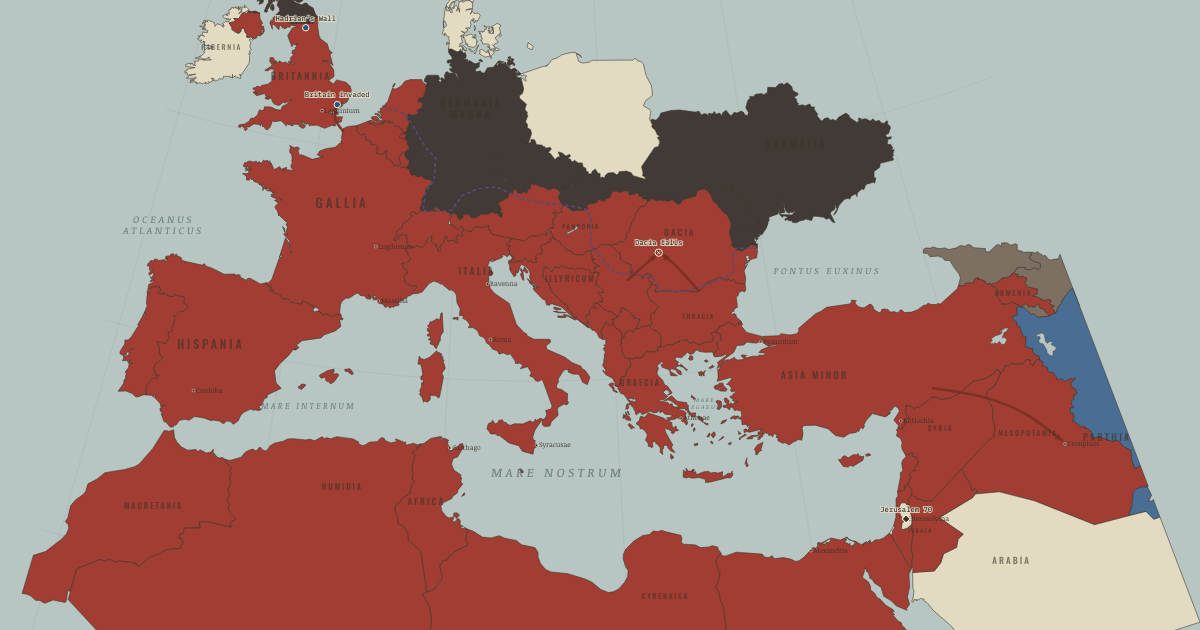
The map above is the world of AD 117 — The greatest extent.
BRIEF EXPLANATION — THE ESSENTIAL ARGUMENT
At its height around AD 117 the Roman empire governed perhaps sixty to seventy million people, and the interesting question is how it managed so many with so few officials. The answer was a partnership with local elites. Rome tied the empire together with roads, cities, a common coinage, shared law and a single system of taxation, but the daily work of government was done by the leading men of each city, who collected the taxes and ran the courts in exchange for status, office and eventually Roman citizenship. The legions guarded the frontiers and, in peacetime, built much of the infrastructure that held the whole network together.
This was an extraordinarily cheap way to rule, and its cheapness was also its hidden weakness. Because so little was held in reserve, the system produced a long peace but had scant capacity to absorb a serious shock. Major revolts, as in Britain and Judaea, were put down with great violence, and from the 160s a devastating plague cut into both population and revenue. Faced with frontiers that cost more to expand than to hold, Hadrian gave up his predecessor’s eastern conquests and marked firm limits, most famously with a wall across northern Britain. The empire was becoming very good at holding what it had, and much less able to replace a major loss.
GUIDED EXPLANATION
The map reached its greatest extent under Trajan around AD 117, stretching from the Atlantic into Mesopotamia, but the more telling fact is how lightly it was governed. Britannia had been invaded under Claudius in AD 43, and Dacia, north of the Danube, was taken in two hard wars between 101 and 106 for its gold, seeding the Latin that would grow into Romanian. Trajan’s final conquests in the east reached the Persian Gulf but were held for only about two years before Hadrian handed them back. Roughly 300,000 soldiers and a very small senior civil service ruled sixty to seventy million people, and they could do so because the real work of government was local. The leading families of each city collected taxes, funded public buildings and administered justice in return for citizenship, office and prestige, and roads, safe sea lanes and a common coinage bound those cities into one system that Romans could call, without irony, mare nostrum, “our sea.”
Efficient as it was, this arrangement left almost nothing in reserve. The frontier, or limes, was a monitored and patrolled zone rather than a solid wall, designed to control movement and collect customs rather than to seal the empire off. When provinces did rebel, the response was severe: the Judaean revolt ended with the destruction of Jerusalem and its Temple in AD 70, and the Bar Kokhba war of 132 to 135 killed, displaced or enslaved great numbers of people. These belong on the map as memorials rather than as measures of imperial success. From about 165 the Antonine plague, probably smallpox, caused heavy but uncertain mortality across the empire, and by the death of Marcus Aurelius in 180 external pressure was rising against a state that kept little central reserve. The very efficiency that made Rome cheap to run had removed its spare capacity.
The choice to stop expanding, made visible on the map by Hadrian’s Wall, changed the empire’s underlying problem. Begun in 122, the wall was less an impassable barrier than a controlled military zone that channelled movement, trade and patrols. New conquest had once supplied land, captives and prestige, so a state that stopped conquering had to fund itself instead through steady taxation and reliable local cooperation. Citizenship helped bind provincial elites to that bargain, but when Caracalla extended it to nearly everyone in the empire in AD 212, it also lost much of its value as a reward, since a prize shared by all rewards no one in particular. The empire remained genuinely powerful for a long time, yet its incentives and its reserves were quietly narrowing, and the next chapter shows what happened when the shocks finally came together.
DEEP EXPLANATION — EVIDENCE & INTERPRETATION
Cities as the Operating System
Rome did not try to administer every village directly from the capital; it governed through chartered cities and existing communities. Local landowners competed for municipal office, paid for public buildings and collected the taxes, and in return they gained legal privileges, citizenship and access to imperial careers. This amounts to a franchise model of government, cheap at the centre because the provincial elites carried out the daily work, and it made Roman identity something to be desired rather than merely endured. Its weakness was a dependence on those same elites’ willingness and wealth, so that if taxes rose while civic office lost its prestige, holding office became a burden that men tried to avoid. Regional differences mattered as well, since the eastern Mediterranean had a dense and ancient network of cities while parts of the western frontier did not. When central power later weakened, the regions with stronger cities and tax systems proved the more resilient, so the same arrangement that explains Rome’s enormous scale also helps explain why its eastern half was the one that survived.
What the “Roman Peace” Conceals
The Pax Romana, the “Roman peace,” describes a reduction of war within the Mediterranean core, not an absence of violence. That peace rested on earlier conquest, on continued fighting along the frontiers, and on the confidence that any rebellion would meet overwhelming retaliation. Boudica’s revolt in Britain and the Judaean wars show where consent ran out. Ancient casualty claims are often inflated and modern estimates remain wide, especially for the Bar Kokhba war, but the reality of large-scale destruction, enslavement and displacement is not in doubt. These events should not be treated as colourful exceptions to an otherwise frictionless system, because they reveal the enforcement that lay beneath the local partnership. Most cities cooperated because cooperation brought real gains and resistance looked hopeless, and that bargain could hold for generations, though it was never a bargain between equals. The word “peace,” in short, describes an order that was experienced very differently by taxpayers, by local elites, by frontier soldiers and by the communities singled out for punishment.
New here? Chapters 1–2 of every atlas are free to sample, and the WW2 atlas is free in full. One membership opens all thirteen — the Cartographer’s Circle.
THE SITES
ON THIS DAY
WHY IT HAPPENED
Cities as the operating system. Rome didn’t administer people; it franchised elites. A conquered region got a charter town, and its landowners got citizenship, careers and status in exchange for running taxes, courts and roads. The empire was a network of a few thousand such bargains — which is why it needed almost no bureaucracy, and why it endured: the governed classes were shareholders. Note the corollary for Chapter 12: where cities were dense (the Greek east), Rome outlasted Rome; where thin (the west), the network was the first thing to die.
The legions as engineers and settlers. A legion in peacetime was a construction firm with swords: roads, bridges, aqueducts, surveying. Veterans’ colonies seeded Latin-speaking towns from Spain to Syria. Conquest’s instrument doubled as integration’s — the same institution that broke a province then built it into the network. Militaries that only fight are cheaper and buy much less.
A frontier held by reputation. Thirty legions could not defend 8,000 km of border as a barrier; they didn’t try. The limes was a tripwire and a customs line; actual security rested on deterrence — the certain knowledge, taught at Sarmizegetusa and Jerusalem, that Rome’s retaliation was unlimited. Deterrence is cheap until it is tested simultaneously in two places; hold that thought for 235.
Good luck wearing the costume of good government. The “Five Good Emperors” (96–180) chose successors by adoption — praised ever since as merit-based design. But each happened to lack a surviving son; the first with one (Marcus Aurelius) promptly ended the streak by anointing the disastrous Commodus. Historians’ warning: distinguish systems from lucky runs before you copy the lesson. The Principate’s succession bug was hiding, not fixed.
THE TURN
Hadrian’s Wall, AD 122. Eighty Roman miles of stone across Britain’s neck — militarily modest, symbolically seismic. Hadrian, inheriting Trajan’s overstretched maximum, gave back Mesopotamia, wrote off expansion, and toured the empire drawing lines: here, and no farther. An ideology older than the Republic — empire without limit, imperium sine fine — quietly retired. The choice was probably right (the eastern conquests were unholdable), but mark what it means on a strategy map: a power that stops choosing where to advance has agreed to let its enemies choose where it will defend. From 122 on, every war in this atlas starts on the other side’s initiative.
WHAT IT CHANGED
Romanization becomes self-sustaining. By 180, Gaul, Spain and Africa are producing senators, authors and emperors (Trajan and Hadrian are Spanish, Septimius Severus African); Latin has generations of native speakers from the Atlantic to the Danube. This cultural depth is why, when the western state dies in Chapter 11, its languages, law and church do not. Conquest lasted centuries; the assimilation it enabled lasts to this morning.
The 212 citizenship: completion and hollowing at once. Caracalla’s universal grant finished the Republic’s oldest trick — turning the defeated into Romans. But by erasing the citizen/subject gradient, it also retired citizenship as an incentive, just as pressure on the frontiers made the army, not the town council, the ladder that mattered. Status competition migrated from civic benefaction to military rank; the cities, the empire’s load-bearing institution, slowly stopped being worth the price of their upkeep.
Plague enters the ledger. The Antonine plague (165–c.180) is the first empire-wide epidemic in the record — armies infected, Egyptian villages emptied on the tax rolls, recruitment and prices disturbed for a generation. Historians now weigh disease alongside politics in Rome’s trajectory (Harper’s “Fate of Rome” makes the strongest case). Whatever its exact toll, note the systemic exposure it revealed: an integrated Mediterranean moves microbes as efficiently as grain.
FIELD QUESTION — Rome governed a quarter of humanity with fewer administrators than a modern mid-sized city. How — and what was the hidden price of governing so cheaply?
The how: subcontracting. Cities self-governed; local elites collected taxes for the status Rome rationed; the army built the infrastructure; deterrence substituted for garrisons. Total state overhead may have been 5–7% of GDP — a miracle of cheapness. The price: the system had no reserves and no redundancy. No standing central army behind the frontier (a usurper’s field army and an invader’s path looked identical); no professional revenue service when city elites stopped volunteering; no institutional loyalty deeper than the current emperor’s name. It was a fair-weather constitution — spectacular at running success, unable to absorb two simultaneous shocks. Chapter 8 supplies the shocks. The transferable question for any efficient system, ancient or modern: what did you delete to get this lean, and what storm makes you miss it?
AN INTERESTING FACT
The best window into daily life on this frontier is a waterlogged rubbish heap: at Vindolanda, a fort near Hadrian’s Wall, anaerobic soil preserved hundreds of wafer-thin wooden writing tablets — the garrison’s actual mail, from strength reports to a note that the soldiers’ beer had run out. The most famous, from around AD 100, is a birthday-party invitation from one officer’s wife, Claudia Severa, to another, Sulpicia Lepidina; its closing greeting, added in Severa’s own hand, is among the earliest known Latin handwriting by a woman. One report calls the locals Brittunculi — “wretched little Britons” — the empire’s casual voice, caught verbatim.
THE DISPATCH
One short letter when a new atlas opens — and the printable study guide for Rome is yours now, free.
NO TRACKING · YOUR ADDRESS IS USED FOR THE DISPATCH AND NOTHING ELSE · UNSUBSCRIBE ANYTIME