MAPS OF HISTORY · Indian Independence & Partition · ALL CHAPTERS · CHAPTER 2
CHAPTER 2 · 1905–1911 · OCT 1905
Bengal Cut in Two
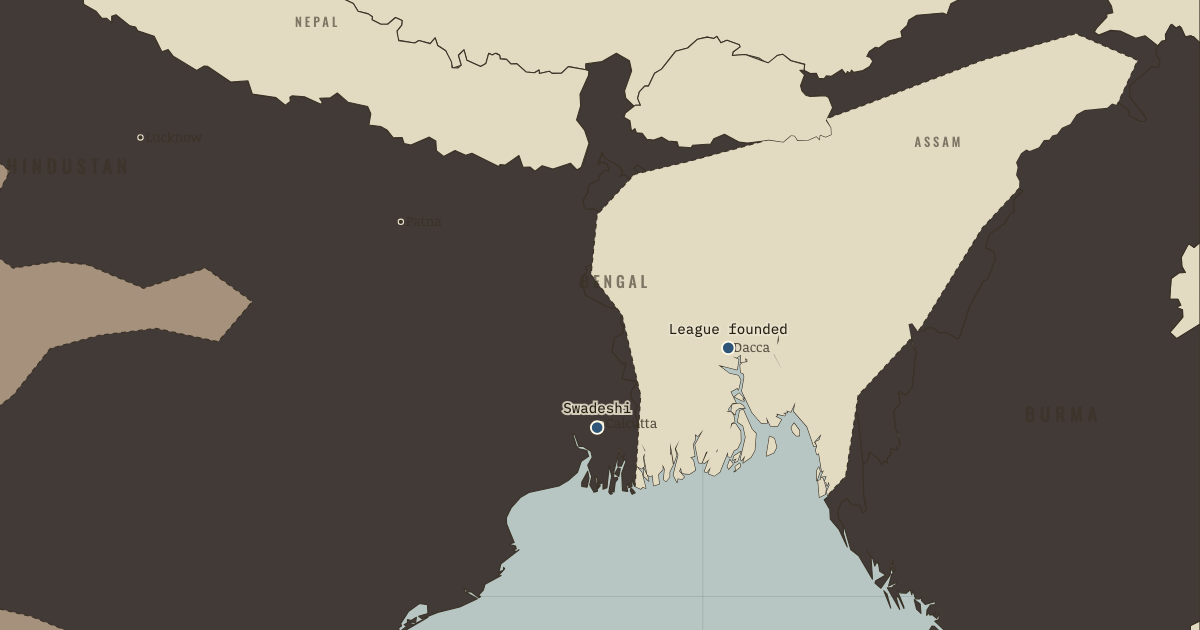
The map above is the world of OCT 1905 — Bengal partitioned.
BRIEF EXPLANATION — THE ESSENTIAL ARGUMENT
The partition of Bengal shows how an administrative decision could become the spark of mass politics, because the line Britain drew in 1905 was read across India as an attack on the nation itself. Curzon defended it as practical reform, since Bengal held 78 million people and was genuinely too large for one governor to run. The boundary he chose, however, split the Bengali-speaking population that led nationalist agitation and created a new Muslim-majority province in the east. Bengalis of both faiths treated the division as a deliberate wound, and their answer was Swadeshi, meaning reliance on goods made in one’s own country, expressed as a boycott of British cloth and a claim to self-rule.
That response mattered because it proved a colonized society could force the empire to retreat without firing a shot, and in 1911 the partition was annulled. The same six years, however, left a more lasting mark on the country’s politics. In 1906 Muslim notables founded the All-India Muslim League to protect a community that feared being permanently outvoted, and in 1909 the Raj granted separate electorates, an arrangement in which Muslims voted only for reserved Muslim seats. This protected minority representation, yet it also built communal identity into the machinery of constitutional politics, where it would remain for the next four decades.
GUIDED EXPLANATION
Curzon’s reform carried a political edge that its administrative logic could not hide. In October 1905 he divided Bengal, the Raj’s most populous province, into a western half around Calcutta and a new eastern province of Eastern Bengal and Assam governed from Dacca. The practical case was real, since one lieutenant-governor could not run 78 million people, but his officials recorded the political advantage plainly. “Bengal united is a power,” one minuted, “Bengal divided will pull several different ways.” The new province gave Muslims a majority and Dacca a capital, while the old one left Bengali speakers outnumbered by Biharis and Oriyas. Bengalis of both faiths read the redrawing as vivisection, and their reaction created the repertoire that Indian nationalism would use for the next forty years. Under the banner of Swadeshi, meaning reliance on goods made in one’s own country, they burned Manchester cloth, founded national schools and banks, and tied rakhi threads across Hindu and Muslim wrists in Tagore’s processions. The age of polite petitioning ended in a single autumn.
The same years cut the other way, and the atlas does not pretend otherwise. In December 1906, at Dacca, Muslim notables led by the Aga Khan founded the All-India Muslim League, partly as a loyalist lobby of landowners and partly out of a genuine fear about what would protect a quarter of the population in any purely majoritarian India. The Raj answered that anxiety in 1909 with the Morley–Minto reforms, whose separate electorates let Muslims vote only for Muslim seats and so raised a constitutional wall between the communities that every later settlement had to build around. Congress meanwhile tore itself apart at Surat in 1907 over whether to petition or to agitate, a revolutionary underground threw its first bombs, and in 1911 the Raj reversed itself, annulling the partition and moving the capital from Calcutta to Delhi, away from the politics Bengal had invented. The eastern wedge vanished from the map, but its shape returned in 1947, and the second time the line would stay.
DEEP EXPLANATION — EVIDENCE & INTERPRETATION
Separate electorates: did Britain invent communalism?
The Morley–Minto reforms of 1909 did something more durable than favour one community: they built an incentive machine. Once Muslims could vote only for Muslim candidates in reserved seats, a Muslim politician gained nothing by appealing across the communal line and lost nothing by ignoring it, so moderation toward Hindus won no votes and hostility toward them cost none. Whether this device created Indian communalism or merely codified a division already present is one of the field’s longest arguments. Francis Robinson stressed the real and distinct interests of a Muslim elite that feared submersion, while Paul Brass emphasized manipulation from above, symbols mobilized by leaders to manufacture a solidarity that need not have hardened. Most historians now conclude that separate electorates institutionalized a difference they had not invented, turning a fluid social fact into a fixed structure of representation that every later constitution had to build around. Once poured into the foundations, that wall could be built higher, yet it could never be removed.
Swadeshi’s two shadows: the bomb and the boycotted
The Swadeshi years are remembered for bonfires of Manchester cloth, yet they cast two shadows the celebration tends to omit. The first was revolutionary violence, because when boycott and petition seemed to stall, secret societies in Bengal such as the Anushilan Samiti and Jugantar turned to bombs and assassination, and figures like Aurobindo Ghose passed from agitation into armed conspiracy before withdrawing into mysticism. This underground current, romantic and largely ineffective, would run alongside Gandhian mass politics for the next forty years. The second shadow was social. The boycott of cheap imported cloth was led by the Hindu bhadralok, the educated propertied middle class, and it fell hardest on those who could least afford homespun and on the Muslim weavers and traders whose livelihoods depended on the import trade. Sumit Sarkar and others have shown how the movement’s Hindu devotional idiom and its class blind spots limited its reach, seeding the very Muslim estrangement that the chapter’s other half records. A movement can be genuinely popular and still speak in only one community’s voice.
New here? Chapters 1–2 of every atlas are free to sample, and the WW2 atlas is free in full. One membership opens all thirteen — the Cartographer’s Circle.
THE SITES
ON THIS DAY
WHY IT HAPPENED
An administrative logic with a political edge. Bengal genuinely was ungovernable as one unit. But the chosen line was one of several available, and officials candidly recorded its advantage: it split the Bengali-speaking intelligentsia who led nationalist agitation, and cultivated East Bengal’s Muslim majority as a counterweight. Divide-and-rule was not the whole story. It was, demonstrably, part of the file. The partition taught Indian politicians that administrative maps were political weapons — a lesson both Congress and the League remembered.
Swadeshi: the economy as battlefield. The boycott hit where empire lived — the textile trade. Imports of British cloth into Bengal fell by a quarter in a year. Bombay and Ahmedabad mills boomed on the demand. Swadeshi fused economic nationalism (Naoroji’s Drain made flesh) with religious symbol and street theatre, and proved a colonized society could hurt the metropole without a single rifle. Gandhi, then in South Africa, studied it closely. Non-Cooperation is Swadeshi generalized.
Muslim anxiety was real, not manufactured. It suits a simple story to call the League a British puppet, and separate electorates were indeed a Raj gift. But the anxiety beneath was authentic: Muslims were a quarter of India, poorer, under-represented in the universities and the professions, and the Swadeshi movement’s Hindu idioms — Kali oaths, Bande Mataram — told many Bengali Muslims this awakening was not entirely theirs. The tragedy of 1905–09 is that both perceptions were reasonable, and the institutions built on them (separate electorates above all) made them permanent.
Congress splits over method. Surat 1907 posed the era’s recurring question: petition or pressure? The Moderates (Gokhale) feared losing the reforms on offer. The Extremists (Tilak — “Swaraj is my birthright, and I shall have it”) argued only agitation ever produced reforms at all. The Raj settled the argument by jailing Tilak for six years, which proved his point. Every later split — Gandhi vs the Swarajists, Congress vs Bose — replays Surat with higher stakes.
THE TURN
16 October 1905 — the day of the partition. The day the partition takes legal effect, Bengal declares mourning: shops shut, hearths cold, the Kali temple thronged, and Tagore leads processions in which Hindus and Muslims tie rakhi on each other’s wrists. It is the first time the nation is performed in the street rather than petitioned in a hall. It works: within six years the Raj retreats for the first time in its history. The turn is double-edged, which is why it is the hinge: the same six years that prove mass pressure works also found the Muslim League and write separate electorates into law. Both 1947 states are, in embryo, present in this one autumn.
WHAT IT CHANGED
The Raj learns retreat is possible — and so does India. The 1911 annulment was meant to buy quiet. Instead it set the precedent every later campaign invoked: sustained agitation moves London. A government that had never once reversed a major decision under Indian pressure had now done so. The mystique of imperial finality never recovered.
Separate electorates: the wall in the foundation. Morley–Minto’s separate electorates (1909) meant Muslim politicians henceforth answered only Muslim voters — moderation toward the other community won no votes, escalation cost none. Constitutionalists defended it as minority protection. In the long run it made communal identity the currency of politics. Nearly every historian of Partition, whatever else they argue, marks this as load-bearing.
Delhi, the imperial capital — briefly. Moving the capital to Delhi in 1911 (announced by George V in person at his own durbar) was retreat dressed as grandeur: away from Bengal’s agitation, toward the Mughal throne’s symbolism. Lutyens’ New Delhi took twenty years to build. The Raj got to use it for sixteen. The empire built its most magnificent capital for its successor state.
FIELD QUESTION — The partition of Bengal was annulled — the agitation won. Why do historians still treat 1905 as the beginning of the road to 1947 rather than a nationalist victory story?
Because everything that made 1947 possible acquired institutional form in these six years. The mass boycott proved the Raj was coercible. But its Hindu devotional idiom showed how easily “the nation” could speak in one community’s voice. Muslim anxiety acquired an organization (the League, 1906) and, fatally, an electoral architecture (separate electorates, 1909) that rewarded communal solidarity and punished cross-communal appeal for the next four decades. And the Raj learned to manage nationalism by conceding form while relocating substance — annul the partition, move the capital. Weigh the ledger: the agitation won a boundary back. The era wrote communal separation into the constitutional foundations. A victory in the streets, and in the statute book a defeat whose size no one yet measured — that is why 1905 opens this atlas rather than decorating it.
AN INTERESTING FACT
Two national anthems were born in this one agitation. Tagore wrote “Amar Shonar Bangla” — “My Golden Bengal” — in 1905 to mourn the partition; sixty-six years later it became the national anthem of Bangladesh, a state whose borders are nearly Curzon’s eastern province. And “Jana Gana Mana,” which he wrote in 1911, is India’s. The same poet, the same six years, the anthems of two countries this map will create — Tagore, who renounced his knighthood over Amritsar in 1919, remains the only person to have authored the anthems of two sovereign states.
THE DISPATCH
One short letter when a new atlas opens — and the printable study guide for Indian Independence & Partition is yours now, free.
NO TRACKING · YOUR ADDRESS IS USED FOR THE DISPATCH AND NOTHING ELSE · UNSUBSCRIBE ANYTIME