MAPS OF HISTORY · Indian Independence & Partition · ALL CHAPTERS · CHAPTER 10
CHAPTER 10 · 1945–1946 · AUG 1946
The Year of the Knife
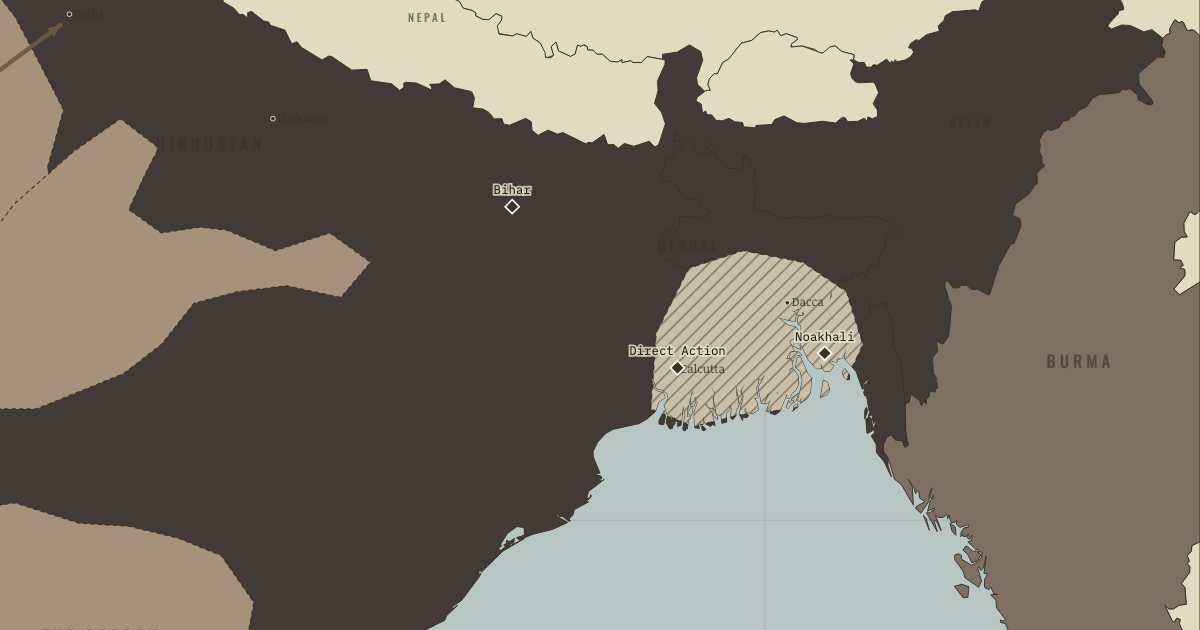
The map above is the world of AUG 1946 — Direct Action.
BRIEF EXPLANATION — THE ESSENTIAL ARGUMENT
By the end of the war Britain had the will to leave India but no longer the means to hold it against its people. The country was bankrupt, its global position weakened, and the loyalty of its Indian forces was no longer certain. Trials of Indian National Army officers at the Red Fort provoked broad public sympathy, and in early 1946 the Royal Indian Navy mutinied in Bombay, revealing unrest inside the very institutions on which the Raj’s coercive power depended. The only real question that remained was to whom power should be handed.
The 1946 election settled that question with brutal clarity, giving Congress most of the general seats and the League almost every Muslim seat, so that Pakistan was now a mandate rather than a resolution. The Cabinet Mission’s federal compromise briefly offered a united India, but disputes over compulsory grouping and central power destroyed the trust it needed to survive. When the plan collapsed, the League called for direct action, and Direct Action Day in Calcutta opened a cycle of communal killing that spread from Bengal to Bihar. From then on the bargaining over India’s future took place under conditions of fear and armed mobilization.
GUIDED EXPLANATION
The end of the war broke the long deadlock, because Attlee’s Labour government, broke and clear-sighted, meant to leave, and only the choice of a successor remained. The winter election of 1945–46 redrew the political map with terrible clarity. Congress swept the general seats, while the League, which had won under five per cent of the Muslim vote in 1937, now took 87 per cent of the Muslim seats and every Muslim seat in the central assembly. Pakistan had become a mandate. The Raj’s own instruments then announced their defection. The INA trials at the Red Fort provoked such fury that the sentences were remitted, and in February 1946 the Royal Indian Navy mutinied in Bombay, with 78 ships flying the tricolour and the crescent together, put down only by Patel’s persuasion. London read the sign correctly, that its sword arm was no longer sure. In March the Cabinet Mission arrived with the last plan for one India: a three-tier union in which provinces would be grouped into Hindu-majority and Muslim-majority sections, under a centre holding only defence, foreign affairs and communications. For one week in June both Congress and the League accepted it, the closest a single Indian state ever came to existing.
The plan died of a doubt and a press conference. On 10 July Nehru remarked that Congress entered the constituent assembly “uncommitted” to the grouping scheme, which confirmed Jinnah’s fear that the compulsory grouping, the substance of Pakistan inside the union’s form, would be unwound by the Hindu majority once the British had gone. The League withdrew its acceptance and turned to direct action. On 16 August 1946 Calcutta became a battlefield for four days, with four to ten thousand dead as both communities killed and were killed, while a League ministry held the province and the police held nothing. The Great Calcutta Killing led to Noakhali in October, where the delta’s Hindus were attacked and a seventy-seven-year-old Gandhi walked the villages barefoot for four months, and Noakhali led in turn to Bihar, where Hindu crowds destroyed Muslim villages and killed thousands. By spring the contagion reached the Punjab. An interim government of Congress and League ministers sat in Delhi sabotaging itself from within, and the choice, as Ismay put it, had narrowed to partition or civil war, a distinction that was dissolving on the streets.
DEEP EXPLANATION — EVIDENCE & INTERPRETATION
The “riot” was not a frenzy — it was organized
The word “riot,” with its suggestion of a sudden crowd madness, is one that historians of Partition have learned to distrust. The killing of 1946–47 was in large part organized. The Great Calcutta Killing was preceded by a League ministry’s declared holiday and by inflammatory mobilization, paramilitary formations on every side, the Muslim League National Guard, the RSS, and Sikh jathas of demobilized soldiers, supplied planning, weapons and trained men, and targets were chosen so that the killing followed a logic of clearing territory rather than the chaos of spontaneous rage. Gyanendra Pandey has shown how calling this violence “communal frenzy” served everyone’s convenience, absolving leaders, states and neighbours by blaming an impersonal collective madness, and Paul Brass has described enduring “institutionalized riot systems” with identifiable organizers and beneficiaries. Naming the organization is not pedantry, because it is the difference between memorializing a natural disaster and memorializing a crime. This atlas treats the dead of Calcutta, Noakhali and Bihar as victims of decisions taken by nameable people for calculable ends, because the alternative, the myth of the maddened mob, is the alibi the killers themselves preferred.
Why Britain left: an empire that ran out of money
The drama of 1946 can make Partition look like a purely Indian quarrel that Britain merely refereed, but the decision to leave at all was driven by Britain’s own collapse as a world power. The war had bankrupted the country, which emerged owing more to India, in the so-called sterling balances, than India owed it, dependent on a punishing American loan and unable to afford the garrisons its empire required. Attlee’s Labour government, elected on a promise of domestic reconstruction, had neither the money nor the will to hold India by force against a population that had shown at the Red Fort and in Bombay harbour that it would no longer reliably serve. India was the first and largest piece to go, but it went inside a general imperial retreat, with Palestine handed to the United Nations and Greece and Turkey handed to the Americans in the same 1947 crisis. Historians divide over how much credit to give British statesmanship for a graceful withdrawal and how much to give Indian pressure and imperial insolvency, and the honest account gives most to the last. Britain discovered that it could no longer afford the alternative to freedom, which is why the leaving, when it came, ran on Britain’s convenience and timetable rather than on India’s readiness.
New here? Chapters 1–2 of every atlas are free to sample, and the WW2 atlas is free in full. One membership opens all thirteen — the Cartographer’s Circle.
THE SITES
ON THIS DAY
WHY IT HAPPENED
1946: the mandate for Pakistan. The League’s electoral transformation — from under 5% to 87% of the Muslim vote in nine years — is the pivot on which everything turns, and it was built of specific materials: the wilderness grievance of 1937, official favour during the war while Congress sat jailed, the promise of Pakistan as deliverance from majority rule, and a campaign fought openly on faith (pirs issuing fatwas, the ballot as profession of belief). After 1946 no one could claim the demand was a lawyer’s bluff without a constituency. Whatever Jinnah had wanted, twenty million voters had now been promised a country.
The armed forces stop being reliable. The INA trials and the RIN mutiny told the planners in London the precise thing that ended empires: the instrument of last resort had become politically unusable. Wavell’s own “breakdown plan” that winter was an evacuation scheme in all but name. Once the army and navy were in doubt, every British calculation ran on a clock. Haste, institutionalized, became the policy the next chapter executes.
The Cabinet Mission: the road not taken. The three-tier plan gave the League Pakistan’s substance (compulsory grouping, a communal veto) inside India’s shell, and gave Congress the union it wanted stripped nearly bare. Both accepted. Each suspected the other of planning to gut it — and Nehru’s July remark, careless or candid, confirmed the suspicion. Historians’ judgments differ (Jalal: Congress preferred a strong-centre partition to a weak-centre union. Others: Jinnah’s acceptance was itself tactical). But June 1946 stands as the demonstration that a united settlement was findable, and that trust, not terms, was what no longer existed.
Violence becomes an argument. Direct Action Day marked the entry of mass killing into the negotiation itself — the discovery, made in Calcutta and applied for a year, that facts created in blood moved conferences that resolutions could not. Once each community’s worst outcome (rule by the other) was illustrated nightly in the refugee columns, moderate positions lost their constituencies everywhere. The riots did not accompany the endgame. They steered it.
THE TURN
Calcutta, 16–19 August 1946. The Great Killing is the hinge on which negotiation turned into amputation. Before it, partition was one lawyer’s formula among several. After four days and several thousand corpses, every party recalculated around the fact that the communities could be made to kill at scale, and would be, again. Wavell brought the League into the interim government to stop the knife. The knife had already done its work on the possibility space. This atlas marks Calcutta as memorial first — the dead of both communities, killed with equal savagery. It is a turning point second, and insists on the order: the political lesson was built out of human beings.
WHAT IT CHANGED
The spiral acquires its own government. Noakhali answered Calcutta, Bihar answered Noakhali, Garhmukteshwar answered Bihar, and by March 1947 the Punjab — where the League brought down the Unionist coalition and no ministry could hold the ring — was arming: veterans of two million wartime soldiers, on all sides, organizing as the state dissolved. The Punjab of chapter 11 was primed in these months.
Attlee sets a deadline. On 20 February 1947 the Prime Minister announced Britain would transfer power “by a date not later than June 1948,” and replaced Wavell with Mountbatten. The deadline was meant to force Indian agreement by making abdication certain. Its actual effect was to convert a slow-motion crisis into a countdown, in which every actor’s incentive was to seize position before the bell.
Gandhi is left behind by his own movement. The Mahatma’s answer to the killing was to walk into it — Noakhali barefoot, village to village, then Bihar, then Calcutta’s slums, one old man against the arithmetic. It worked where he physically stood (Calcutta stayed calm through August 1947 while the Punjab burned — Mountbatten’s “one-man boundary force”) and nowhere he did not. The movement he built now followed men with different sums: Patel counting states, Nehru counting days, Jinnah counting provinces. His last fasts were aimed at his own side.
FIELD QUESTION — For one week in June 1946, Congress and the League had both accepted a plan that kept India united. Was the Cabinet Mission plan a real chance, or an agreement neither side meant?
Treat the acceptances as evidence, and read them closely. Jinnah’s (6 June) came with the League resolution noting the plan’s grouping as the “foundation” of Pakistan — acceptance as instalment. Congress’s (24 June) came hedged with its own interpretations, and Nehru’s 10 July press conference merely said aloud what the hedges implied: a permanent constituent-assembly majority does not bind itself. So the plan was “accepted” by two parties each planning to litigate its soul later. This is Jalal’s point in reverse: the scheme’s genius (sovereignty left ambiguous between union and groups) was exactly what neither could live with, because each had spent a decade telling its followers ambiguity meant betrayal. A real chance would have required enforcement — a decade of British guarantee for the grouping clause — that a bankrupt, departing Britain could not credibly offer. Verdict: the terms were findable, and June 1946 proves it. The trust and the time were not, and the press conference only advanced the funeral. The uncomfortable corollary: by 1946, saving the union required the one commodity — a trusted third party with staying power — whose absence was the whole reason the union was ending.
AN INTERESTING FACT
The Royal Indian Navy mutiny of February 1946 was defused not by the Raj but by the nationalists it was fighting for: Vallabhbhai Patel talked the ratings into surrender with a promise that national parties would protect them (“the discipline of the movement required it,” he said — and Jinnah issued a parallel appeal to Muslim ratings), while Aruna Asaf Ali, heroine of 1942, dissented memorably that she would “rather unite Hindus and Muslims at the barricade than on the constitution-making front.” Neither free India nor Pakistan reinstated the dismissed sailors — that took until symbolic gestures decades later — and the mutiny, too radical for every party’s taste in 1946, had to wait for historians to restore it to the story of independence.
THE DISPATCH
One short letter when a new atlas opens — and the printable study guide for Indian Independence & Partition is yours now, free.
NO TRACKING · YOUR ADDRESS IS USED FOR THE DISPATCH AND NOTHING ELSE · UNSUBSCRIBE ANYTIME