MAPS OF HISTORY · WWI · ALL CHAPTERS · CHAPTER 2
CHAPTER 2 · AUG–SEP 1914 · AUG 1914
The Guns of August
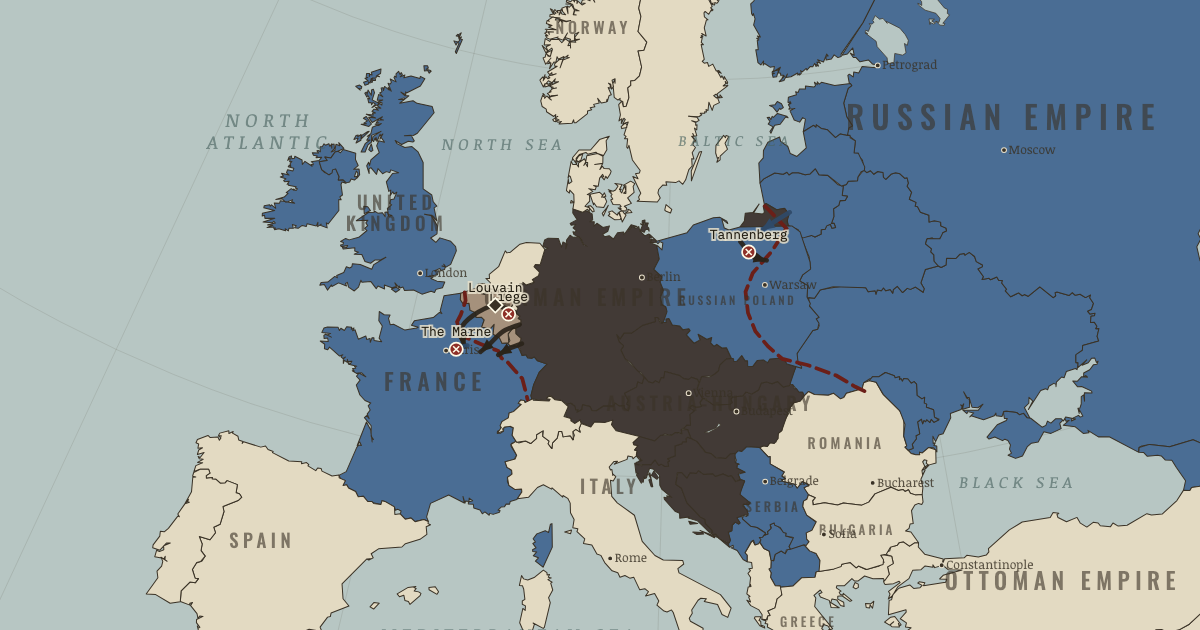
The map above is the world of SEP 1914 — The Marne — the short war dies.
BRIEF EXPLANATION — THE ESSENTIAL ARGUMENT
Germany began the war facing the problem it had dreaded for twenty years, which was the prospect of fighting France in the west and Russia in the east at the same time. Its answer, worked out long in advance, was to defeat France quickly while Russia was still slowly gathering its enormous army, and then to move east by rail before Russia was ready. To do this the German plan sent its strongest forces wheeling through neutral Belgium to envelop Paris from the north, trading Belgian neutrality for the speed the whole scheme required. The armies crossed Belgium and pushed toward Paris close to schedule, while France’s own opening attacks failed with terrible losses and Russia invaded German East Prussia sooner than the planners had assumed.
The plan then broke down under the strain of its own demands. An advancing army outruns its food, ammunition and fresh horses as it marches away from the railways that supply it, and the German right wing was worn out after covering roughly five hundred kilometres on foot. When the German armies drifted east of Paris and opened a gap between them, French and British forces struck into it at the river Marne in early September, and Germany fell back and began to dig defensive trenches. Germany did destroy an entire Russian army at Tannenberg in the east, but a victory there could not repair the western timetable on which the whole strategy depended.
GUIDED EXPLANATION
The arrows sweeping through Belgium show Germany’s attempt to defeat France before Russia could bring its full weight to bear. Belgian resistance at the frontier forts and German violence against Belgian civilians slowed the advance and handed the Allies a powerful propaganda story. France’s own attacks in Lorraine, launched in the belief that spirit would overcome firepower, failed within days at appalling cost. Russia meanwhile invaded East Prussia earlier than German planners had expected, forcing Germany to divide its attention between two fronts at the decisive moment.
Germany destroyed a Russian army at Tannenberg, helped by its railways and by Russian radio messages sent without proper coding. In the west, however, the German troops were exhausted and far ahead of their supplies, and as they wheeled east of Paris they opened a gap between two of their armies. French and British forces attacked into that gap at the Marne on 5 September, and Germany retreated to the river Aisne and dug in. The dashed front line that now appears on the map marks the failure of the short-war plan on which German strategy had rested.
The map can make the German advance look close to success, because Paris lay only about fifty kilometres away, yet the real limit was supply rather than distance. The men had marched roughly five hundred kilometres, the horses were failing, and food and ammunition lagged far behind, while French forces fell back toward intact railways and depots. Joffre, the French commander, also replaced failed generals without hesitation and used the rail network to shift armies to the threatened flank. Russia’s early move into East Prussia helped France by pulling German attention eastward, even though the battle at Tannenberg cost Russia an entire army. The Marne did not end German military power, but it ended the sequence on which Germany had gambled, which was to beat France first and Russia second. Once that timetable failed, Germany faced exactly the long war on two fronts that its plan had been designed to avoid.
DEEP EXPLANATION — EVIDENCE & INTERPRETATION
Logistics of the sweep
The German advance is often judged by how close it came to Paris, but distance on the map is a misleading measure of an army’s strength. A force on the march consumes food, ammunition, fodder for its horses and replacements for its casualties, and all of it must be carried forward from the railheads the army is steadily leaving behind. Roads grow congested, horses weaken and orders arrive late, while the defender falls back toward its own supplies and shifts reserves along an intact rail network. By early September the German right wing had marched roughly five hundred kilometres and could no longer sustain the pace the plan assumed. Command decisions by Moltke, the German chief of staff, certainly mattered, yet the deeper constraint was the plan’s demand for continuous rapid movement by a mass army still powered mainly by boots and horses. Military theorists call this the culminating point, the moment when an attacker keeps advancing on the map after its power to turn movement into a decisive result has already begun to fade.
Tannenberg and the logic of coalition war
Russia’s early invasion of East Prussia was costly for Russia yet valuable for the alliance as a whole, and understanding why requires seeing the war as a partnership rather than a set of separate fronts. German forces used intercepted Russian radio messages and their own rail mobility to surround and destroy Samsonov’s Second Army at Tannenberg. Russia had attacked before it was fully ready partly in order to relieve the pressure on France, and Moltke sent two army corps east in response, though they arrived too late for the battle and did not by themselves cause the German defeat at the Marne. Their absence still illustrates how coalition warfare works, since one ally can buy time for another by forcing the enemy to divide its attention and its troops. The victory also lifted Hindenburg and Ludendorff to national fame, which gave German politics a military leadership cult that would matter for years. A single battle therefore produced two very different effects, the immediate destruction of a Russian army and a longer shift inside German political life.
New here? Chapters 1–2 of every atlas are free to sample, and the WW2 atlas is free in full. One membership opens all thirteen — the Cartographer’s Circle.
THE SITES
ON THIS DAY
WHY IT HAPPENED
The two-front arithmetic. Germany’s core problem since 1894: France and Russia together outnumbered it, but Russia mobilized slowly. Schlieffen’s answer was sequence — annihilate France inside Russia’s mobilization window. The plan traded Belgian neutrality (and thus, in the event, British belligerency) for speed, and assumed a six-week war because it had to be six weeks. Necessity was mistaken for feasibility.
A plan diluted, or a plan impossible?. Moltke the Younger weakened the right wing relative to Schlieffen’s sketch and let the Lorraine armies counterattack rather than lure the French west. Traditionalists blame the dilution; the logistics school answers that no army of 1914 — moving on boots and horse fodder beyond its railheads, its cavalry blind against rifles — could have kept the original timetable anyway. The best evidence: even the diluted wing was starving and exhausted by the Marne.
Plan XVII and the cult of the offensive. France’s own plan hurled everything at Lorraine, guns firing over open sights, doctrine preaching that morale conquers firepower. It failed in ten days at ghastly cost — but its failure left Joffre’s armies positioned, by accident and railways, to swing against the German flank at the Marne. Both sides’ plans failed; the side whose failure left it nearer its depots recovered first.
Russia moves early — for its ally. Russia attacked East Prussia in two weeks instead of six, unready, to save Paris. It cost Samsonov’s army at Tannenberg — and it worked: the two corps Moltke sent east were absent from the Marne. The Entente’s first strategic act was paying in Russian lives for French time; the pattern will repeat in both directions.
THE TURN
The Marne, 5–12 September. A German staff officer, Lieutenant-Colonel Hentsch, sent forward with authority to coordinate a retreat, found the gap between First and Second Armies real and ordered the fallback. The war’s whole shape pivots here: Germany’s one plan for a short war is dead, and its leaders know it — Moltke reportedly told the Kaiser, “Majesty, we have lost the war.” Everything after this is the search for an exit that never comes.
WHAT IT CHANGED
The race to the sea — and the wall. Each side tries to turn the other’s open flank northward until there are no flanks left, only a fortified line from Switzerland to the Channel. First Ypres, in the mud of Flanders, kills the old British regular army stopping the last German lunge. Chapter 3 anatomizes the wall they built instead.
Tannenberg makes a duumvirate. Hindenburg and Ludendorff become Germany’s idols — and by 1916, effectively its military dictators, sidelining Kaiser and chancellor alike. A battle won by a staff officer’s rail plan ends, step by step, with generals running the German state into the ground.
Atrocity and the war of cultures. Louvain and Dinant gave the Entente its narrative: this was a war of civilization against “the Hun.” Propaganda inflated real crimes into cartoons, with a long-term cost. When truthful reports of far worse crimes arrived in the next war, memories of the 1914 exaggerations fed disbelief.
The shell famine. By winter every army has fired more ammunition than its planners projected for the whole war. The crisis births the total war economy — state-run factories, women in the munitions plants, rationed metals — and topples governments in Britain and France. Industrial mobilization, not élan, will decide this war.
FIELD QUESTION — The Schlieffen Plan came within 50 km of Paris. Was it a near-run gamble, or never really possible?
Interrogate the margin. “Nearly worked” assumes the last 50 km were like the first 400 — but the right wing at the Marne was at the end of unpaved supply lines, short two corps, its horses dying, its men marching on bleeding feet, against a defender being fed by intact railways radiating from Paris. Logistics historians argue the plan’s culminating point arrived on schedule regardless of Moltke’s choices; operational historians point to real German errors (the drift east, the gap, Lorraine). Both agree on the deeper point: a plan that requires perfection from men, horses and enemies is not a plan but a wish — and Germany had bet its entire strategic position, including Britain’s neutrality, on it.
AN INTERESTING FACT
The famous taxis of the Marne ran on the meter. Some six hundred Paris cabs shuttled roughly five thousand men of the 7th Division to the front — a sliver of the armies engaged, and probably not decisive — and afterward the French treasury settled with the cab companies at 27 per cent of the metered fare: 70,012 francs, invoiced and paid. The legend mattered more than the lift; the republic in extremis had requisitioned the everyday, and Paris never forgot it.
THE DISPATCH
One short letter when a new atlas opens — and the printable study guide for WWI is yours now, free.
NO TRACKING · YOUR ADDRESS IS USED FOR THE DISPATCH AND NOTHING ELSE · UNSUBSCRIBE ANYTIME