American Civil War · CHAPTER 5 ·
Anaconda Plan and the river war
Chapter 5 of The American Civil War, 1840–1877: “The Anaconda and the Rivers”
General Winfield Scott’s Anaconda Plan aimed to blockade the Southern coast and seize the Mississippi. In February 1862 gunboats and Grant’s troops took Forts Henry and Donelson, opening the Tennessee and Cumberland rivers; Shiloh in April cost roughly 23,700 casualties, and Farragut’s fleet then captured New Orleans.
Chapter 5 is included with every paid plan. WW2 is free in full, and chapter 1 of every atlas is free. A free account opens 3 more chapters a day. Starter, at $9 a month, opens all 21 with no daily limit — see the plans.
Free printable American Civil War study guide, sent by email ↓
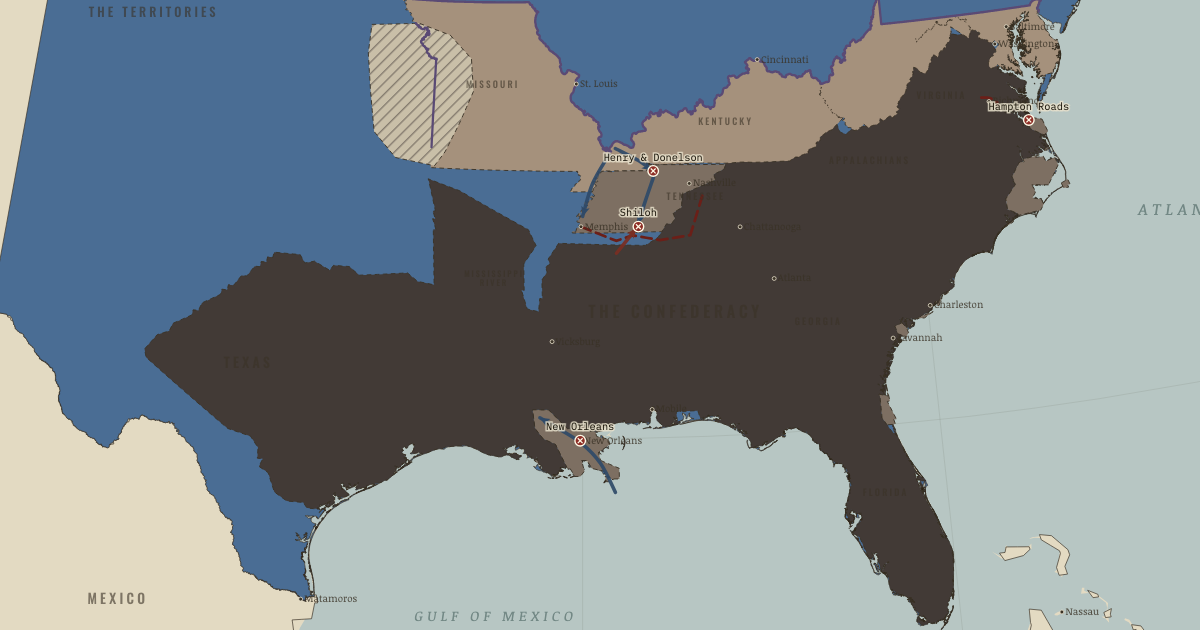
The map above is the world of The United States, June 1862 — New Orleans and Memphis fall.
Every state on the map that year: The world in 1871 · Europe in 1871.
Part of IB History: The American Civil War →
SHORT EXPLANATION
General Winfield Scott's Anaconda Plan offered a way to defeat the Confederacy without relying on one great battle. A blockade would restrict trade along the coast, while control of the Mississippi would cut through the Southern interior. Critics wanted a quicker victory, but Scott's plan had an economic logic: even ships that escaped capture had to pay for the risk, making imports dearer and cotton harder to send abroad. As the Union navy grew, its coastal bases also became places where enslaved people sought freedom and compelled federal officers to decide what protection to give them.
The rivers made the inland part of the strategy possible. In a country with few good roads, gunboats and steam transports could carry men and heavy supplies across Confederate defensive lines. Grant's troops and the navy took Forts Henry and Donelson in early 1862, opening the way to Nashville; Farragut's fleet captured New Orleans from the sea. At Shiloh a Confederate attack nearly reversed the advance. Union forces held the field, but the battle showed the cost of entering and holding the Southern interior. By June, Union control reached deep into it.
The full story
A blockade need not catch every ship to put pressure on a country. A merchant who risks capture or delay must pay more for freight and insurance, and the buyer must pay more in turn. As the Union navy grew from a few dozen ships to hundreds, the Confederacy received fewer useful supplies at higher prices. Bases taken along the coast served another purpose too: at Port Royal, enslaved people escaped to the fleet. Commanders then had to decide whether to return them to their claimants or protect their freedom.
The Union could also use waterways to bring its industrial strength into the Confederacy. In February 1862, Grant's troops and gunboats captured Forts Henry and Donelson, opening the Tennessee and Cumberland rivers. Nashville fell, the first Confederate state capital to be lost. That April, a surprise attack at Shiloh nearly undid the advance; Union reinforcements arrived and held the field after roughly 23,700 casualties. Farragut's fleet passed the forts below New Orleans and took the Confederacy's largest city and financial center. On the map, the corridors from the upper and lower river approach Vicksburg.
These advances worked together. Hatteras and Port Royal gave the navy places to repair and supply ships, while ironclad gunboats helped armies move heavy stores past forts. At Donelson, Grant's demand for unconditional surrender removed an entire Confederate army and exposed Nashville; at Shiloh, the Union learned what defending such an opening could cost. New Orleans was a port and financial center as well as territory on a map. Its loss damaged the cotton economy, and Vicksburg remained the barrier between Union forces on the upper and lower Mississippi. Blockade runners continued to sail and Confederate armies continued to resist, but Richmond had fewer routes and resources. Union occupation also opened places where enslaved people could act for their own freedom.
FULL EXPLANATION
A blockade as a statistical weapon
A runner reaching port carried goods, but it did not restore the trade that the blockade disrupted. Fast steamers favored compact, expensive cargo over the bulk shipments of peacetime. Patrols added uncertainty, insurance costs and time at risk. Cotton exports collapsed, while imports such as rifles, medicine, machinery and salt required scarce foreign exchange. Historians debate the share of Southern deprivation attributable to blockade, damaged railroads, Confederate policies and Union occupation. The causes could reinforce one another: goods landed at Wilmington still had to travel inland, and cotton delivered to Nassau did not automatically become usable credit. The supply system could therefore deteriorate even while individual ships got through.
Why rivers multiplied Union power
The Tennessee, Cumberland and Mississippi offered routes into the Confederacy where poor roads made wagon transport difficult. Steamers could carry artillery, food and reinforcements farther and faster, and Northern yards built and converted armored gunboats faster than Southern yards could match. Rivers and ships did not remove every obstacle: forts, low water, mines, disease and divided commands repeatedly slowed operations. Grant made use of openings before Confederate departments could close them. At Donelson he turned a breach into a mass surrender; after the shock at Shiloh he stayed and counterattacked. Each part of the system depended on the others. A gunboat could pass a fort but needed infantry to hold a town, while an army deep inland needed river supplies to remain there. Manufacturing, waterways and command together made the advance possible.
Key places on the map
On this day
Why it happened
Geography as strategy. The Confederate defensive line could be crossed by water. The Tennessee and Cumberland gave Union vessels routes south, carrying supplies past roads made difficult by mud and bridges that defenders could burn. Northern yards converted river steamers into ironclad gunboats within months. With a tenth of the shipbuilding capacity, the Confederacy could not match them. The rivers mattered because Union foundries could put vessels on them; the foundries mattered because the rivers carried those vessels inland.
The blockade’s slow arithmetic. Successful voyages were common: five in six runners got through in 1861, and one in two still did so in 1864. Yet each voyage had to bear the cost of risk. By 1863, a barrel of flour bought for $8 in Nassau reportedly sold for ten times as much in Charleston. The Confederacy needed cotton exports to pay for imports, and shipping the cotton had become harder too. A count of captures alone misses this pressure; prices and trade volumes show what continued passage cost.
Grant emerges. Grant had failed at farming and sold firewood before returning to command. At Henry and Donelson he moved against the seam between two Confederate departments, where divided authority made a response harder, before his plan had been properly approved. His superiors continued trying to shelve him during 1862. Lincoln reportedly defended him: “I can’t spare this man. He fights.”
Ironclads make the blockade possible. The battle at Hampton Roads (see the marker) showed what armor could do. The CSS Virginia exposed the vulnerability of wooden warships; the Monitor arrived that night and met her, and neither destroyed the other. The Union's advantage lay also in what came afterward. Its industry went on to outbuild the South in ironclads by an estimated twenty to one, making the new kind of ship available at scale.
THE TURNING POINT
Shiloh, 6–7 April 1862. Albert Sidney Johnston attacked Grant at dawn on 6 April, hoping to destroy the Union army at Shiloh before reinforcements arrived and close the river approaches again. Johnston was killed in the peach orchard that afternoon. The reinforcements came, and on 7 April Union troops counterattacked. Nearly 24,000 casualties brought home to both publics the scale of the fighting. Grant later wrote: “I gave up all idea of saving the Union except by complete conquest.” Shiloh showed what that conquest could cost.
What it changed
The Confederate heartland starts to bleed. Nashville and Memphis brought Southern iron and gunpowder mills and a productive farm belt within Union reach. The grey-tan wedge in Tennessee does not shrink again on the map. Confederate armies in the West would spend three years trying to recover ground opened by ten days of fighting in February.
New Orleans: the door closes from the sea. New Orleans fell without a land battle for the city. The Confederacy had lost its largest city and port, as well as its banking capital; the loss damaged the cotton trade that financed imports. The lower river's grey-tan band now reaches toward the Union position in the north, with Vicksburg still between them.
Contraband: emancipation from below. On the sea islands and in river towns, enslaved people reached Union forces and claimed freedom through their own actions. Officers called them “contraband of war” to avoid returning them. Their arrival forced practical decisions before the government had settled a national policy. Chapter 7 follows the political change.
DISCUSSION QUESTION — Why could a slow strategy such as blockade gain support alongside campaigns for a decisive battle?
The costs of a slow strategy are visible before its gains. Taxes, casualty lists and elections come at once, while a gradual fall in Southern imports attracts less attention than a defeat at Bull Run. River campaigns gave the Union visible victories as blockade and occupation built pressure. Scott's plan could operate alongside the search for decisive battles and become more important when quick victory failed. Blockades, sanctions and containment raise a similar problem of sustaining support while their effects accumulate, though their circumstances differ.
An interesting fact
Robert Smalls was a 23-year-old enslaved harbor pilot when, before dawn on 13 May 1862, he took the Confederate transport Planter from its Charleston wharf. Its officers were asleep ashore. He stopped at a nearby wharf for his wife and children, put on the captain's straw hat and used the correct whistle signals to pass Fort Sumter's guns. Smalls delivered the ship and his knowledge of Charleston's defenses to the Union blockade; Congress awarded the party prize money. He ended the war a captain, the first Black man to command a vessel in United States service, and later served five terms in Congress. He also bought the Beaufort house where he had been enslaved.
Related
THE FREE PRINTABLE STUDY GUIDE
Get the printable study guide for The American Civil War free. I’ll send you a few short letters, then one when a new atlas opens. That’s all. — Paul
NO TRACKING · YOUR ADDRESS IS USED FOR THE DISPATCH AND NOTHING ELSE · UNSUBSCRIBE ANYTIME