MAPS OF HISTORY · The Decolonization of Africa · ALL CHAPTERS · CHAPTER 8
CHAPTER 8 · 1961–1975 · AUG 1975
The Portuguese Empire Falls Last
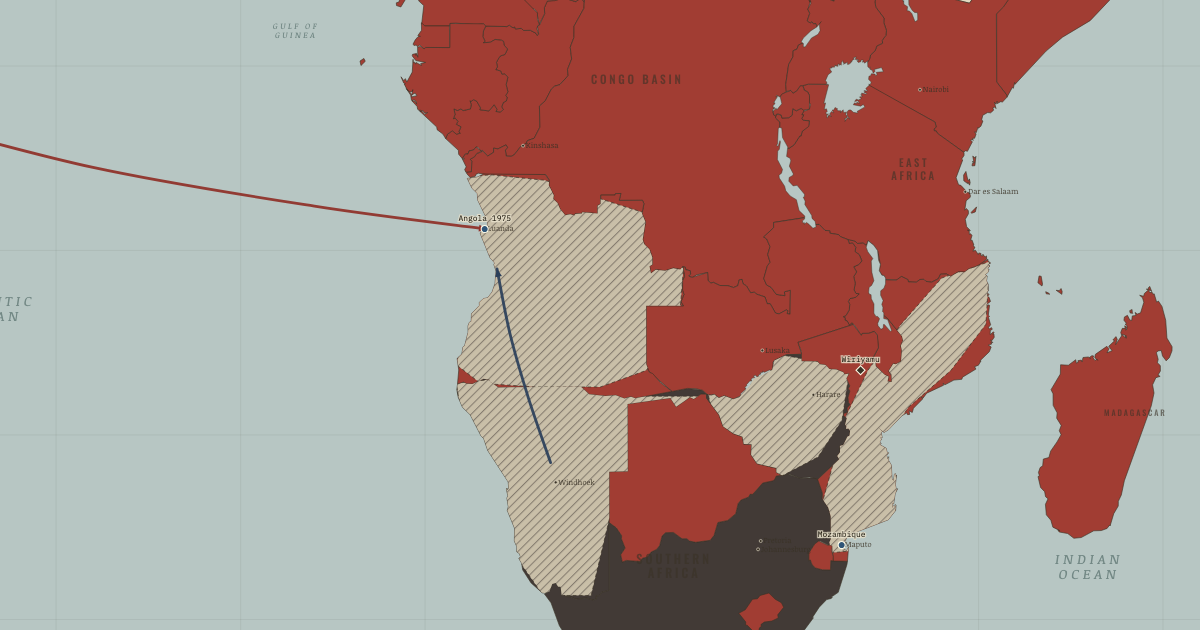
The map above is the world of 1975 — The Portuguese empire ends.
BRIEF EXPLANATION — THE ESSENTIAL ARGUMENT
Portugal held on to Angola, Mozambique and Guinea-Bissau long after the richer empires had withdrawn, and the reason lay in Portugal itself. It was Europe’s poorest state and an authoritarian one, and Salazar’s dictatorship staked its legitimacy on remaining a great imperial power while depending economically on colonial resources and on settler emigration as a social safety valve. It declared the colonies legally part of Portugal, encouraged white settlement, and resolved to fight where wealthier democracies had bargained. Liberation therefore had to be won by war, and movements such as Cabral’s PAIGC in Guinea-Bissau, FRELIMO in Mozambique and the rival movements of Angola fought Portugal through the 1960s and into the 1970s.
The empire fell not in Africa but in Lisbon. Thirteen years of unwinnable colonial war radicalized the Portuguese army itself, and in April 1974 junior officers overthrew the dictatorship in the near-bloodless Carnation Revolution, explicitly in order to end the wars. Portugal then withdrew with startling speed, and five territories became independent within about eighteen months. In Angola, however, independence and catastrophe arrived on the same day, as three rival movements turned on one another for the capital and the Cold War poured in behind them. A war of liberation became an internationalized civil war that would last twenty-seven years, so that freedom here changed the war’s name rather than ending it.
GUIDED EXPLANATION
Portugal described its colonies as overseas provinces and fought to keep them from the early 1960s. Cabral’s PAIGC built liberated zones with schools and clinics inside Guinea-Bissau, FRELIMO waged war in Mozambique, and the MPLA, FNLA and UNITA competed inside Angola. Cold War and regional patrons armed these movements, but each conflict also grew out of the particular local form of Portuguese rule and out of rivalries among the movements themselves. The decisive weakness was never really military; it was that a poor dictatorship had no democratic mechanism through which war-weariness could change policy, so the fighting simply continued.
Thirteen years of that fighting wore down the Portuguese army and radicalized its younger officers, whose 1974 revolution removed the very regime that had made empire non-negotiable. Once that obstacle was gone, Portugal dropped its colonies within months. Angola then revealed the danger of an abrupt exit without an agreed settlement. Cuban troops arrived to back the MPLA, South African forces drove north from Namibia to stop them, and the United States and the Soviet Union supported opposing sides, so that independence ended Portuguese sovereignty without ending organized violence. The civilian suffering in Angola and Mozambique continued for decades afterward, and it must remain at the centre of the account.
Unlike Britain and France, Portugal was Europe’s poorest state and an authoritarian one. Salazar’s regime staked its legitimacy on being a great imperial power and depended economically on colonial resources and settler emigration as a safety valve. It had no democratic public to tire of the wars and no post-imperial future it could imagine. So it fought on for thirteen years after the rest of Europe had quit. The exception that proves how much decolonization depended on the metropole’s own politics.
Guinea-Bissau (recognized 1974), then in 1975 Mozambique, Angola, and the island states. The last major European empire on the continent dissolved almost overnight once Lisbon decided to quit. It is the clearest proof that decolonization’s pace was set as much by the colonizer’s domestic politics as by conditions on the ground: nothing had changed militarily in early 1974, but a revolution in Portugal freed a continent’s worth of colonies within eighteen months.
DEEP EXPLANATION — EVIDENCE & INTERPRETATION
Why the Weakest Empire Held on Longest
Portugal’s poverty made withdrawal harder rather than easier, which is the paradox at the heart of this chapter. The Estado Novo dictatorship used empire to sustain its claim that Portugal remained a major, multi-continental nation, and the colonies also supplied resources and an outlet for settler emigration. Britain and France were rich democracies whose electorates and institutions could register the mounting cost of colonial war and translate it into a change of policy, whereas Portugal suppressed exactly that feedback. The regime could therefore keep fighting long after military victory had become implausible, and the cost was displaced onto the armed forces, where junior officers faced repeated deployments and blocked promotion. The liberation wars ended up transforming metropolitan politics by making the dictatorship itself the obstacle to peace, and once the Carnation Revolution removed that obstacle the colonial system collapsed almost at once. Decolonization, the case shows, depended on politics at both ends: the strength of resistance mattered, but so did whether the imperial state possessed institutions able to revise its goals before the strain shattered the regime.
How One War Turned Straight Into Another
Angola did not move from a united national movement to a peaceful transfer of power, because no such unity had ever existed. The MPLA, FNLA and UNITA had different leaders, regional bases, ideologies and foreign relationships, and Portugal’s rapid departure left no accepted mechanism for sharing power or merging their armed forces. Each movement feared that any compromise would let a rival capture the state, and foreign patrons magnified that security dilemma rather than creating it. Cuba intervened for the MPLA, South Africa entered against it, and American and Soviet resources internationalized the contest, so that outside support did not invent Angola’s divisions but greatly increased the firepower behind them and reduced every incentive to settle. To call the conflict only a proxy war erases Angolan agency, while calling it only a civil war understates how outside powers prolonged it. The transition demonstrates that formal independence and effective peace are separate achievements, since freedom from colonial rule can be complete while the struggle over who controls the postcolonial state remains wide open.
New here? Chapters 1–2 of every atlas are free to sample, and the WW2 atlas is free in full. One membership opens all thirteen — the Cartographer’s Circle.
THE SITES
ON THIS DAY
WHY IT HAPPENED
Why Lisbon could not let go. Unlike Britain and France, Portugal was Europe’s poorest state and an authoritarian one. Salazar’s regime staked its legitimacy on being a great imperial power and depended economically on colonial resources and settler emigration as a safety valve. It had no democratic public to tire of the wars and no post-imperial future it could imagine. So it fought on for thirteen years after the rest of Europe had quit. The exception that proves how much decolonization depended on the metropole’s own politics.
Cabral and the theory of the peasants’ war. Amílcar Cabral was the era’s most original revolutionary thinker: an agronomist who mapped his people’s social structure, built liberated zones with schools and clinics inside Guinea-Bissau, and insisted the struggle was cultural as much as military. “tell no lies, claim no easy victories.” His PAIGC came closest to outright military victory, controlling most of the countryside before Portugal conceded. His assassination in 1973 (the memorial), months before independence, robbed Africa of one of its finest minds.
The army that overthrew its own war. The decisive break came from within the Portuguese military: junior officers, worn down by an endless, unwinnable war and exposed to leftist ideas, concluded that the colonies could not be held and that the dictatorship fighting for them must go. The Carnation Revolution of April 1974 was a coup against a colonial war. The clearest case in this atlas of the colonized wearing down the colonizer until its own society broke. Liberation in Africa toppled a government in Europe.
The Cold War inherits the war. The rival Angolan movements had rival patrons. The MPLA leaned Soviet, UNITA and the FNLA toward the West and apartheid South Africa. So the instant Portugal left, the superpowers and Pretoria rushed in. Cuban regulars, Soviet arms, South African armour and American money turned a decolonization into a proxy battlefield of the global Cold War. The internationalization was not incidental. It was the reason the Angolan and Mozambican wars ran for a quarter-century after the Portuguese sailed home.
THE TURN
Luanda, 11 November 1975 — freedom and civil war on the same day. As Portugal’s flag comes down, three liberation movements are already fighting for the capital, Cuban troops are landing to hold it for the MPLA, and a South African armoured column is driving up from the south to stop them. Angola is independent and at war in the same hour. The purest illustration on this map of how a colonial war, ending, could hand straight over to a Cold War proxy war that outlasted it by decades. The tan turns red, and the red immediately begins to bleed. Freedom, here, changed the war’s name but not its casualties.
WHAT IT CHANGED
Five flags in one year. Guinea-Bissau (recognized 1974), then in 1975 Mozambique, Angola, and the island states. The last major European empire on the continent dissolved almost overnight once Lisbon decided to quit. It is the clearest proof that decolonization’s pace was set as much by the colonizer’s domestic politics as by conditions on the ground: nothing had changed militarily in early 1974, but a revolution in Portugal freed a continent’s worth of colonies within eighteen months.
Angola and Mozambique: liberation into proxy war. Both new states, Marxist and aligned with the Soviet bloc, were immediately destabilized by apartheid South Africa and its allies. UNITA in Angola, RENAMO in Mozambique. In wars that killed perhaps a million and a half people between them, mostly civilians, mostly by famine and landmine. The Portuguese wars of liberation became the Cold War’s and apartheid’s wars of destabilization, seamlessly. Remember the civilian dead of both.
The frontline hardens. With Angola and Mozambique free and hostile, white-ruled Rhodesia and South Africa lost their buffer and faced guerrilla bases on their borders. Mozambique’s independence directly tightened the noose on Rhodesia. Angola’s put a Cuban army on Namibia’s frontier. The fall of the Portuguese empire set up the final act. The war for the settler south. Scrub forward and watch the last charcoal shrink.
FIELD QUESTION — Why did the Portuguese empire, the weakest of the colonial powers, hold on to its African colonies longest — and why did it then collapse all at once?
Precisely because Portugal was weak and authoritarian. Britain and France were rich democracies whose publics and treasuries could weigh the costs of empire and choose to quit. Their governments could survive letting colonies go. Salazar’s Portugal was a poor dictatorship whose legitimacy rested on imperial grandeur, whose economy leaned on colonial resources and settler emigration, and which had no democratic mechanism to register war-weariness or imagine a post-imperial future. So it fought on for thirteen years after the rest of Europe had withdrawn. The collapse was total and sudden because the binding constraint was never military but political and domestic: when the endless war finally radicalized the Portuguese army into overthrowing the dictatorship in 1974, the entire rationale for holding the colonies vanished overnight, and Lisbon dropped them all within eighteen months. The case demonstrates a theme running through the whole atlas: decolonization’s timing was driven at least as much by politics in the metropole as by the strength of the liberation movements. The same war that could not defeat Portugal in Africa defeated it in Lisbon.
AN INTERESTING FACT
The end came announced by a song: at 12:20 a.m. on 25 April 1974, Rádio Renascença played José Afonso’s banned “Grândola, Vila Morena” — the conspirators’ confirmation signal — and the army moved on Lisbon; the carnations came from a restaurant worker named Celeste Caeiro, who had armfuls of them from a cancelled celebration and pressed them into the soldiers’ rifle barrels. By then the colony had already outrun the colonizer: Guinea-Bissau had declared independence from inside its liberated zones in September 1973, and the UN General Assembly had voted 93–7 to condemn Portugal’s “illegal occupation” of a republic much of the world now recognized.
THE DISPATCH
One short letter when a new atlas opens — and the printable study guide for The Decolonization of Africa is yours now, free.
NO TRACKING · YOUR ADDRESS IS USED FOR THE DISPATCH AND NOTHING ELSE · UNSUBSCRIBE ANYTIME