ON THIS DAY ·
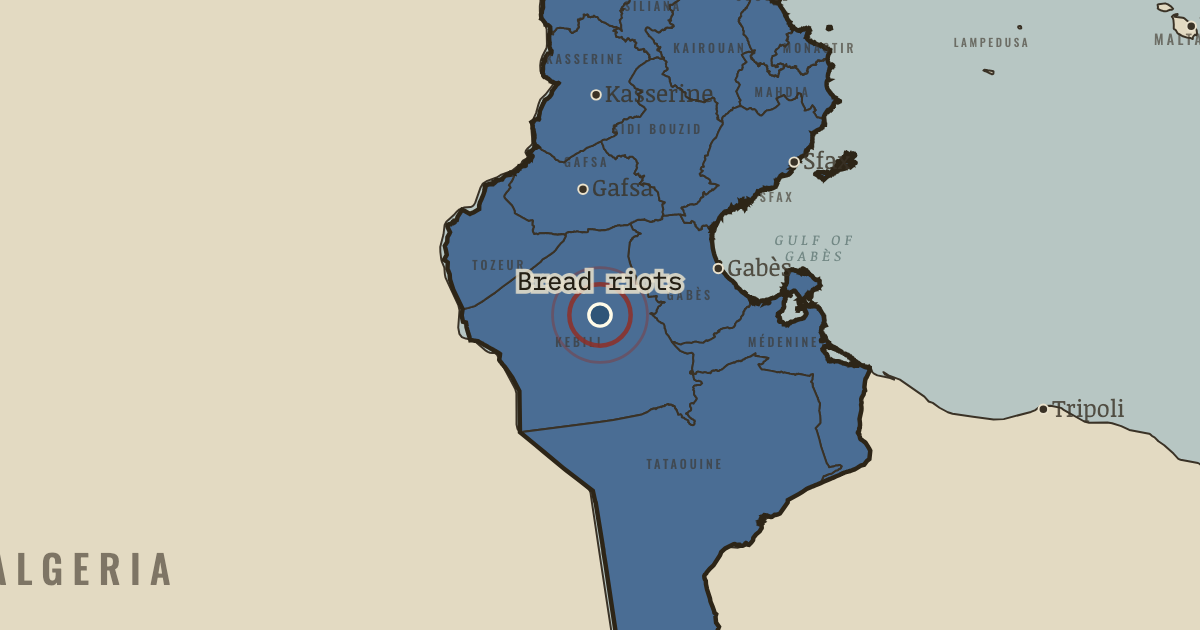
Tunisian bread riots
29 Dec 1983 — The government announces that bread and semolina prices will roughly double. Riots begin in Douz and the oases of the Nefzaoua, then spread north through Kasserine and Gafsa, reaching Tunis by 3 January. Bourguiba cancels the increase on 6 January.
WW2 is free in full, and chapter 1 of every atlas is free. A free account opens 3 more chapters a day. Starter, at $9 a month, opens all 21 with no daily limit — see the plans.
Free printable Feminism and the Tunisian Revolution study guide, sent by email ↓
The moment in context
On 13 August 1956, before Tunisia had a constitution, Bourguiba’s government decreed the Personal Status Code. It took effect on 1 January 1957. Why could a new government make such extensive changes to family law when its neighbors did not? Sociologist Mounira Charrad looks to the alliances through which those governments held power.
From Tunisia under Bourguiba, chapter 7 of Protest and Change: Second-Wave Feminism and Tunisia, 1945–2015 (1956).
The place: Tunisian bread riots — map and full story →
Teach this in 5 minutes
- Why it happened — A nationalist party that owed little to tradition. Neo-Destour (‘New Constitution’) was founded in 1934 at Ksar Hellal in the Sahel, Tunisia’s coastal heartland. Its French-educated lawyers and…
- The turn — The Personal Status Code, 13 August 1956. The Code decreed on 13 August 1956 made divorce a matter for courts and abolished polygamy and repudiation. Tunisian women gained legal rights for…
- What it changed — The most liberal family law in the Arab world. Bourguiba and Ben Ali extended the Code. In 1993, for example, mothers gained new rights over their children. The Code became part of Tunisian…
Then ask the room: Was the Personal Status Code a victory for Tunisian women, or a tool of Bourguiba’s state? The argued answer is on the chapter page →
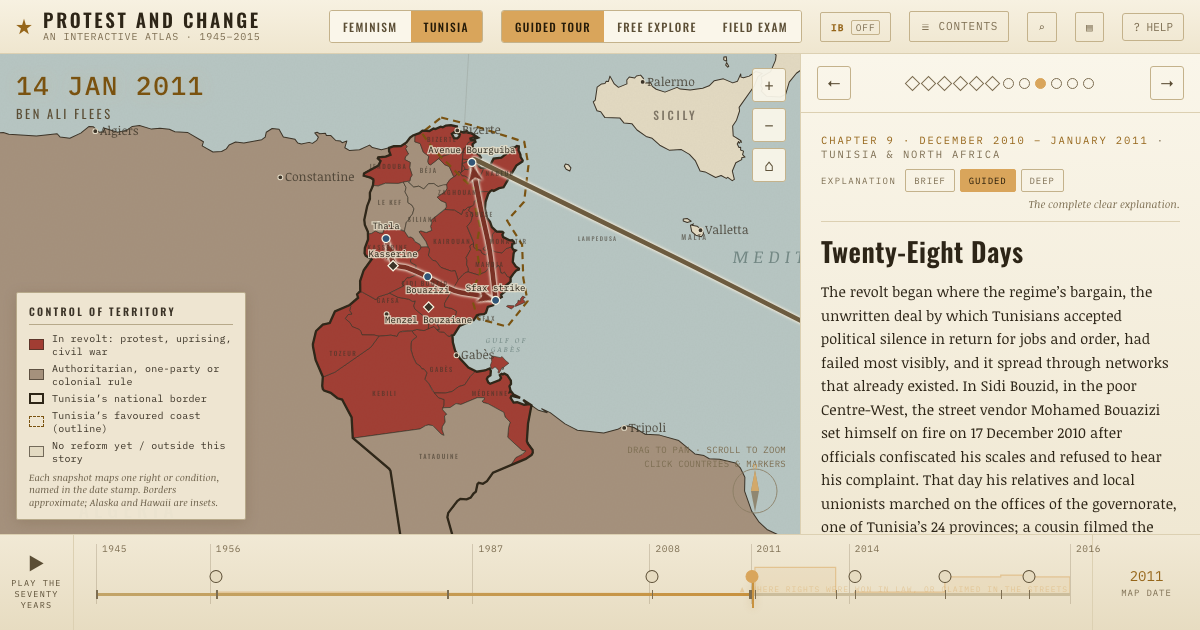
The atlas that shows it
THE FREE PRINTABLE STUDY GUIDE
Get the printable study guide for Protest and Change free. I’ll send you a few short letters, then one when a new atlas opens. That’s all. — Paul
NO TRACKING · YOUR ADDRESS IS USED FOR THE DISPATCH AND NOTHING ELSE · UNSUBSCRIBE ANYTIME