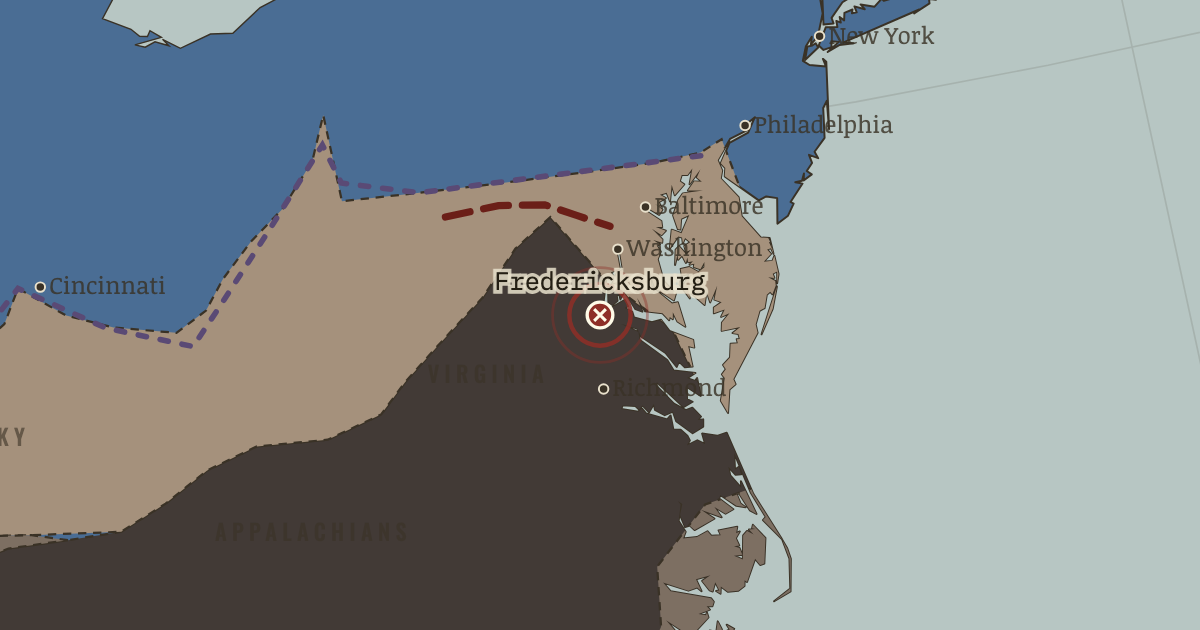
13 Dec 1862 — Burnside sends fourteen brigades against a stone wall on Marye’s Heights. The attacks gain nothing at the cost of 12,600 Union casualties. Watching the battle, Lee says: “It is well that war is so terrible, or we should grow too fond of it.”
WW2 is free in full, and chapter 1 of every atlas is free. A free account opens 3 more chapters a day. Starter, at $9 a month, opens all 21 with no daily limit — see the plans.
13 DECEMBER 1862 · THE AMERICAN CIVIL WAR, 1840–1877
The moment in context
In September 1862, Lee entered Maryland and Bragg advanced into Kentucky. The two campaigns sought a result that battlefield gains alone could not provide. Supplies and border-state recruits would help the Confederate armies, while a victory on Northern or border soil might affect the autumn elections and persuade Britain to mediate. A Union soldier then discovered a lost copy of Lee’s orders. McClellan could see that his opponent’s army was dangerously divided, but at Antietam he committed his forces in stages and left large reserves idle. Lee’s battered army held its ground and withdrew; Bragg also retreated after Perryville.
Why it happened — Why Lee invaded. Virginia’s stripped farms could no longer feed Lee’s army easily, so Northern fields offered a practical reason to move. The invasion also offered a…
The turn — Antietam, 17 September 1862. Lee left Maryland without the rising he had hoped for. Britain did not mediate, the midterms did not break Lincoln’s government, and Lee’s…
What it changed — The war acquires a second war aim. From January 1863, a Union advance could put the Proclamation into effect. Hover over the map’s grey-tan zones to see notes on garrisons, contraband…
Then ask the room: The Proclamation excluded loyal slave states and needed Union force to take effect in rebel territory. Why might it still be called the war’s most important single document? The argued answer is on the chapter page →