ON THIS DAY ·
Xi’an Incident
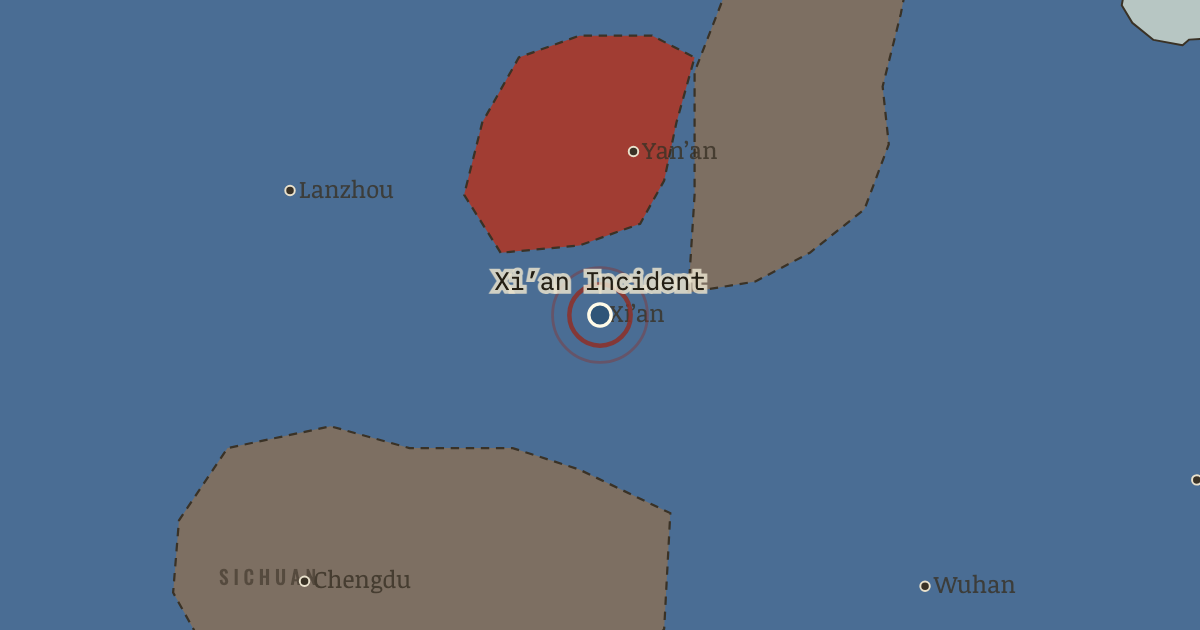
12 Dec 1936 — Zhang Xueliang kidnaps his own commander-in-chief, Chiang, to force a united front against Japan. Chiang had refused to fight for Zhang’s homeland, Manchuria. Stalin urges Chiang’s release, and Zhou Enlai negotiates it. A warlord’s desire to recover his homeland has suspended the civil war by mutiny and helped the CCP survive 1936.
WW2 is free in full, and chapter 1 of every atlas is free. A free account opens 3 more chapters a day. Starter, at $9 a month, opens all 21 with no daily limit — see the plans.
Free printable Chinese Revolution study guide, sent by email ↓
The moment in context
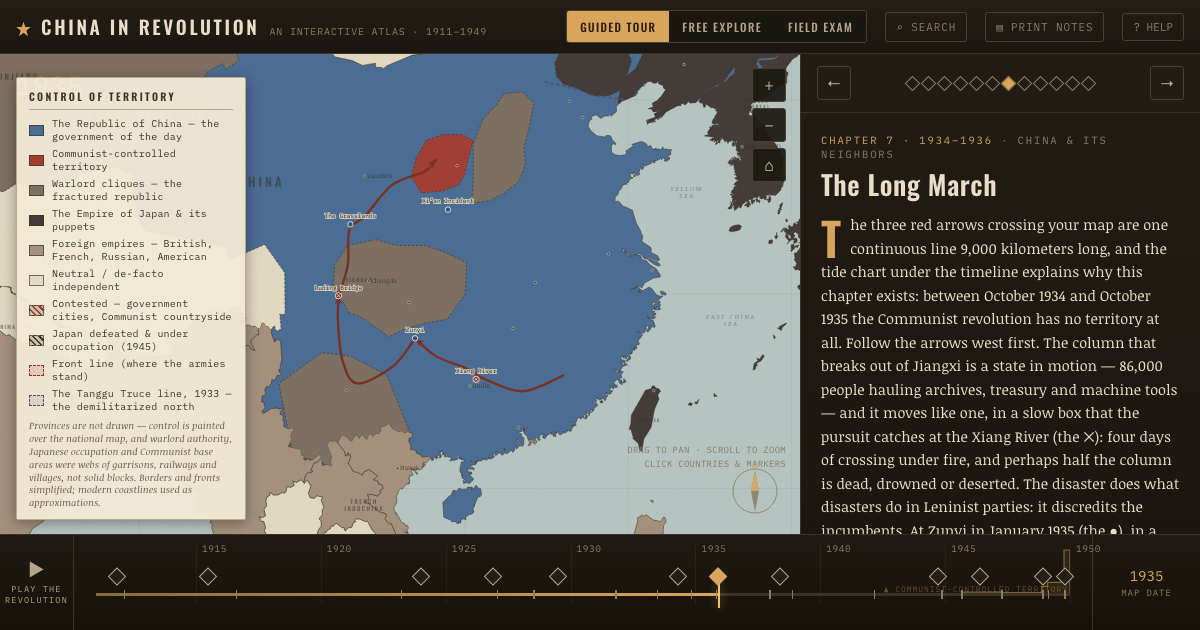
The three red arrows trace roughly 9,000 kilometers, but they can make the Long March look more purposeful than it was. The journey began with the collapse of the Jiangxi base in October 1934. Some 86,000 people broke out, carrying archives, treasury and machine tools with them: the institutions of a state were traveling with an army that had lost its home. Between October 1934 and October 1935, the Communist revolution held no territory at all.
From Long March, chapter 7 of China in Revolution, 1911–1949 (1935).
The place: Xi’an Incident — map and full story →
Teach this in 5 minutes
- Why it happened — A destination found on the road. The Jiangxi base could no longer be held (Chapter 6), but escape did not dictate a single destination. The column went west along watersheds where…
- The turn — Zunyi, 15–17 January 1935. The Xiang crossing had exposed the cost of the existing command’s decisions. At Zunyi the leaders acted on that failure: the Comintern-backed…
- What it changed — Yan’an becomes the laboratory. The small red zone around Yan’an remained a base through 1947. In its loess country the party developed practices it would extend after 1945: rent…
Then ask the room: How did the Long March’s founding story contribute to its historical importance, and how should we assess it? The argued answer is on the chapter page →
The atlas that shows it
THE FREE PRINTABLE STUDY GUIDE
Get the printable study guide for China in Revolution free. I’ll send you a few short letters, then one when a new atlas opens. That’s all. — Paul
NO TRACKING · YOUR ADDRESS IS USED FOR THE DISPATCH AND NOTHING ELSE · UNSUBSCRIBE ANYTIME