ON THIS DAY ·
Hoyt v. Florida
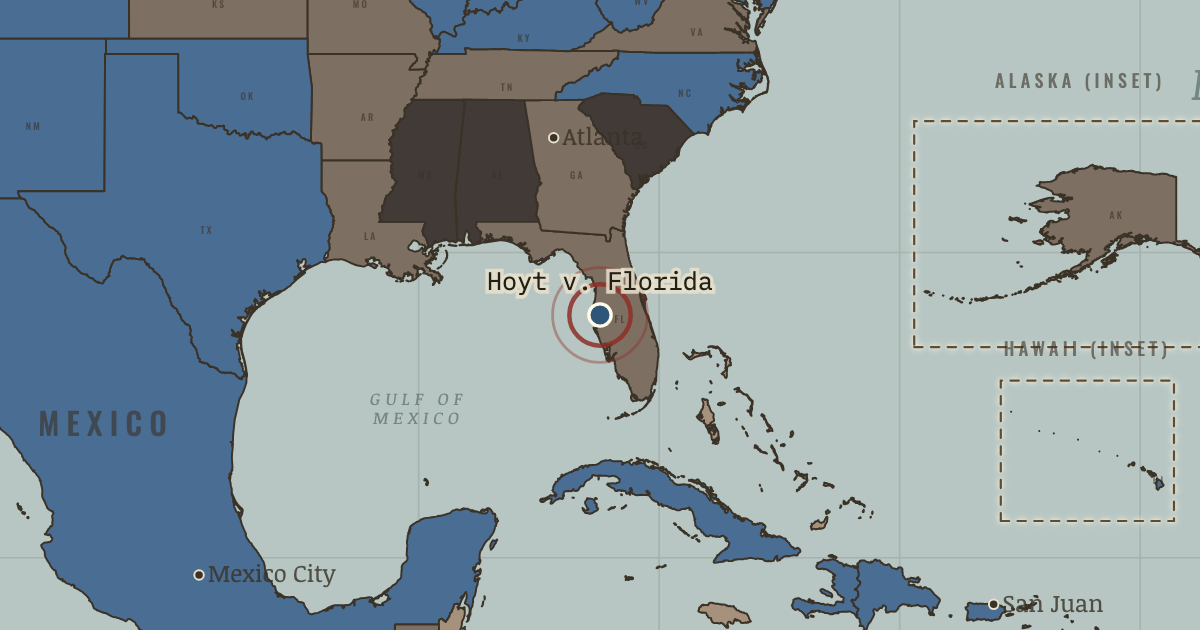
20 Nov 1961 — An all-male jury in Tampa has convicted Gwendolyn Hoyt. The Supreme Court upholds her conviction and Florida’s practice of keeping women off jury lists unless they volunteer, reasoning that woman is “still regarded as the center of home and family life.”
WW2 is free in full, and chapter 1 of every atlas is free. A free account opens 3 more chapters a day. Starter, at $9 a month, opens all 21 with no daily limit — see the plans.
Free printable Feminism and the Tunisian Revolution study guide, sent by email ↓
The moment in context
In 1957 Gwendolyn Hoyt struck her husband with a baseball bat during a quarrel in Tampa, Florida. He died, and an all-male jury convicted her of murder. Florida placed women on jury lists only if they registered to serve. Few did so, and the Supreme Court upheld the arrangement in Hoyt v. Florida (1961). Woman, the Court reasoned, was “still regarded as the center of home and family life.”
From Origins of second-wave feminism, chapter 1 of Protest and Change: Second-Wave Feminism and Tunisia, 1945–2015 (1963).
The place: Hoyt v. Florida — map and full story →
Teach this in 5 minutes
- Why it happened — The vote without equality. The Nineteenth Amendment secured women’s vote in 1920, but the expectation that political power would bring legal equality was left unfulfilled.…
- The turn — The Feminine Mystique, 19 February 1963. A 1957 questionnaire for Friedan’s Smith College reunion began an inquiry that grew through five years of interviews. Her book appeared on 19…
- What it changed — A language for consciousness-raising. Women in the small “consciousness-raising” groups of the late 1960s compared experiences and found political roots in personal problems. Friedan’s…
Then ask the room: Was The Feminine Mystique a cause of second-wave feminism, or a symptom of changes that were already under way? The argued answer is on the chapter page →
The atlas that shows it
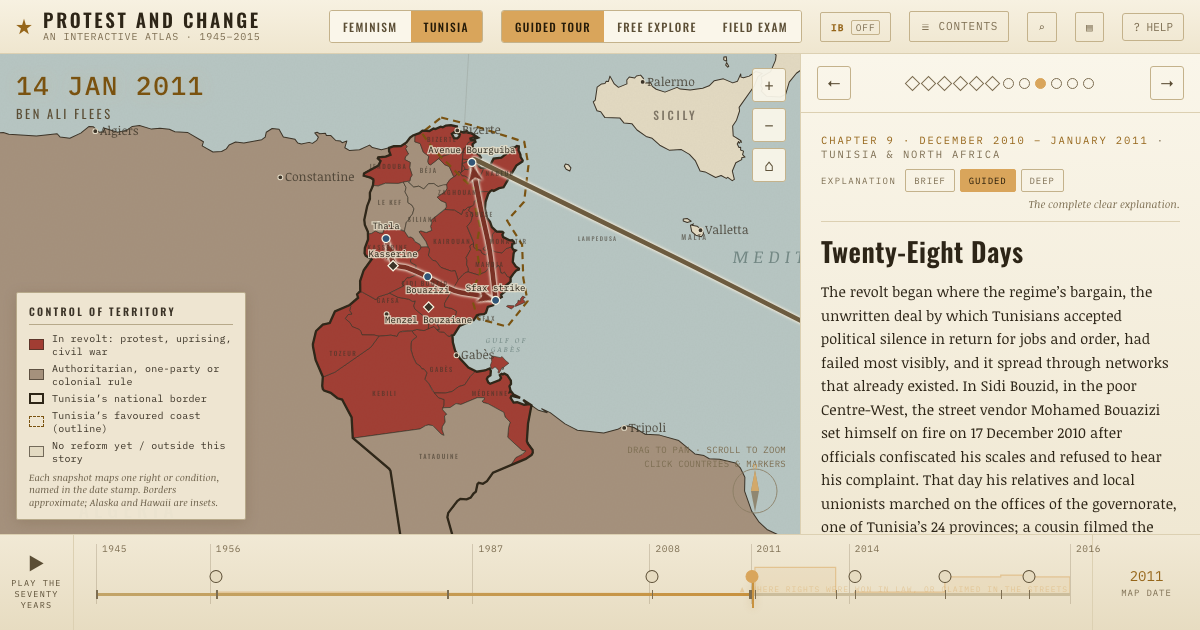
THE FREE PRINTABLE STUDY GUIDE
Get the printable study guide for Protest and Change free. I’ll send you a few short letters, then one when a new atlas opens. That’s all. — Paul
NO TRACKING · YOUR ADDRESS IS USED FOR THE DISPATCH AND NOTHING ELSE · UNSUBSCRIBE ANYTIME