ON THIS DAY ·
PLA in Lhasa and the Tibetan uprising
26 Oct 1951 — The PLA enters Lhasa under the Seventeen-Point Agreement. 10–20 Mar 1959 — Crowds gather around the Norbulingka palace to prevent the Dalai Lama from going to a Chinese army camp. He escapes on the 17th, and the PLA shells the palace on the 20th. The disputed estimates of the dead in Lhasa range from roughly 2,000 to 10,000.
WW2 is free in full, and chapter 1 of every atlas is free. A free account opens 3 more chapters a day. Starter, at $9 a month, opens all 21 with no daily limit — see the plans.
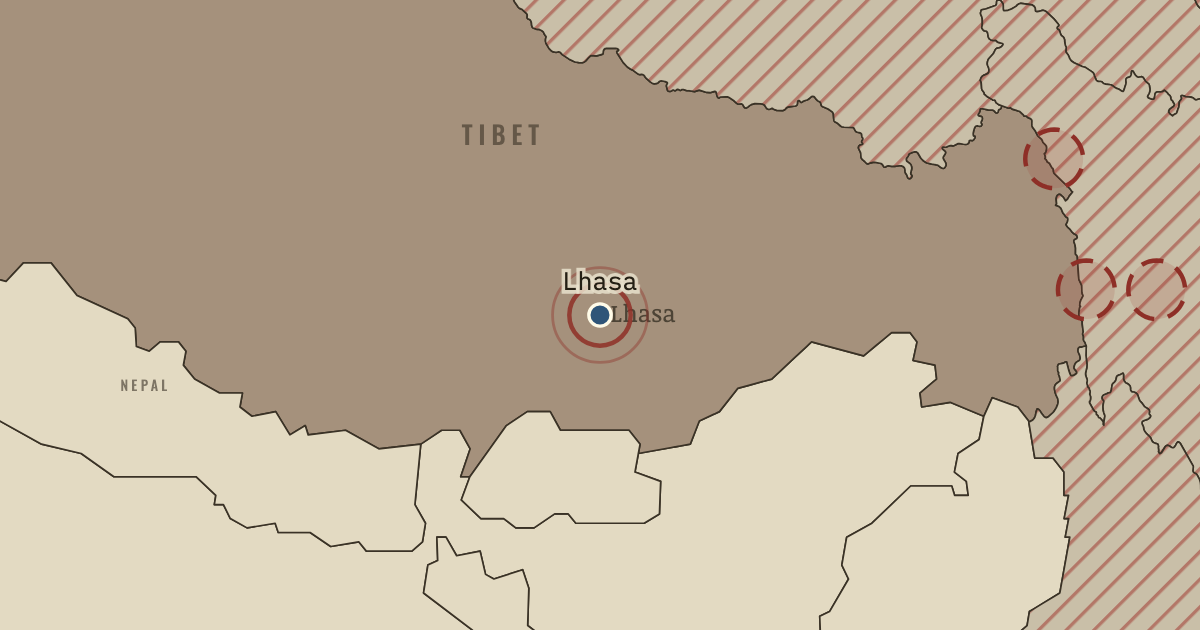
The moment in context
The Qing empire had governed Han Chinese alongside Mongols, Tibetans, Uyghurs and other peoples until 1912. Its successor, the Republic of China, lost control of Outer Mongolia, Tibet and much of Xinjiang. The Communists claimed the old imperial borders for the new People’s Republic. That ambition left a question: how would a state presenting itself as a nation govern peoples whose histories were bound to those borders in different ways?
From Tibet and Xinjiang under Mao, chapter 3 of The People’s Republic under Mao, 1949–1976 (1956).
The place: PLA in Lhasa and the Tibetan uprising — map and full story →
Teach this in 5 minutes
- Why it happened — The Qing borders as a national claim. Nationalists and Communists both claimed the Qing empire’s borders at their height as China’s rightful borders. On that view, Tibetan…
- The turn — Lithang, February–March 1956. Lithang showed how difficult it was to confine the effects of reform to one side of a provincial line. In February–March 1956 the army besieged and…
- What it changed — Tibet transformed after 1959. Beijing used the rising to end the 1951 settlement. It dissolved the old government, undertook land reform in Tibet in 1959–61, closed most…
Then ask the room: Was the People’s Republic of the 1950s a nation-state or an empire on its frontiers? The argued answer is on the chapter page →
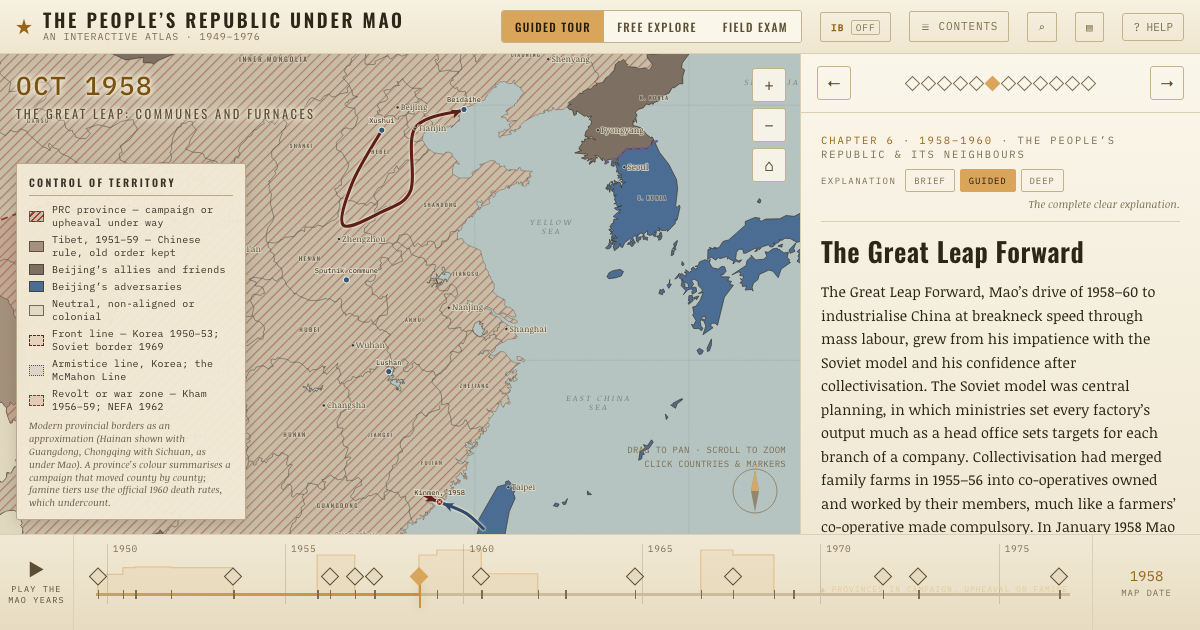
The atlas that shows it
THE FREE PRINTABLE STUDY GUIDE
Get the printable study guide for The People’s Republic under Mao free. I’ll send you a few short letters, then one when a new atlas opens. That’s all. — Paul
NO TRACKING · YOUR ADDRESS IS USED FOR THE DISPATCH AND NOTHING ELSE · UNSUBSCRIBE ANYTIME