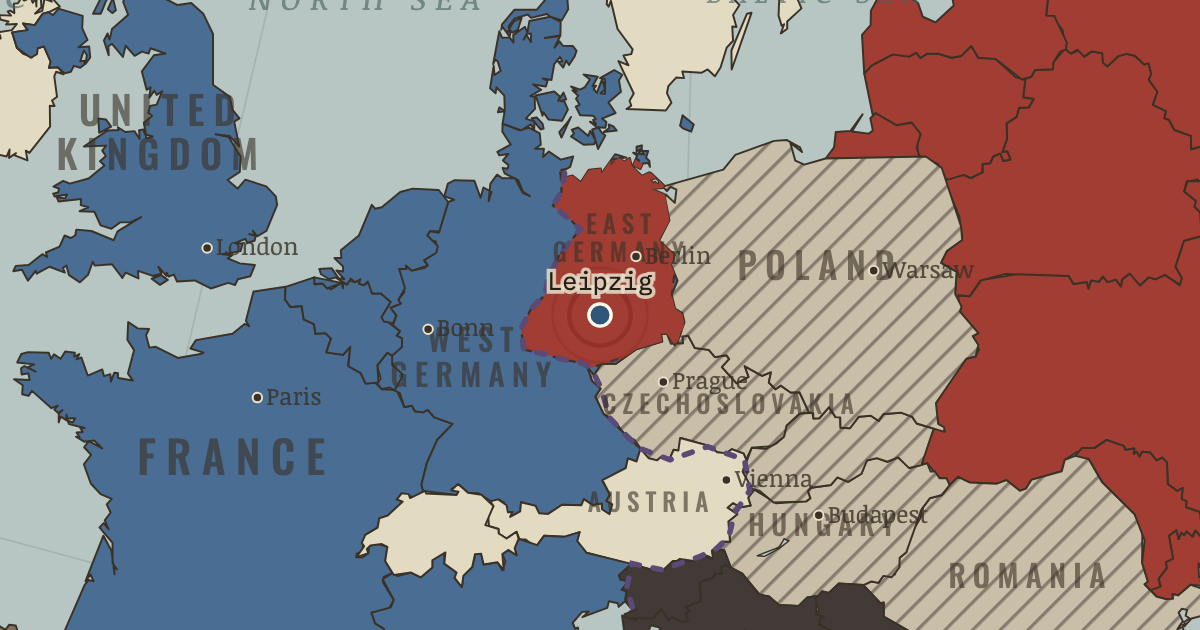
9 Oct 1989 — In Leipzig, 70,000 people march, chanting “Wir sind das Volk.” The order to shoot never comes. Once the state blinks, demonstrations fill every square in the GDR.
WW2 is free in full, and chapter 1 of every atlas is free. A free account opens 3 more chapters a day. Starter, at $9 a month, opens all 21 with no daily limit — see the plans.
Gorbachev inherited a system whose difficulties could no longer be concealed by impressive military power. In the early 1980s Soviet growth was estimated at about 1%, perhaps less than zero, although the official figures were unreliable. The country imported 30–40 million tons of grain a year, and its computers lagged far behind those of the West. A government that licensed copying machines like weapons also restricted the circulation of the knowledge needed for modernization. The fall in oil prices in 1986 removed a valuable cushion. Gorbachev and his “men of the Sixties,” whose outlook had been shaped by the Secret Speech and the crushing of the Prague Spring, believed that opening the system could save it.
Why it happened — Why reform — the numbers Gorbachev read. Gorbachev inherited a system whose difficulties could no longer be concealed by impressive military power. In the early 1980s Soviet growth was…
The turn — Berlin, 9 November 1989, 18:53. At 18:53 on 9 November, Günter Schabowski, the Politburo spokesman, was asked when new travel rules would take effect. Searching his notes, he…
What it changed — Germany reunifies — inside the West. The German question followed. Kohl pressed for reunification despite allied caution, Bush supported him, and Gorbachev accepted a united Germany in…