ON THIS DAY ·
Battle of Sakarya
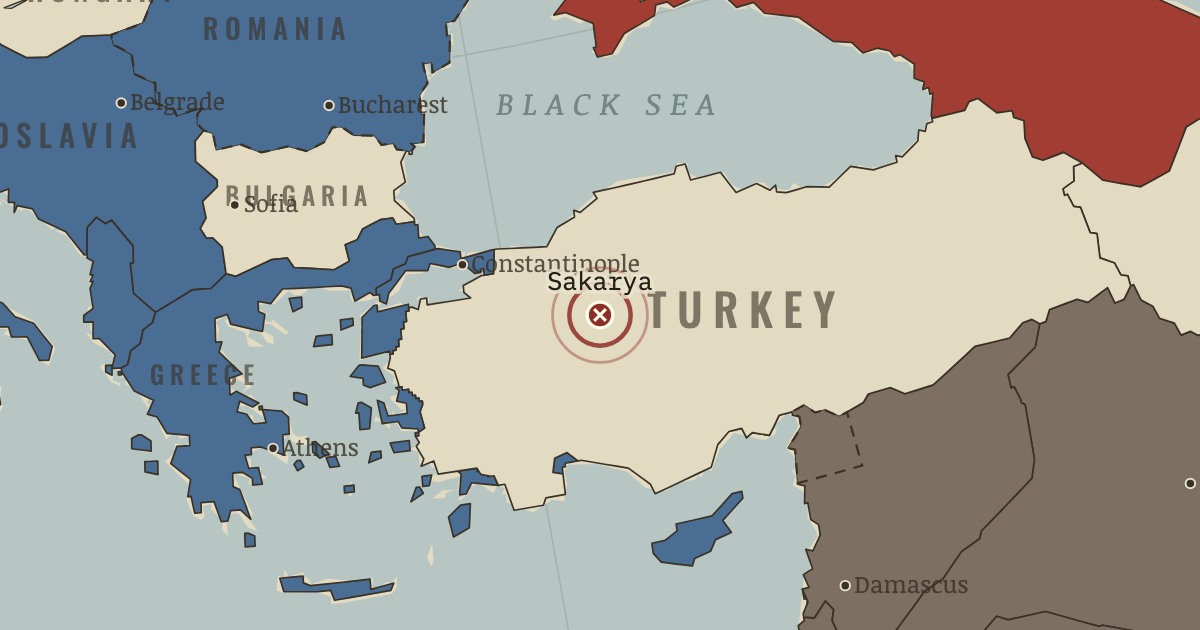
23 Aug–13 Sep 1921 — The Greek army attacks Mustafa Kemal’s defenses along the Sakarya river, some eighty kilometres from Ankara. After three weeks it has failed to break through, and it never advances again. The Treaty of Sèvres, signed barely a year earlier, dies here.
WW2 is free in full, and chapter 1 of every atlas is free. A free account opens 3 more chapters a day. Starter, at $9 a month, opens all 21 with no daily limit — see the plans.
The moment in context
The victors said that nations should govern themselves. Yet self-determination, a principle rather like independence decided by referendum, competed with their promises to allies and their power to take land from defeated states. The treaties with Germany’s allies show the results. Saint-Germain left Austria a German-speaking republic of about six and a half million people and prohibited union with Germany. At Trianon, Transylvania went from Hungary to Romania, Slovakia to Czechoslovakia, and Croatia and the Vojvodina to the new Kingdom of the Serbs, Croats and Slovenes, later called Yugoslavia. Neuilly deprived Bulgaria of its Aegean coast. Sèvres divided lands of the Ottoman Empire, the Turkish state ruled by a sultan or emperor, among Britain, France, Italy and Greece.
From Europe’s new borders after WWI, chapter 15 of The Great War, 1871–1923 (JUL 1923).
The place: Battle of Sakarya — map and full story →
Teach this in 5 minutes
- Why it happened — The method Versailles set. Versailles settled Germany’s frontiers in Chapter 14 and supplied a method for the other treaties: a Covenant, or founding charter, for the League…
- The turn — Lausanne, 24 July 1923. İsmet Pasha, Turkey’s delegate at Lausanne, refused to sign a treaty retaining the capitulations, foreign financial control or reparations. The…
- What it changed — Guardians and revisionists. The new map gave governments different interests in its survival. France allied with Poland in 1921 and later signed treaties with the Little…
Then ask the room: “In 1919–1923 armies drew the map of Europe, and treaties only signed it.” How far do you agree? The argued answer is on the chapter page →
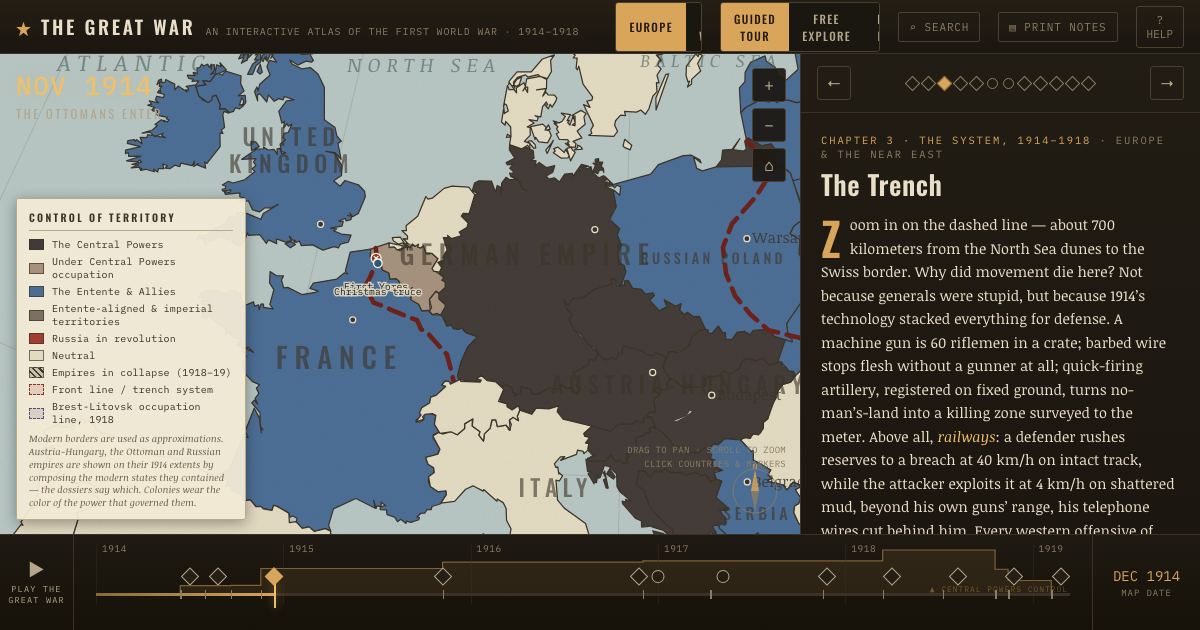
The atlas that shows it
THE FREE PRINTABLE STUDY GUIDE
Get the printable study guide for WWI free. I’ll send you a few short letters, then one when a new atlas opens. That’s all. — Paul
NO TRACKING · YOUR ADDRESS IS USED FOR THE DISPATCH AND NOTHING ELSE · UNSUBSCRIBE ANYTIME