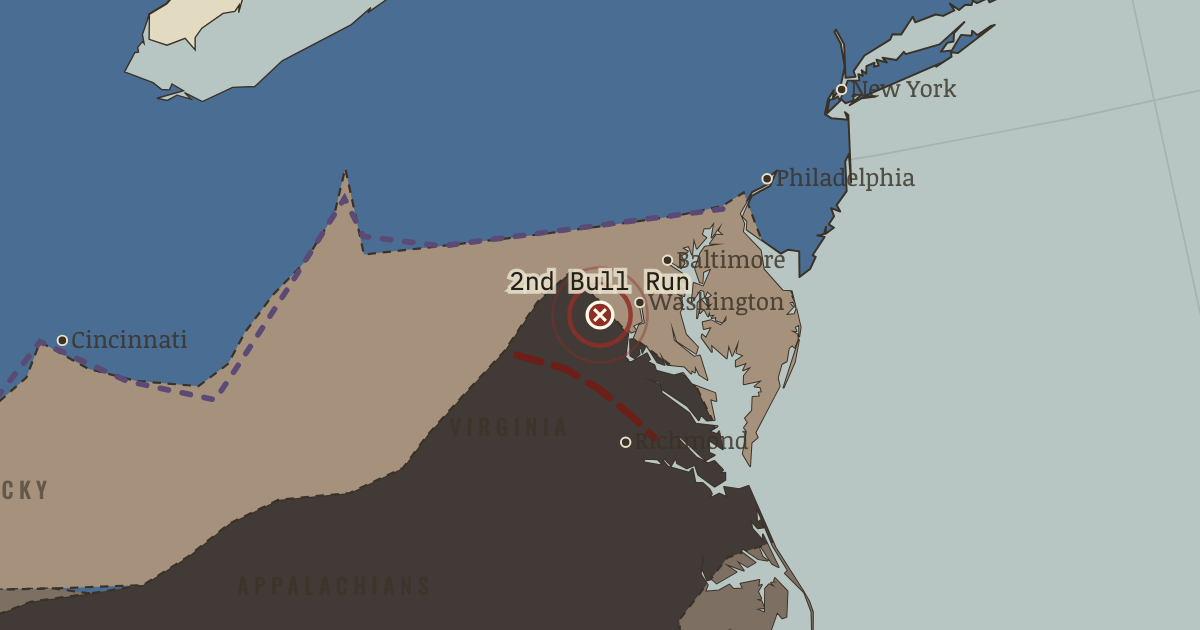
29–30 Aug 1862 — On the old Manassas ground, Jackson’s 54-mile flank march and Longstreet’s hammer blow rout Pope. In less than three months, Lee has shifted the fighting from Richmond’s gates to Washington’s.
WW2 is free in full, and chapter 1 of every atlas is free. A free account opens 3 more chapters a day. Starter, at $9 a month, opens all 21 with no daily limit — see the plans.
30 AUGUST 1862 · THE AMERICAN CIVIL WAR, 1840–1877
The moment in context
McClellan had a plan for reaching Richmond without marching all the way overland. Union command of the sea allowed him to transport the Army of the Potomac to the Virginia Peninsula, and he organized and supplied that great army with considerable skill. He also believed he faced a much larger enemy: his intelligence service repeatedly estimated Confederate strength at roughly twice its true size. His preference for a limited war ending in reconciliation reinforced his caution. By late May 1862 his men were reportedly close enough to hear Richmond's church bells, but the reinforcements he wanted were being held near Washington, where the government feared for its own safety.
Why it happened — McClellan’s mathematics of caution. McClellan commanded an army described as the largest yet assembled in the hemisphere. He nevertheless repeatedly believed the enemy outnumbered him.…
The turn — Gaines’ Mill and the Seven Days, 25 June–1 July 1862. During the Seven Days McClellan's army fought effectively as it retreated, and at Malvern Hill it inflicted heavy losses. It had not been destroyed.…
What it changed — The war radicalizes. The failure before Richmond weakened the argument for a limited war. In July Congress passed the Second Confiscation Act, which provided for freedom…