ON THIS DAY ·
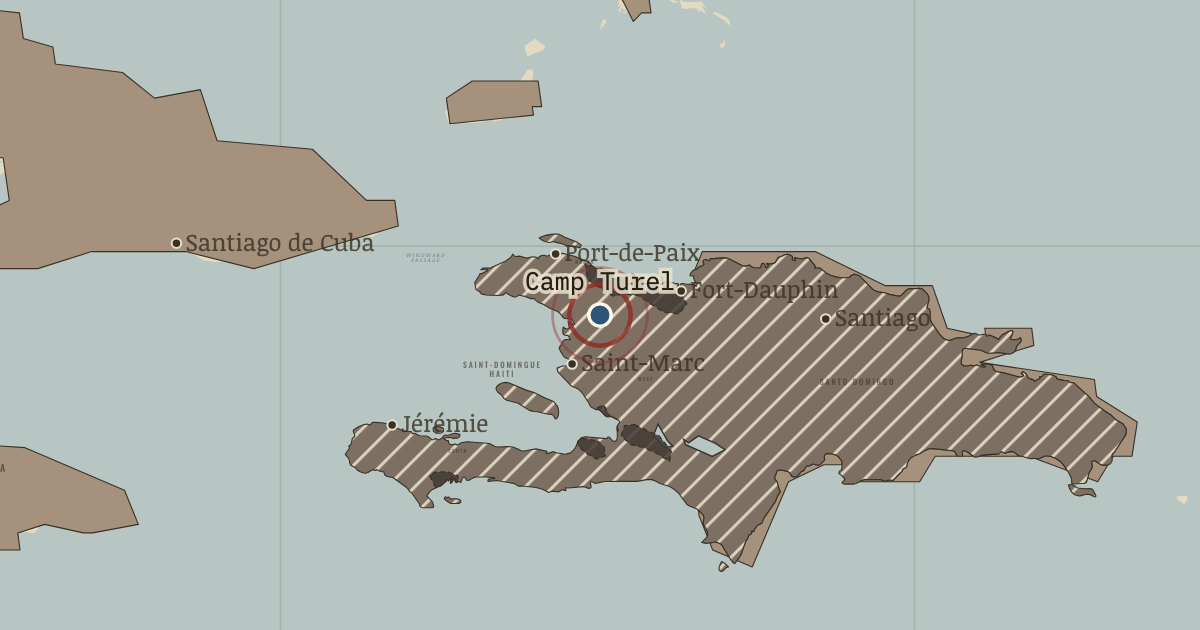
Proclamation of Camp Turel
29 Aug 1793 — From his camp in the hills, Toussaint issues his first proclamation. He is fighting for Spain at the time, but declares that he wants liberty and equality to reign in Saint-Domingue. He signs the proclamation Louverture.
WW2 is free in full, and chapter 1 of every atlas is free. A free account opens 3 more chapters a day. Starter, at $9 a month, opens all 21 with no daily limit — see the plans.
Free printable Haiti and Kenya independence study guide, sent by email ↓
The moment in context
The struggle for Saint-Domingue put the meaning of freedom into the hands of rival powers. In 1793 Spain paid northern insurgent leaders as auxiliaries, or allied fighters on a salary. Planters in the West and South invited British troops to Jérémie and the Môle, hoping to preserve slavery. France’s commissioner Sonthonax, holding Le Cap with too few soldiers, sought fighters by offering them freedom. On 29 August he proclaimed general emancipation in the North, invoking the words “men are born and remain free and equal in rights”.
From Toussaint Louverture, chapter 3 of Two Roads to Independence: Haiti 1789–1838 and Kenya 1895–1978 (1801).
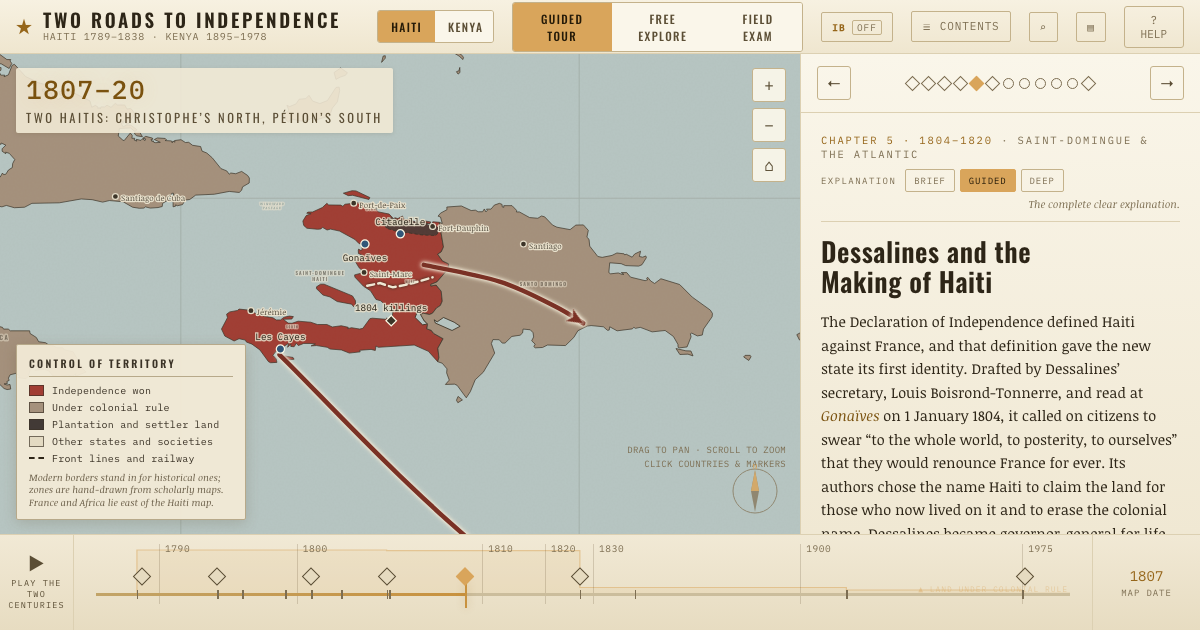
The place: Proclamation of Camp Turel — map and full story →
Teach this in 5 minutes
- Why it happened — Imperial war made freedom a weapon. France’s commissioners lacked the soldiers to hold Saint-Domingue against Spain and Britain in 1793. The insurgents offered a large army, and…
- The turn — The Constitution of 1801. The constitution adopted on 9 May 1801 and proclaimed in July gave Toussaint’s military rule a legal form. A law drafted in Saint-Domingue defined…
- What it changed — Napoleon decides to reconquer. Napoleon saw Toussaint’s constitution, occupation of Santo Domingo and independent diplomacy as grounds for restoring French control. The…
Then ask the room: Was Toussaint Louverture a liberator or a new master? The argued answer is on the chapter page →
The atlas that shows it
THE FREE PRINTABLE STUDY GUIDE
Get the printable study guide for Two Roads to Independence free. I’ll send you a few short letters, then one when a new atlas opens. That’s all. — Paul
NO TRACKING · YOUR ADDRESS IS USED FOR THE DISPATCH AND NOTHING ELSE · UNSUBSCRIBE ANYTIME