ON THIS DAY ·
Haitian Revolution begins in Saint-Domingue
On the night of 22–23 August the enslaved of Saint-Domingue’s northern plain rise. Within months more than a thousand estates lie in ruins, and the only successful slave revolution in history has begun.
WW2 is free in full, and chapter 1 of every atlas is free. A free account opens 3 more chapters a day. Starter, at $9 a month, opens all 21 with no daily limit — see the plans.
Free printable Haiti and Kenya independence study guide, sent by email ↓
The moment in context
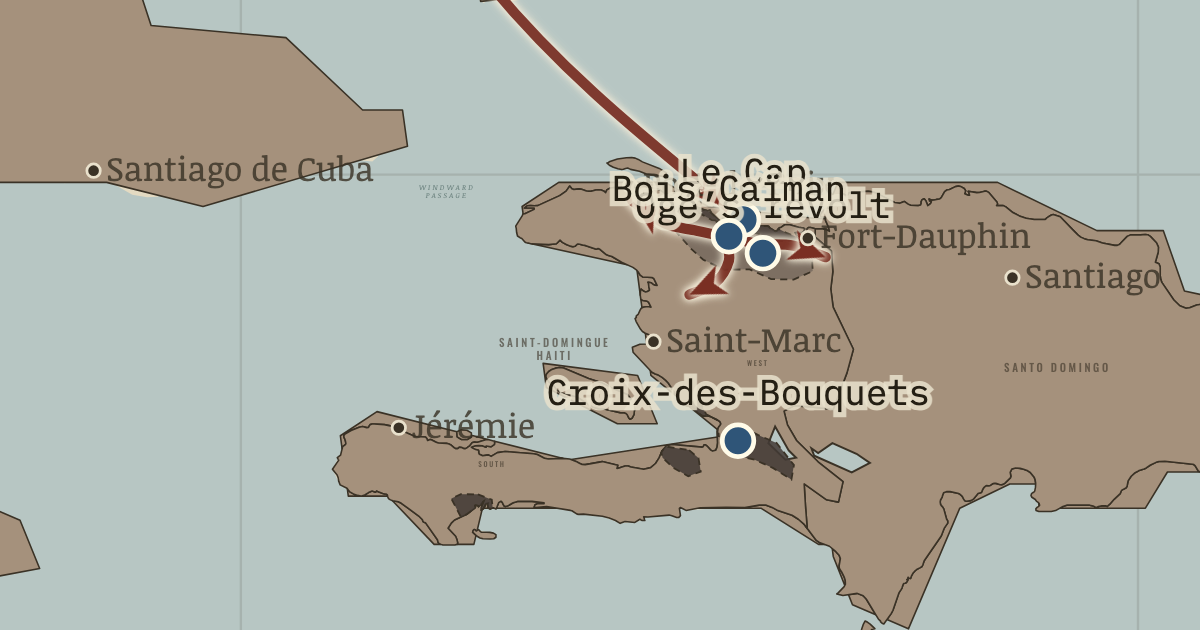
The Declaration gave Saint-Domingue's free groups a common language without giving them a common purpose. White planters elected colonial assemblies, councils rather like state legislatures, and the boldest at Saint-Marc in 1790 demanded control over colonial laws, including slavery and race. In Paris the Society of the Friends of the Blacks, an anti-slavery club founded in 1788, lobbied for the rights of free people of colour as a modern campaign group might lobby parliament. The planters' lobby fought those claims. Vincent Ogé, a merchant of colour who had argued for equality in Paris, returned secretly by the route shown by the northern arrow. In October 1790 he raised a few hundred armed men near Grande-Rivière; he did not call for abolition. Defeated within days, Ogé and his comrade Jean-Baptiste Chavannes escaped into Spanish Santo Domingo, whose officials handed them back. In February 1791 Ogé and Chavannes were broken on the wheel at Le Cap. The spectacle was meant to warn others; it also made the men martyrs.
From Outbreak of the Haitian Revolution, chapter 2 of Two Roads to Independence: Haiti 1789–1838 and Kenya 1895–1978 (1791).
Teach this in 5 minutes
- Why it happened — Rights declared for all and applied to few. The Assembly proclaimed rights for all men while depending on colonial trade and hesitating to apply that principle in Saint-Domingue. Its 1790 and…
- The turn — Bois Caïman and the night of 22 August 1791. Before August 1791 the future of Saint-Domingue was disputed by free people in Paris and the colonial assemblies. The rising following Bois Caïman…
- What it changed — War across the North. The insurgent armies held much of the northern plain and mountains through 1792 against colonial militias and troops from France. Leaders emerged…
Then ask the room: Did the French Revolution cause the Haitian Revolution? The argued answer is on the chapter page →
The atlas that shows it
THE FREE PRINTABLE STUDY GUIDE
Get the printable study guide for Two Roads to Independence free. I’ll send you a few short letters, then one when a new atlas opens. That’s all. — Paul
NO TRACKING · YOUR ADDRESS IS USED FOR THE DISPATCH AND NOTHING ELSE · UNSUBSCRIBE ANYTIME