MAPS OF HISTORY · ON THIS DAY · JULY 27 · Korean Armistice Agreement (1953)ON THIS DAY · 27 JULY 1953
Korean Armistice Agreement
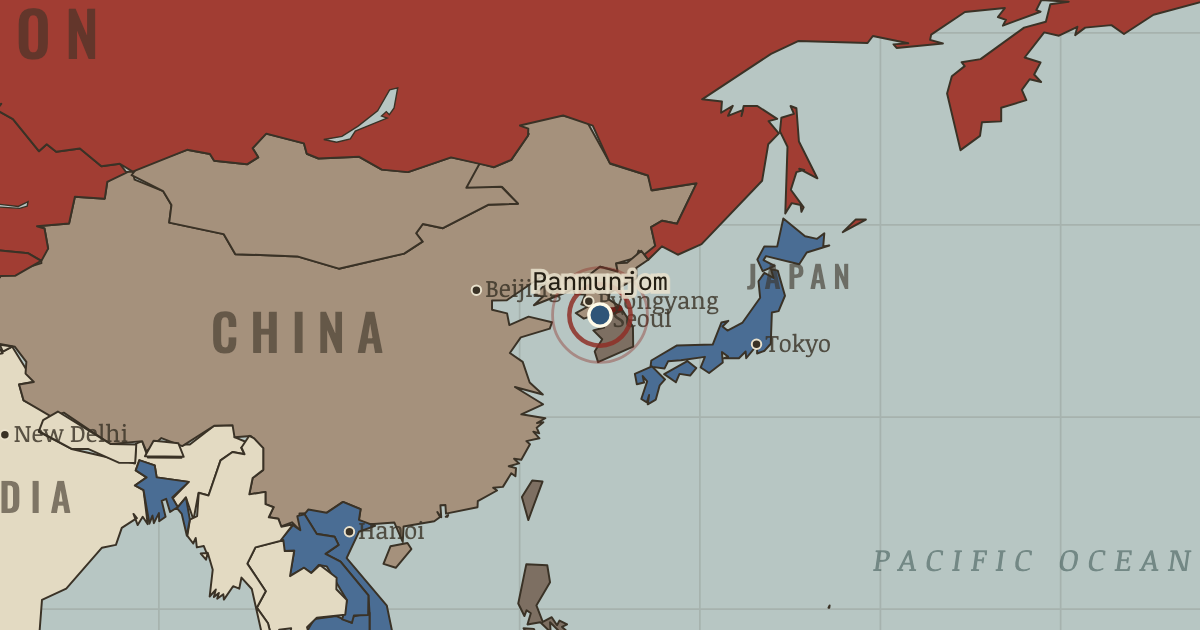
27 Jul 1953 — The fighting stops after two years of talks and slaughter along a static front. There is no peace treaty: a 4-km-wide scar remains where the war began, and it is still there.
27 JULY 1953 · THE COLD WAR, 1945–1991 These maps are reconstructed from published sources · The Berlin Airlift, 1948–1949 · North Atlantic Treaty: Algerian departments cease to apply from 3 July 1962 · Berlin’s four-power status and its termination · The rise and fall of the Berlin Wall · Cliopatria v0.2.1 historical polities · Decolonization of Asia and Africa, 1945–1960 · United Nations Command: the 1953 armistice · US Army Korean War campaigns · NATO membership chronology · Natural Earth v5.1.2 country geography · Natural Earth administrative references · The collapse of the Soviet Union · South Yemen: independence and alignment chronology · South Yemen: Soviet relationship, 1971 intelligence estimate
Source details US government historical publication. Historical facts cited; no source artwork or prose reproduced NATO, treaty footnote 2. Historical treaty facts cited; no artwork or prose reproduced US government historical publication. Historical facts cited; no source artwork or prose reproduced US government historical publication. Historical facts cited; no source artwork or prose reproduced Cliopatria contributors / Seshat Global History Databank. CC BY 4.0 · Selected dated records; documented component selection, unions and shared-edge extraction. US Department of State, Office of the Historian. US government publication United Nations Command. Historical facts cited; no source artwork or prose reproduced US government historical publication. Historical facts cited; no source artwork or prose reproduced NATO. Historical facts cited; no artwork or prose reproduced Natural Earth contributors. Public domain · Full source components and holes retained; documented historical unions and repairs. Natural Earth contributors. Public domain US Department of State, Office of the Historian. US government publication US Department of State. US government historical publication US Department of State, FRUS 1969–1976, volume XXIV, document 182. US government historical publication This political-alignment geography uses national and administrative extents; it does not map every military front. Modern-reference perimeters are explicitly recorded where no more suitable reviewed historical geometry was adopted. All source parts and holes are retained.
The Soviet, Yugoslav, Czechoslovak, Sudanese and other historical unions remove later internal borders. Occupation and armistice lines retain their separate meanings.
South Yemen uses the 1969 source as a geographic proxy for earlier Aden/protectorates. The boundaries and status of individual protectorates are not resolved at this scale.
Morocco uses the nearest independent 1956 outer perimeter. The separate French/Spanish protectorate boundary lies outside this political-alignment layer, and Cape Juby remains in the Spanish source footprint until 1958.
Dated assignments correct omissions across the legacy views: independent Algeria is non-aligned after July 1962; Greece and Turkey join NATO in 1952, and Spain in 1982. South Yemen is separate from North Yemen, with British administration before late 1967 and the Soviet-aligned Marxist government after 1969.
The narrative date for the chapter is 1953.6; the displayed source state is the named w53 timeline reference. Each layer records its date-specific source intervals and nearest-date choices.
proxy: 1945–1990, later municipal exterior reference · proxy: Natural Earth v5.1.2 contemporary reference · proxy: Pre-1963 Netherlands New Guinea; later provincial reference · reconstruction: 1945–1958 · reconstruction: 1945–1960 · reconstruction: 1945–1962 · reconstruction: 1945–1991 · reconstruction: 1945–1991 geographic union · reconstruction: 1950–1957 · reconstruction: 1952–1991 · reconstruction: 1953 · reconstruction: 1953–1963 · reconstruction: 1953–1972 · reconstruction: Before May 1963 · reconstruction: Postwar Yugoslav reference · reconstruction: Pre-1963 North Borneo; later coast/reference exterior · vector: 1936–1986 · vector: 1945–1957 · vector: 1946–1946 · vector: 1948–1962 · vector: 1949–1952 · vector: 1953–1955 · vector: 1953–2023 · vector: 1956–1957 · vector: 1958–1960 · vector: 1969–1986
Layer records and reconstruction methods
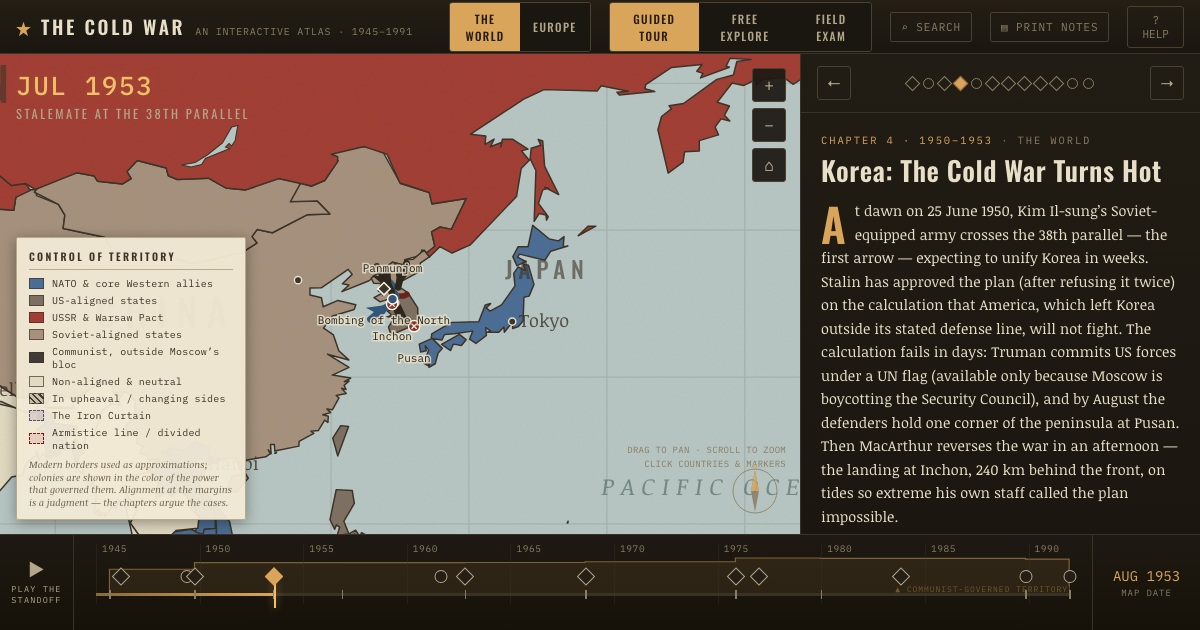
The moment in context Kim Il-sung expected his invasion of South Korea to be a three-week war of liberation. He believed people in the South would rise to welcome his army. Stalin had previously resisted an attack, but the Soviet bomb and the communist victory in China made the risk look cheaper. Secretary of State Dean Acheson’s January account of the existing American Pacific defense perimeter had left Korea outside its stated line, giving Kim and Stalin reason to think Washington might stand aside. It did not.
From Korean War , chapter 4 of The Cold War, 1945–1991 (AUG 1953).
The place: Korean Armistice Agreement — map and full story →
Teach this in 5 minutes Why it happened — Estimates that compounded one another. Kim promised a three-week victory and expected South Koreans to welcome his troops. Stalin, having refused earlier requests, reconsidered after the…The turn — Inchon, 15 September 1950. The Inchon landing placed North Korean forces between MacArthur’s troops and defenders breaking out from Pusan. Within two weeks they disintegrated.…What it changed — A larger military Cold War. Korea made defense increases associated with NSC-68 politically attainable. Congress supported them, and US defense spending rose from approximately…Then ask the room: Would stopping at the 38th parallel in October 1950 have been wiser? The argued answer is on the chapter page →
The atlas that shows it
THE FREE PRINTABLE STUDY GUIDE
Get the printable study guide for The Cold War free. I’ll send you a few short letters, then one when a new atlas opens. That’s all. — Paul
NO TRACKING · YOUR ADDRESS IS USED FOR THE DISPATCH AND NOTHING ELSE ·
UNSUBSCRIBE ANYTIME