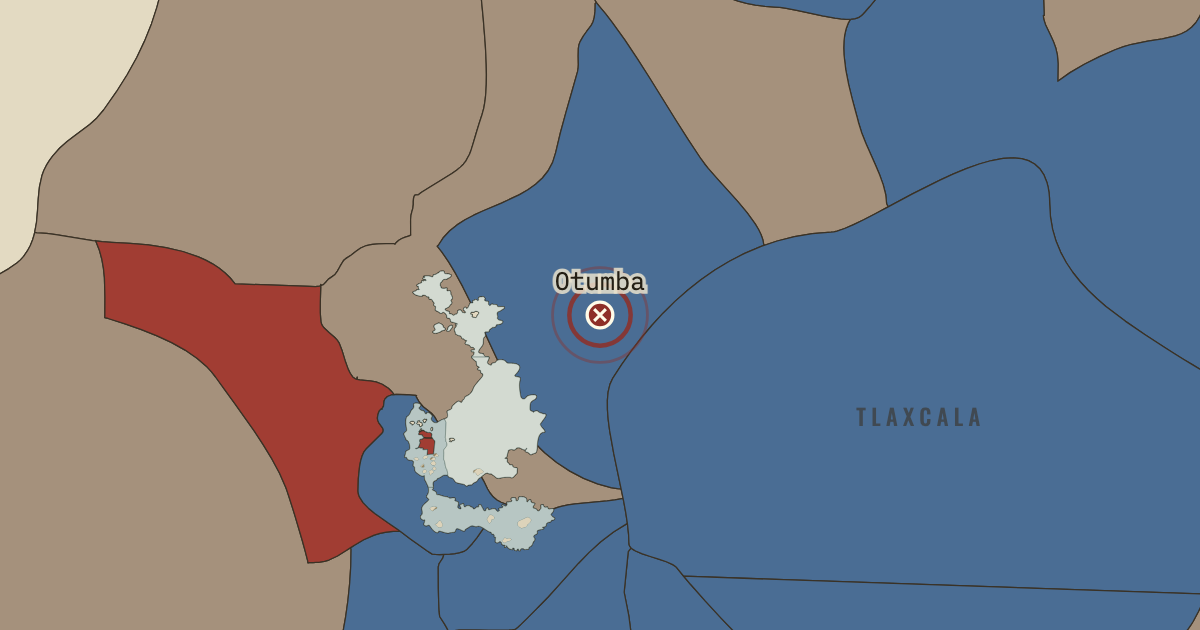
7 July 1520 — Only days after fleeing Tenochtitlan, the battered Spaniards and their allies faced a Mexica army on the plain of Otumba. They broke through, reportedly by striking at its commanders, and soon afterward reached safety in Tlaxcala.
WW2 is free in full, and chapter 1 of every atlas is free. A free account opens 3 more chapters a day. Starter, at $9 a month, opens all 21 with no daily limit — see the plans.
7 JULY 1520 · CLIMATE AND INNOVATION: THE NORSE AND THE AZTECS, C. 790–1521
The moment in context
Why did the Triple Alliance leave Tlaxcala and its neighbors outside its empire while fighting them repeatedly? The answer depends on whom we believe. Fernando de Alva Ixtlilxochitl says that in 1454, the last year of the great famine, rulers agreed to fight Tlaxcala, Huexotzinco and Cholula on fields usually near Atlixco. The combatants would take captives for sacrifice without taking each other's lands. Diego Durán credits the adviser Tlacaelel with the idea. Ross Hassig sees repeated fighting as a relatively cheap way to wear down strong enemies; Barry Isaac treats the ritual story as a later explanation for failure to conquer them. Meanwhile, tributary provinces encircled Tlaxcala. Tlaxcalans told the Spaniards that the blockade had deprived them of salt and cotton. Whatever the wars' purpose, their result was an independent neighbor with a long grievance.
From Fall of the Aztec Empire, chapter 11 of Climate and Innovation: The Norse and the Aztecs, c. 790–1521 (1521).
Why it happened — Tribute and encirclement created enemies. The tribute that fed Tenochtitlan came from conquered communities that retained their own rulers. Totonac lords complained about its collectors.…
The turn — Tlaxcala chooses alliance, September 1519. Tlaxcala's rulers chose alliance with Cortés in September 1519 after fighting his small force and negotiating with him. Their decision belonged to…
What it changed — The fall of Tenochtitlan. Tenochtitlan fell on 13 August 1521, when Cuauhtemoc, its last ruler, was captured on the lake. Hunger, thirst, disease and violence had killed tens…
Then ask the room: Why did the Mexica system, so effective against the environment, prove so vulnerable to its human enemies? The argued answer is on the chapter page →