ON THIS DAY ·
Marco Polo Bridge Incident
A skirmish at the Marco Polo Bridge outside Beijing ignites full war between Japan and China — the Second World War’s first front.
WW2 is free — every chapter. No sign-up.
The moment in context
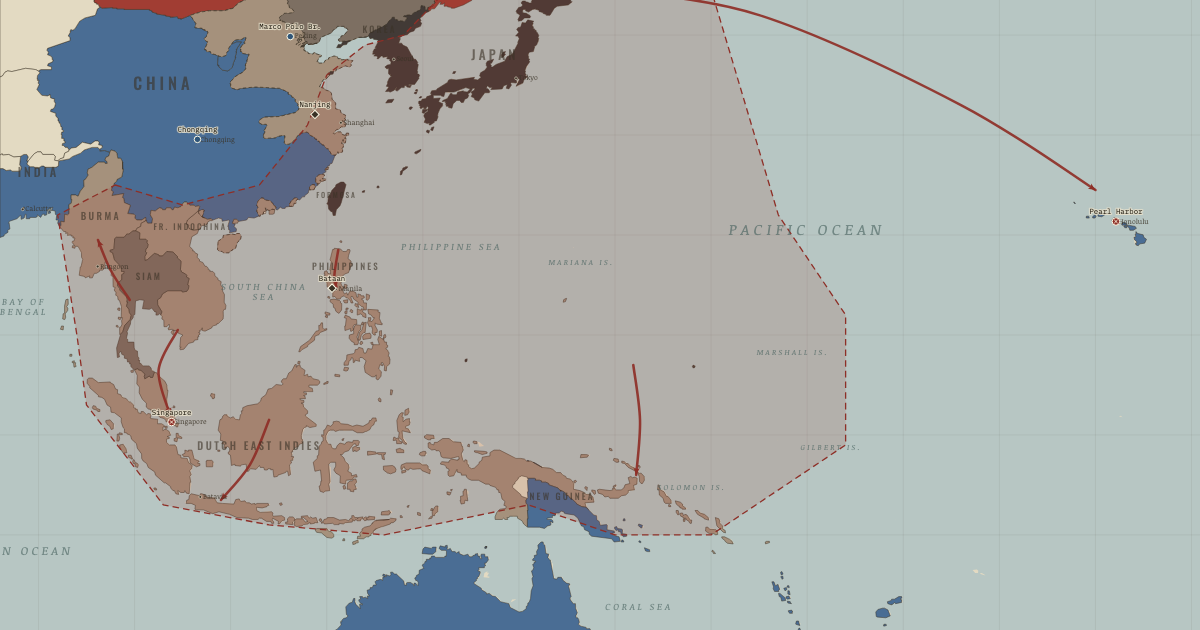
Japan’s war in China had already lasted four years when its leaders decided to attack the United States. Japan had seized Manchuria in 1931 and launched a full-scale invasion of China in 1937. Its armies took coastal cities and railways, but these victories did not bring surrender: the Chinese government withdrew inland to Chongqing and continued the war.
From Japanese expansion and Pearl Harbor, chapter 7 of The War Room — WW2, 1936–1945 (MAY 1942).
Teach this in 5 minutes
- Why it happened — An empire built on imported oil. Japan depended on imports for 80% of its oil, mostly from the United States. After the move into Indochina, the July 1941 embargo cut that supply.…
- The turn — Pearl Harbor, 7 December 1941. Japan achieved surprise, hitting eight battleships for the loss of 29 aircraft. Yet the carriers were at sea, and the oil tanks and shipyards were…
- What it changed — The sleeping giant. American industry was only one-tenth mobilized when war began, but within a year it out-produced the Axis. By 1944 the United States launched more…
Then ask the room: How could Pearl Harbor be a successful surprise attack and a strategic mistake? The argued answer is on the chapter page →
The atlas that shows it
THE FREE PRINTABLE STUDY GUIDE
Get the printable study guide for WW2 free. I’ll send you a few short letters, then one when a new atlas opens. That’s all. — Paul
NO TRACKING · YOUR ADDRESS IS USED FOR THE DISPATCH AND NOTHING ELSE · UNSUBSCRIBE ANYTIME