ON THIS DAY ·
Battle of Waterloo
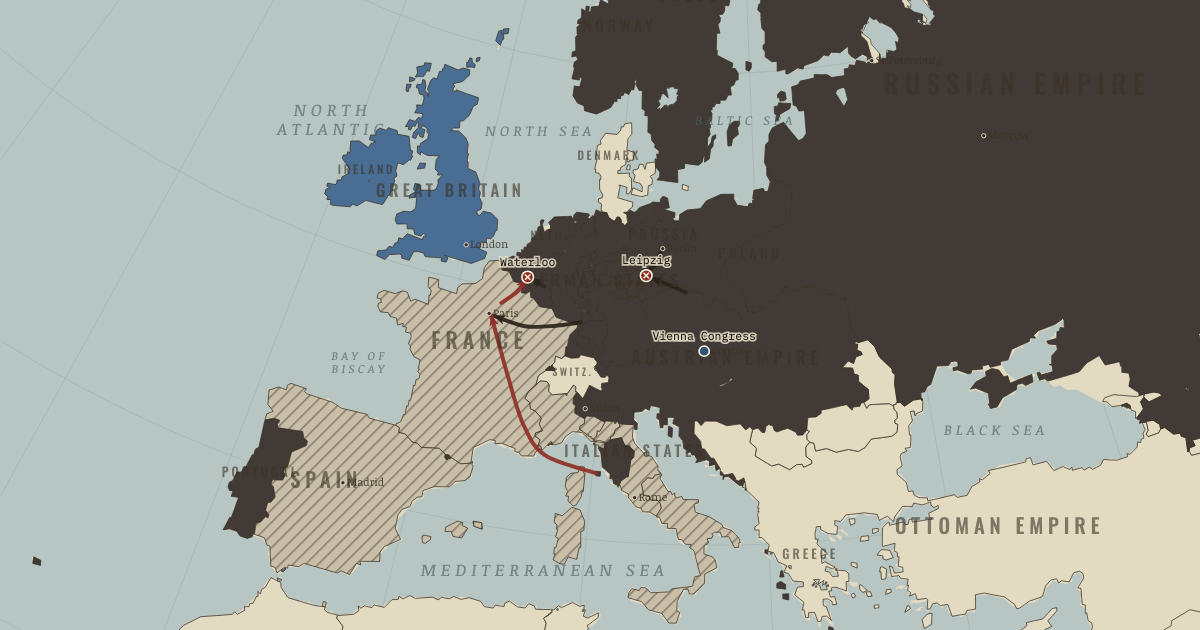
Waterloo. Napoleon’s last army breaks against Wellington’s ridge and Blücher’s evening arrival.
WW2 is free in full, and chapter 1 of every atlas is free. A free account opens 3 more chapters a day. Starter, at $9 a month, opens all 21 with no daily limit — see the plans.
Free printable Age of Revolutions study guide, sent by email ↓
The moment in context
The powers fighting Napoleon had repeatedly discovered how dangerous it was to act separately. By 1813 Russia, Prussia, Austria and Sweden were bringing their armies into a common effort, sustained in part by British finance. At Leipzig in October their forces converged on Napoleon and outnumbered him. They continued the battle despite local setbacks, while several of his German allies changed sides. The retreat that followed destroyed the French satellite system east of the Rhine.
From Fall of Napoleon, chapter 9 of The Age of Revolutions, 1775–1848 (JUN 1815).
Teach this in 5 minutes
- Why it happened — The coalition learned to cooperate. Napoleon had profited when his opponents fought and made peace separately: he could turn against one before another was ready. By 1813 the powers…
- The turn — Leipzig, 16–19 October 1813. Waterloo ended Napoleon’s return, but Leipzig had already broken the system that protected his empire. On 16–19 October 1813 he faced forces roughly…
- What it changed — Consultation and intervention. Meetings of the Concert at Aix-la-Chapelle, Troppau and Verona gave the powers a way to consult. Cooperation could serve another purpose too. Some…
Then ask the room: Was the Congress of Vienna a masterpiece of statecraft or a conspiracy against the future? The argued answer is on the chapter page →
The atlas that shows it
THE FREE PRINTABLE STUDY GUIDE
Get the printable study guide for The Age of Revolutions free. I’ll send you a few short letters, then one when a new atlas opens. That’s all. — Paul
NO TRACKING · YOUR ADDRESS IS USED FOR THE DISPATCH AND NOTHING ELSE · UNSUBSCRIBE ANYTIME