ON THIS DAY ·
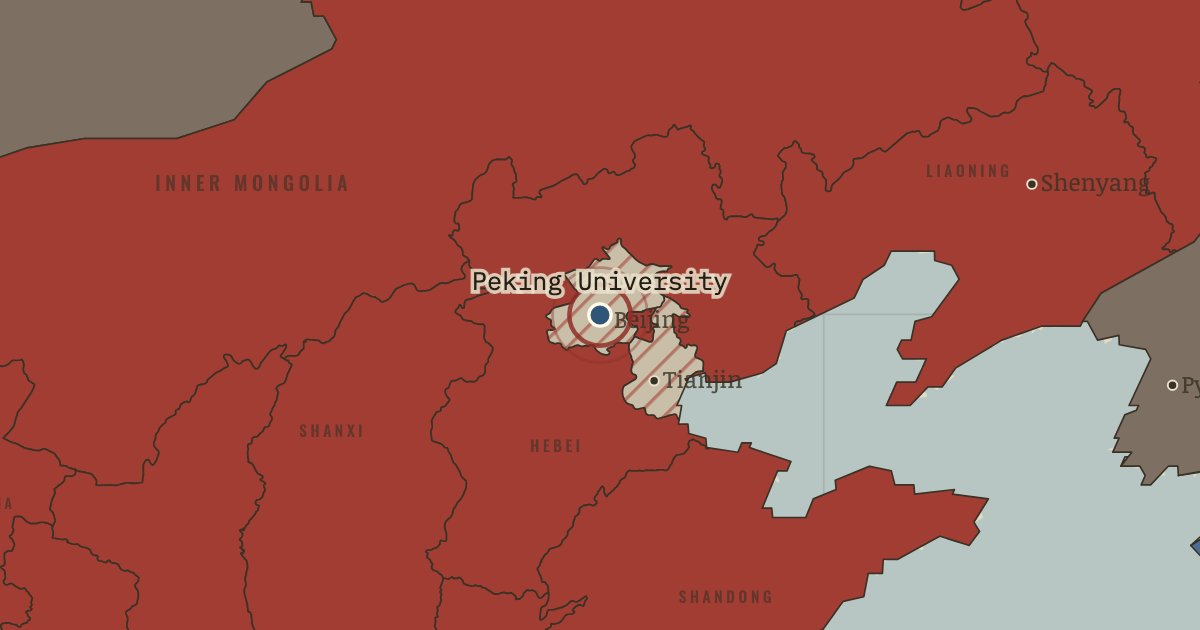
Peking University student protests
19 May 1957 — On a wall they call the “Democratic Wall”, Peking University students paste big-character posters asking why the Party stands above the law. Lin Xiling, a student, tells packed meetings that the system itself is responsible for the faults. Within weeks the posters became evidence against their authors. Lin was labelled a rightist and spent fifteen years in prison.
WW2 is free in full, and chapter 1 of every atlas is free. A free account opens 3 more chapters a day. Starter, at $9 a month, opens all 21 with no daily limit — see the plans.
The moment in context
In 1956 Communist leaders faced a disturbing question: what happened when a party’s mistakes could no longer be discussed openly? Khrushchev’s secret speech in February condemned Stalin, showing that a Communist leader could be judged by his own party. Later that year, risings in Poland and Hungary showed the danger of accumulated grievances. Mao believed China could respond differently, by hearing complaints before they produced an explosion.
From Hundred Flowers Campaign, chapter 5 of The People’s Republic under Mao, 1949–1976 (1957).
The place: Peking University student protests — map and full story →
Teach this in 5 minutes
- Why it happened — Khrushchev’s secret speech. On 25 February 1956 Khrushchev told the Soviet party congress that Stalin had been a criminal and a self-glorifying tyrant. His successors had…
- The turn — 8 June and 1 July 1957. The People’s Daily editorials of 8 June and 1 July 1957 converted a public invitation into a hunt. The Party had asked to be corrected; it now…
- What it changed — No one left to warn. The Great Leap Forward began in 1958 after economists, engineers, statisticians and journalists who might have exposed its impossible targets had…
Then ask the room: Was the Hundred Flowers campaign a genuine opening that failed, or a deliberate trap? The argued answer is on the chapter page →
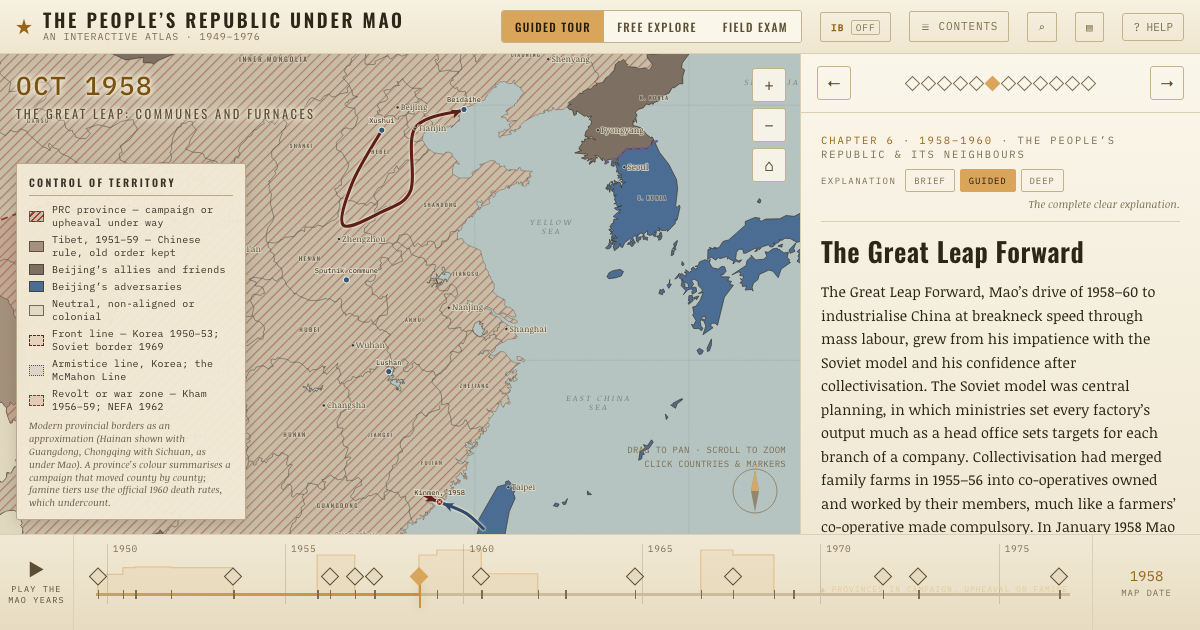
The atlas that shows it
THE FREE PRINTABLE STUDY GUIDE
Get the printable study guide for The People’s Republic under Mao free. I’ll send you a few short letters, then one when a new atlas opens. That’s all. — Paul
NO TRACKING · YOUR ADDRESS IS USED FOR THE DISPATCH AND NOTHING ELSE · UNSUBSCRIBE ANYTIME