ON THIS DAY ·
Treaty of Frankfurt
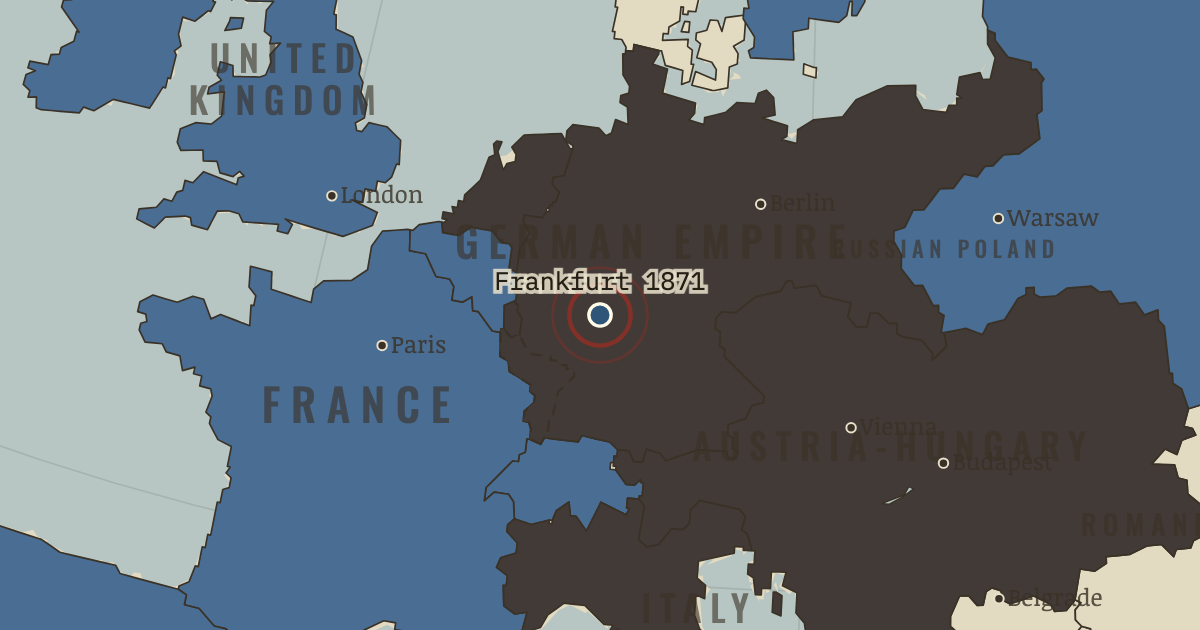
10 May 1871 — Under the Treaty of Frankfurt, France gives up Alsace and most of Lorraine and must pay an indemnity of five billion francs. German troops are to remain on French soil until the debt is paid. France pays it early, by September 1873, but the loss of the provinces remains unacceptable to it.
WW2 is free in full, and chapter 1 of every atlas is free. A free account opens 3 more chapters a day. Starter, at $9 a month, opens all 21 with no daily limit — see the plans.
The moment in context
Bismarck wanted Germany to belong to the larger group in a Europe of five great powers. France had lost Alsace and Lorraine to Germany in 1871; if it found a strong partner, it might try to recover them by force. Germany therefore needed good relations with both Austria-Hungary, the Habsburg empire ruled from Vienna, and Russia. In 1873 the three emperors formed a league to consult and preserve peace. Their interests were hardest to reconcile in the Balkans, where both Austria-Hungary and Russia sought influence as the Ottoman Empire, ruled from Constantinople, retreated. Russia’s victory over the Ottomans in 1878 seemed likely to give it a large client Bulgaria. The powers reduced Bulgaria at the Congress of Berlin, and Russia blamed Germany. Bismarck then made a choice that complicated his own task: the secret Dual Alliance of 1879 promised Austrian defense against Russia. Italy joined in 1882, creating the Triple Alliance.
From Alliance system before WWI, chapter 1 of The Great War, 1871–1923 (AUG 1907).
The place: Treaty of Frankfurt — map and full story →
Teach this in 5 minutes
- Why it happened — A new giant in the middle of Europe. The new Germany changed the scale of the European problem. Its population grew from about 41 million in 1871 to about 65 million by 1910, while…
- The turn — Kronstadt, July 1891. The French squadron at Kronstadt in July 1891 offered a striking public sign of Russia’s change of direction. Only thirteen months after the German…
- What it changed — A war plan built on two fronts. The Franco-Russian alliance made a two-front war central to German planning. Alfred von Schlieffen’s answer, set out by 1905 and put into action in…
Then ask the room: Did Bismarck’s alliance system keep the peace, or did it build the trap that closed in 1914? The argued answer is on the chapter page →
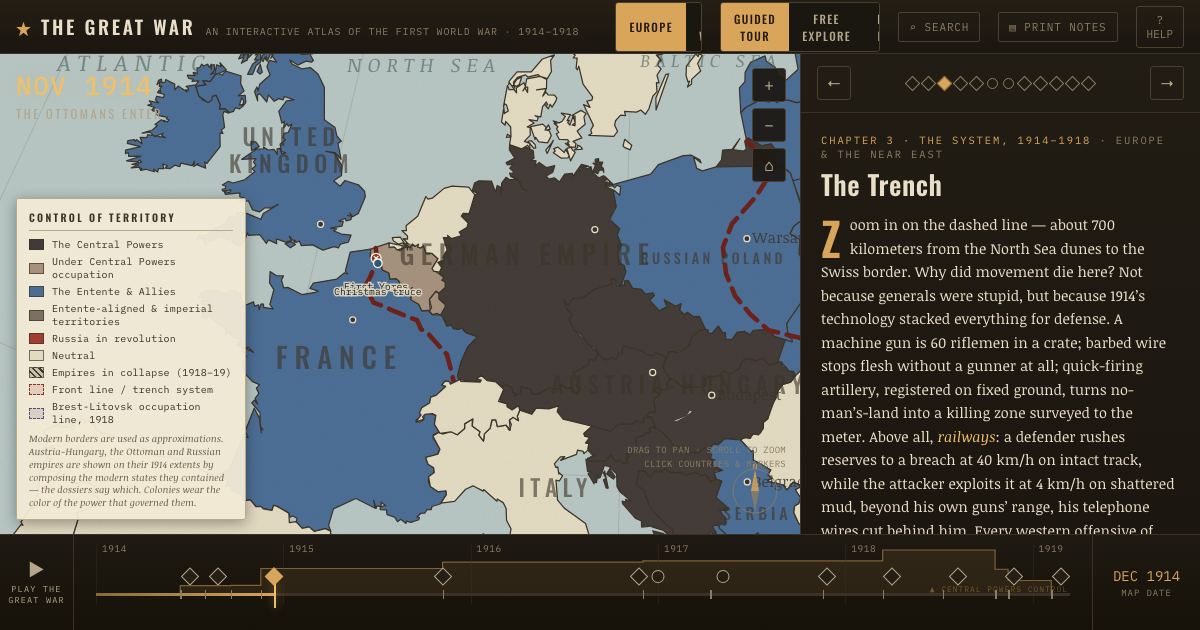
The atlas that shows it
THE FREE PRINTABLE STUDY GUIDE
Get the printable study guide for WWI free. I’ll send you a few short letters, then one when a new atlas opens. That’s all. — Paul
NO TRACKING · YOUR ADDRESS IS USED FOR THE DISPATCH AND NOTHING ELSE · UNSUBSCRIBE ANYTIME