MAPS OF HISTORY · ON THIS DAY · April 21 · 1949
ON THIS DAY · 21 APRIL 1949
The Yangtze crossing
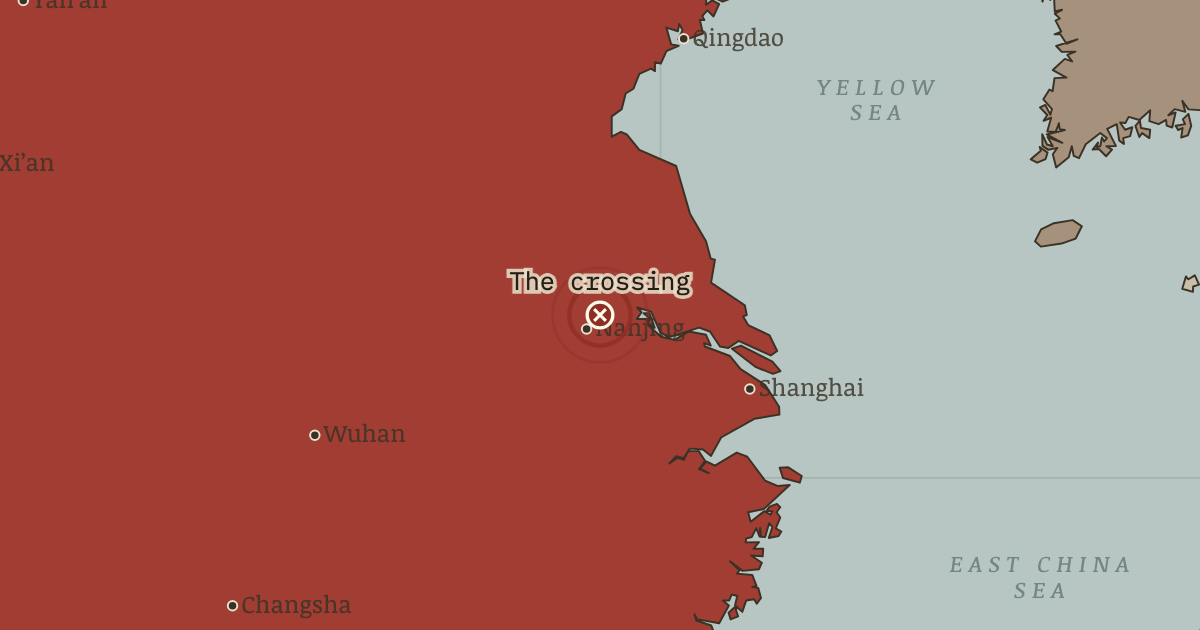
20–21 Apr 1949 — After peace terms lapse, a million men cross the river on junks and sampans on a 500-km front in two nights; Nanjing falls on the 23rd. The last great natural line of the war is passed almost without pause — the Nationalist army south of it exists mostly on paper.
THE MOMENT IN CONTEXT
The 1949 victory settled control of most of mainland China, yet it did not amount to a complete territorial settlement. The last campaign was a river crossing that met almost no one. On the night of 20–21 April 1949 (the ✕ on the Yangtze), after peace terms lapsed, a million men crossed on junks and sampans along a five-hundred-kilometer front. Nanjing fell on the 23rd, its government buildings emptied and the capital taken by soldiers who photographed each other in the presidential chair. Through the rest of the year the red columns ran south and west, Shanghai in May, Changsha and Lanzhou in August, Canton in October and Chungking in November, as provincial armies defected by the group and the “liberation” of the southwest became a procession. Xinjiang’s garrison crossed over in September, so the grey-tan plate that had sat in the map’s corner since 1912 went red without a battle. On 1 October, from the Gate of Heavenly Peace (the ● at Peking), Mao proclaimed the People’s Republic of China. Thirty-eight years separated the accidental bomb at Wuchang from that balcony, and the succession to the Qing was finally settled. The tide chart that had shown nothing for twenty years, a heartbeat at Ruijin, a flatline in 1934 and a hill-country smudge through the Japanese war, now ended at the top of its scale.
From Chapter 12 — The People’s Republic of China in Revolution, 1911–1949 (1949).
OPEN THE INTERACTIVE MAP →New here? Chapters 1–2 of every atlas are free to sample, and the WW2 atlas is free in full. One membership opens all thirteen — the Cartographer’s Circle.
TEACH THIS IN 5 MINUTES
- Why it happened — The war against Japan as the great reordering. In 1937 the CCP was forty thousand survivors in loess hills. In 1945 it was a million troops and ninety million people under some form of its…
- The turn — Tiananmen, 1 October 1949. Choose the balcony over the battles because it marks the thing the whole atlas has been about: not a victory but a succession — the moment a state…
- What it changed — The revolution starts governing. Within three years the new state does what no Chinese government had done in a century: unified currency, suppressed inflation, land reform…
Then ask the room: Why did Mao win and Chiang lose — and was Communist victory inevitable once Japan surrendered? The argued answer is on the chapter page →
THE ATLAS THAT SHOWS IT
THE DISPATCH
One short letter when a new atlas opens — and the printable study guide for China in Revolution is yours now, free.
NO TRACKING · YOUR ADDRESS IS USED FOR THE DISPATCH AND NOTHING ELSE · UNSUBSCRIBE ANYTIME