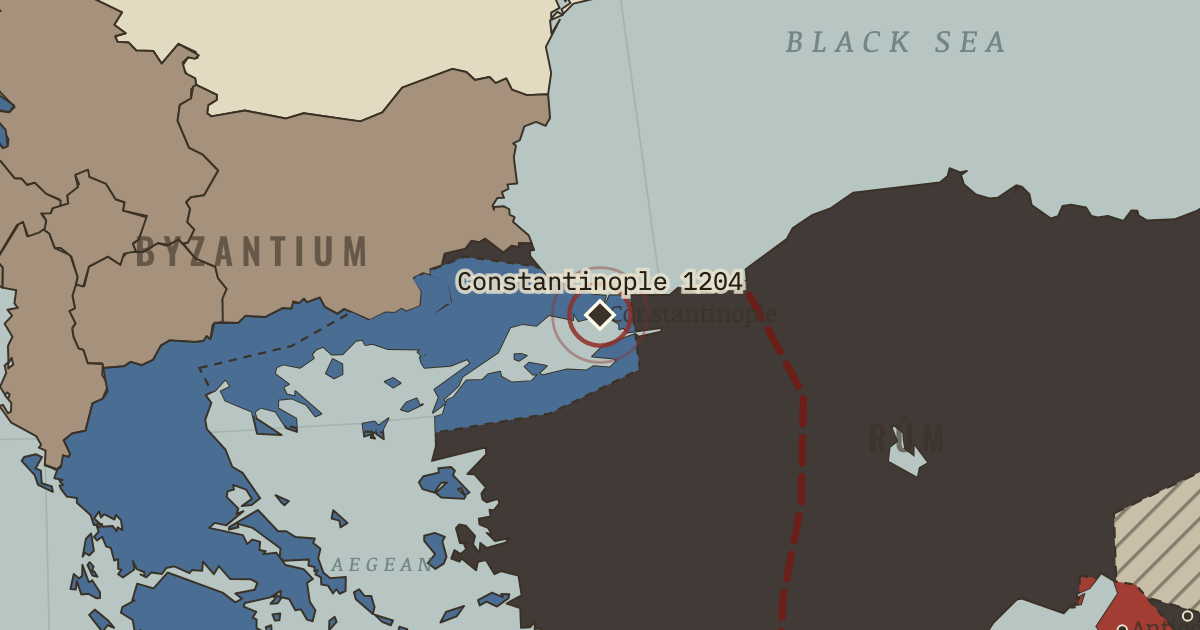
12–13 Apr 1204 — an expedition launched against Islam storms and pillages Constantinople, the greatest Christian city on earth. Relics and the bronze horses of San Marco are carried to Venice, and Byzantium is fatally maimed. This is a site of memory.
WW2 is free in full, and chapter 1 of every atlas is free. A free account opens 3 more chapters a day. Starter, at $9 a month, opens all 21 with no daily limit — see the plans.
The Fourth Crusade was supposed to strike Egypt. Saladin had drawn on its resources, and Richard had identified it as a key to securing Jerusalem. To reach it, the leaders made a contract at Venice in 1201 for a fleet large enough to carry far more men than eventually assembled. Venice built the ships and suspended much of its ordinary commerce for the undertaking. When the smaller army arrived, it could not pay the agreed price; without the fleet, it could not sail. Venice had both a substantial claim and power over the expedition’s next move.
From Fourth Crusade, chapter 8 of The Crusades, 1095–1291 (1204).
Why it happened — The Venetian debt. The leaders contracted for a fleet larger than the crusade that assembled could afford. They needed Venice’s ships but could not pay the agreed…
The turn — The pretender’s bargain, 1203. The leaders accepted Alexios’s offer in 1203 and sent the fleet toward Constantinople. His promised money, troops and church union made the…
What it changed — Byzantium fatally weakened. The map shows the Byzantines recovering Constantinople in 1261. They returned to a fragmented and weakened empire, however. The losses of 1204…