ON THIS DAY ·
Ping-pong diplomacy
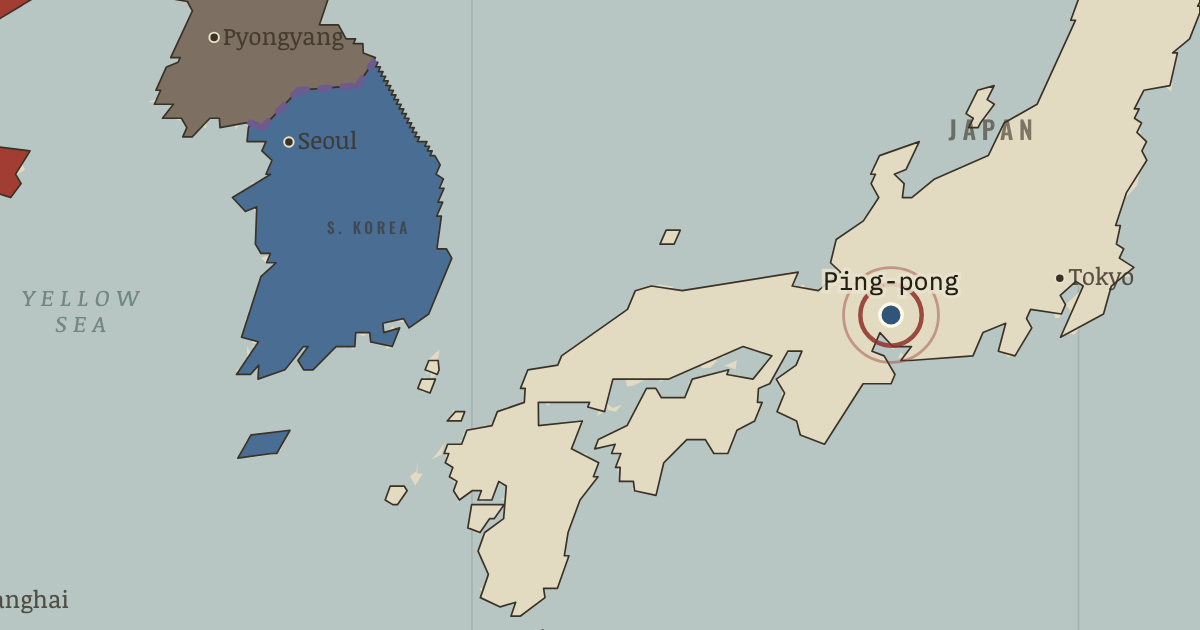
4 Apr 1971 — At the world championships in Nagoya, American player Glenn Cowan boards the Chinese team’s bus, where its star, Zhuang Zedong, greets him. Days later, Mao approves an invitation to the US team. Zhou Enlai receives the visitors in Beijing on 14 April, and Washington reads the signal at once.
WW2 is free in full, and chapter 1 of every atlas is free. A free account opens 3 more chapters a day. Starter, at $9 a month, opens all 21 with no daily limit — see the plans.
The moment in context
Mao’s relationship with Stalin helps explain why the Soviet leader’s condemnation in 1956 was so unsettling. Mao had resented Stalin’s treatment of him, yet he defended Stalin’s legacy when Khrushchev attacked it in a secret speech. A personality cult—the official worship of a living leader, rather like the reverence owed a divine king—was also part of Mao’s own authority. If Stalin could be condemned for such a cult, Mao might face the same criticism.
From Sino-Soviet split and Nixon in China, chapter 11 of The People’s Republic under Mao, 1949–1976 (1972).
The place: Ping-pong diplomacy — map and full story →
Teach this in 5 minutes
- Why it happened — Mao and Khrushchev read 1956 differently. Khrushchev’s condemnation of Stalin and peaceful coexistence with the West suggested to Mao that Moscow was retreating from revolution. The…
- The turn — Zhenbao Island, March 1969. Beijing planned the 2 March ambush on Zhenbao Island as a warning. The Soviet response on 15 March was heavy; the August clash at Tielieketi and…
- What it changed — Nixon in Beijing. Nixon’s week in China in February 1972 ended two decades of American refusal to deal with the People’s Republic. The Shanghai Communiqué set out…
Then ask the room: Why did Mao, the champion of world revolution, welcome Richard Nixon to Beijing in 1972? The argued answer is on the chapter page →
The atlas that shows it
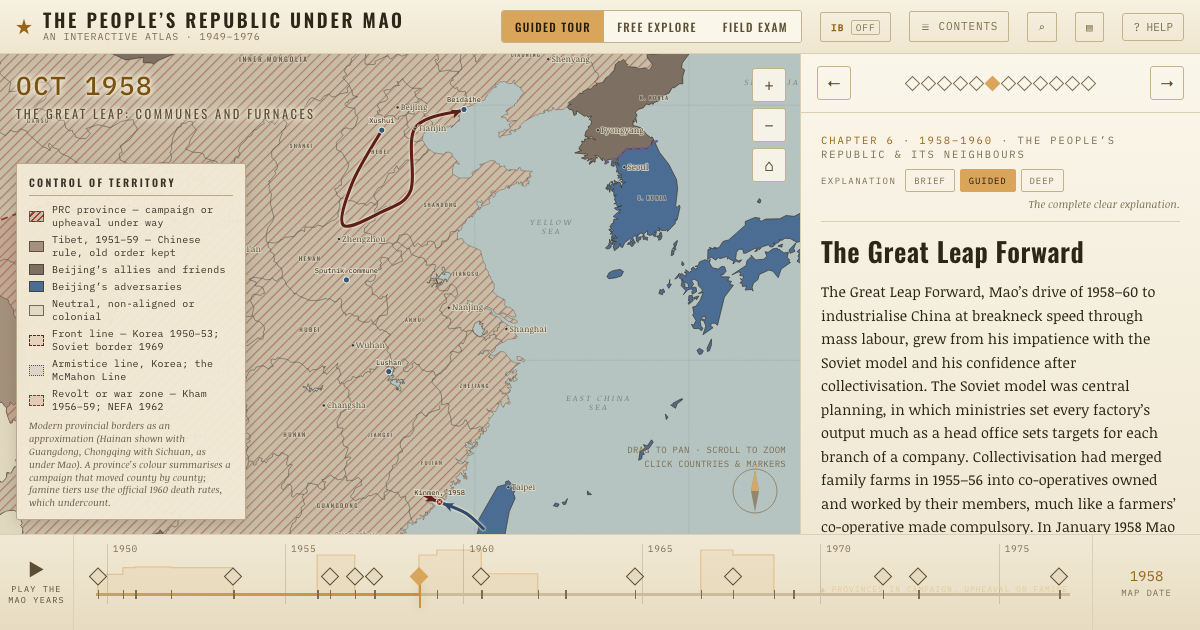
THE FREE PRINTABLE STUDY GUIDE
Get the printable study guide for The People’s Republic under Mao free. I’ll send you a few short letters, then one when a new atlas opens. That’s all. — Paul
NO TRACKING · YOUR ADDRESS IS USED FOR THE DISPATCH AND NOTHING ELSE · UNSUBSCRIBE ANYTIME