MAPS OF HISTORY · The Age of Revolutions · ALL CHAPTERS · CHAPTER 9
CHAPTER 9 · 1813–1815 · JUN 1815
The Fall
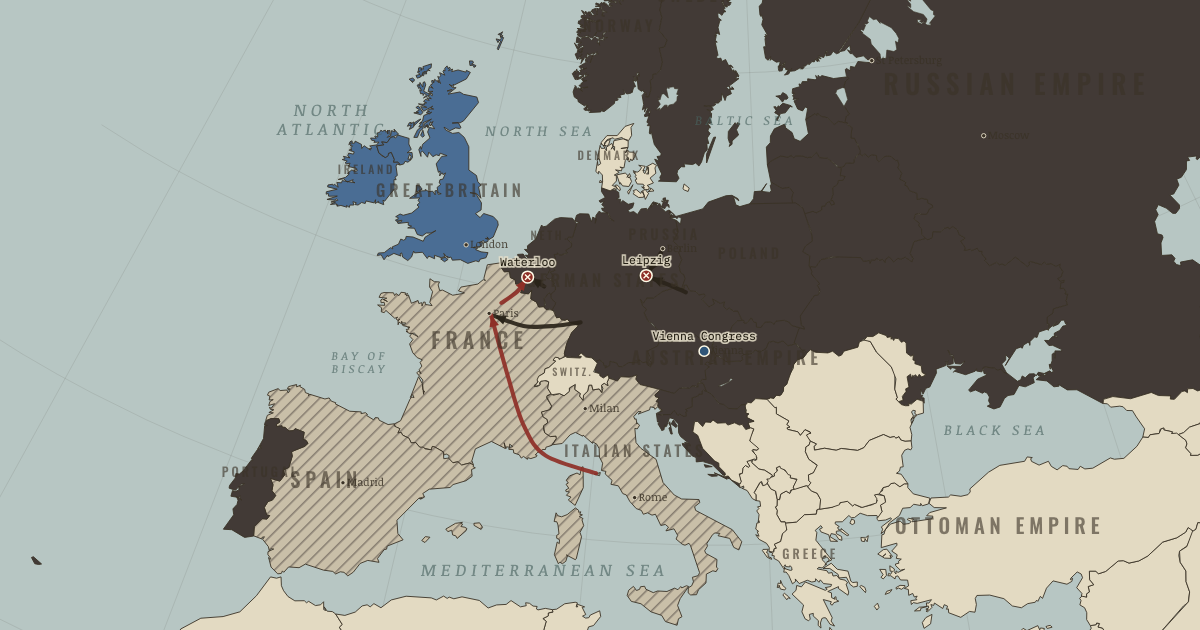
The map above is the world of JUN 1815 — The world restored.
BRIEF EXPLANATION — THE ESSENTIAL ARGUMENT
After Russia, Napoleon’s enemies finally coordinated. They adopted French mass warfare, accepted common aims and used the Trachenberg strategy: avoid Napoleon where he commanded personally, attack his marshals and maintain the coalition after setbacks. Leipzig in October 1813 broke French control of Germany.
The allies entered Paris in 1814 and restored the Bourbons. Napoleon returned from Elba but lost at Waterloo when Wellington held until Blücher arrived. At Vienna, the powers balanced states, contained France and created consultation. The settlement limited general war for decades while suppressing national and constitutional demands.
GUIDED EXPLANATION
The Sixth Coalition finally combined Russia, Prussia, Austria, Sweden and British finance into a single effort, and its armies had by now learned from France itself. At Leipzig in October 1813 their converging forces outnumbered Napoleon and, crucially, refused to dissolve after local setbacks, while several German allies defected in the middle of the battle. The French retreat that followed ended the satellite system east of the Rhine. In 1814 coalition troops entered Paris, and Napoleon abdicated once his own marshals refused to fight on.
Napoleon escaped Elba in March 1815 and regained France without an initial battle. At Waterloo on 18 June, Wellington’s army held a defensive ridge while Prussian forces recovered from Ligny and arrived on the French flank. The defeat ended the Hundred Days. The Congress of Vienna had already been designing the postwar map. France was contained but eventually readmitted, buffer states were strengthened and the great powers agreed to consult during crises. This balance helped prevent another continent-wide war until 1914. The tradeoff was political: dynastic “legitimacy” overrode Polish, Italian, German and other national claims, and intervention became a tool against revolution.
The map between Leipzig and the restored order reveals why Leipzig mattered more than Waterloo, because the satellite states vanish before France itself is invaded. The coalition had removed the network that supplied French troops and shielded French borders, and only then could it march on Paris. Vienna set about building a different network, this time of balancing powers and buffer states rather than dependencies. It did not restore the exact map of 1789; it kept the reforms that were useful and rearranged territory to prevent any single power from dominating again. Stability between states was bought at the price of fewer legal routes for subjects to revise the settlement.
DEEP EXPLANATION — EVIDENCE & INTERPRETATION
Napoleon’s enemies learned how not to lose
Earlier coalitions often fought separately and made peace separately. By 1813 survival required coordination. British subsidies supported continental armies; diplomats renewed common commitments; commanders used the Trachenberg Plan to avoid offering Napoleon his preferred decisive battle. Coalition warfare still involved rivalry, and battlefield execution was uneven, but no single defeat ended cooperation. This is organizational learning under repeated failure. French methods — corps, mass mobilization and national appeals — had also spread to opponents. Napoleon remained formidable; the environment around his talent changed. Leipzig was not simply genius declining. It was a system designed to defeat divided enemies meeting enemies who had copied its tools and repaired their political coordination. The map records the result. Explanation must also keep institutions, material pressure and political choice visible, because none of those forces worked alone.
The Vienna settlement solved one problem
Vienna’s negotiators prioritized preventing another bid for continental domination. They avoided permanently humiliating France, built buffers and created habits of consultation. Measured against great-power war, the settlement was remarkably durable. It did not require every act of domestic repression that followed. The same rulers linked external balance with internal dynastic security because they believed revolution had caused twenty years of war. That belief made constitutions and national movements international police matters. The settlement therefore solved an eighteenth-century problem — competition among great powers — while postponing nineteenth-century questions about representation and nationhood. Its durability and its coercion are not contradictory judgments; they refer to different objectives and different groups bearing the cost. That distinction prevents a dramatic moment from becoming a single-cause story. Revolutionary outcomes emerged through interacting interests, constraints and decisions over time.
New here? Chapters 1–2 of every atlas are free to sample, and the WW2 atlas is free in full. One membership opens all thirteen — the Cartographer’s Circle.
THE SITES
ON THIS DAY
WHY IT HAPPENED
The coalition finally fought as one. Twenty years of separate defeats taught the powers to subordinate rivalry to survival: unified command (Schwarzenberg), British subsidies underwriting everyone (£11 million in 1813 alone), and agreed war aims renewed at each setback (Chaumont, 1814: no separate peace). Napoleon’s system was built to beat coalitions in detail; the Trachenberg Plan simply refused to be beaten in detail. His enemies’ learning curve, not his decline, is the master variable of 1813.
The nations he awakened. The Leipzig armies were full of volunteers — German students, Prussian Landwehr, Russian serf-militia — fighting for fatherlands, a category French bayonets had taught them. The War of Liberation was the Revolution’s methods under the Restoration’s flags: the most dangerous legacy export in the atlas.
France’s exhaustion. A quarter-century of war: ~1.4 million French dead, conscription classes called years early, the 1813 cavalry mounted on requisitioned farm horses. When the allies crossed the frontier, the population that had risen in 1792 stayed home. Legitimacy spent is not refundable at the moment of invasion — the marshals’ mutiny of April 1814 was simply the account closing.
THE TURN
Leipzig, 16–19 October 1813. Waterloo is the famous name, but Waterloo only decided how the story ended twice; Leipzig decided that it ended. Outnumbered five to three, with allies defecting between assaults and one bridge as a line of retreat (blown early, drowning a rearguard and a marshal), Napoleon lost Germany, his satellite system, and any mathematical path to victory in three days. After Leipzig every later drama — 1814’s brilliance, Elba, the Hundred Days — is epilogue played for stakes already settled: the coalition had learned to win, and knew it.
WHAT IT CHANGED
A machine for peace, run by policemen. The Concert’s congresses (Aix-la-Chapelle, Troppau, Verona) become standing counter-revolutionary machinery: Troppau (1820) asserts a right of armed intervention against any revolution. Peace between states is purchased with a police system inside them — the exact trade Chapter 11 examines.
The hundred days that hardened the peace. France’s instant re-defection to Napoleon terrified the victors into the harsher second Treaty of Paris (indemnity, occupation) and into permanent vigilance. It also gave the Bourbons an unpayable debt to the ultras who returned with them — the White Terror and the reactionary drift that ends in 1830.
Britain banks the world. Alone undamaged, holding Malta, the Cape, Ceylon and maritime supremacy, Britain exits the wars as the globe’s banker, carrier and insurer — the blue on this map now backed by an industrial revolution no rival shares. Its chosen instrument henceforth is trade, not occupation: watch it applied to Latin America next chapter.
The veterans of the idea. Half-pay officers, disbanded volunteers, Carbonari, Decembrists, Greek klephts armed with surplus muskets: demobilization scatters men who have seen constitutions and nations-in-arms across a continent officially returned to 1789. The Restoration polices a Europe that remembers.
FIELD QUESTION — Was the Congress of Vienna a masterpiece of statecraft or a conspiracy against the future?
As great-power statecraft, Vienna was highly successful: it reintegrated France, balanced power and built consultation, helping prevent general war for decades. As a settlement of popular claims, it largely refused the future. Dynastic legitimacy overrode national and constitutional demands, and intervention protected rulers from subjects. The honest verdict depends on the objective measured. Vienna managed interstate rivalry better than revolutionary legitimacy. It created durable peace among governments while making later struggles over who could govern unavoidable.
AN INTERESTING FACT
The Congress of Vienna never actually convened: in nine months there was not a single plenary session — the map of Europe was redrawn in committees, salons and ballrooms, earning the Prince de Ligne’s verdict that “the Congress dances, but it does not march.” (Ligne died mid-Congress, in December 1814, having joked that he would at least give the delegates a new entertainment — the funeral of a field marshal.) The Final Act was signed on 9 June 1815, nine days before Waterloo: Europe’s new order was inked while the man it was built against marched on Brussels.
THE DISPATCH
One short letter when a new atlas opens — and the printable study guide for The Age of Revolutions is yours now, free.
NO TRACKING · YOUR ADDRESS IS USED FOR THE DISPATCH AND NOTHING ELSE · UNSUBSCRIBE ANYTIME