MAPS OF HISTORY · China in Revolution · ALL CHAPTERS · CHAPTER 5
CHAPTER 5 · 1927–1931 · 1929
The Purge and the Nanjing Decade
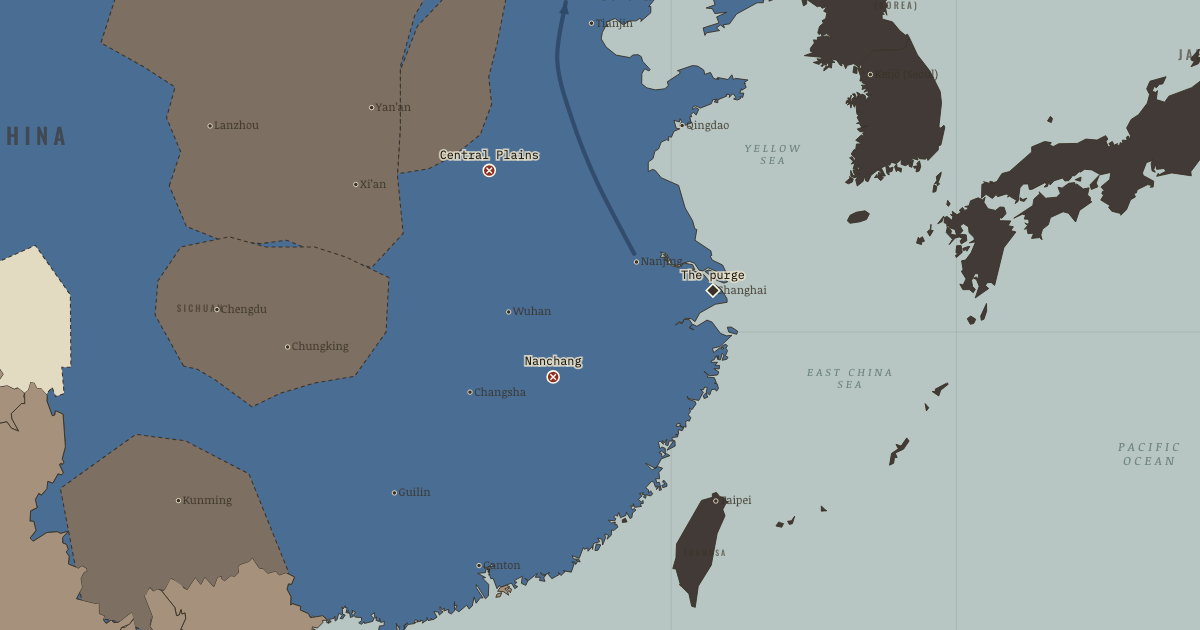
The map above is the world of 1928 — Peking taken — nominal reunification.
BRIEF EXPLANATION — THE ESSENTIAL ARGUMENT
In April 1927 Chiang Kai-shek’s forces and allied gangsters attacked Communists and unionists in Shanghai, ending the First United Front and driving the Communist survivors out of the cities. Failed uprisings at Nanchang and elsewhere then pushed them toward rural base areas, a forced relocation that quietly changed the social and military direction of the whole revolution.
Chiang completed the Northern Expedition in 1928, and Manchuria raised the Nationalist flag after Japan murdered Zhang Zuolin, yet reunification remained a bargain struck with regional commanders rather than a true conquest. Nanjing built banks, laws, universities and industry, but its reach was narrow and its spending fell heavily on the army, so that when Japan chose to test this brittle state it did so almost at once.
GUIDED EXPLANATION
The Nanjing Decade is the name given to the Nationalist government’s main period of state-building, from 1927 to 1937, and it opened with a betrayal that fixed the shape of everything after. On 12 April 1927, in Shanghai (the ◆ there), Chiang turned on his own allies. Green Gang enforcers and NRA soldiers killed hundreds of unionists and Communists in a single morning, and thousands more across the south in the following weeks, so that the First United Front died in its own moment of victory. The Communist answer came in August at Nanchang (the ✕), where Communist-led regiments seized the city for three days, an action from which the People’s Liberation Army still dates its founding. They failed, and the survivors under Zhu De trickled into the hills where Chapter 6 will find them. The consequence is the point to hold, because the purge drove the CCP out of the coastal cities where it had been born and into the countryside. There, after years of catastrophe, it would eventually discover the strategy that wins this atlas. None of the men who carried out the purge understood the favour they were doing their enemies.
While the purge unfolded, the map turned blue to its northern edge. The last arrow of the Northern Expedition reached Peking in 1928. Japan’s Kwantung Army, preferring its Manchurian client dead to defeated, then dynamited Zhang Zuolin’s train outside Mukden (the ● at Huanggutun). It miscalculated, because his son Zhang Xueliang raised the Nationalist flag over Manchuria that December. On paper China was now reunified under the Nanjing government, but the paper repays close reading. Yan Xishan still ran Shanxi, Feng Yuxiang the northwest and the Guangxi generals the far south. In 1930 they combined against Chiang in the Central Plains War (the ✕ at Zhengzhou), a struggle of a million men and the largest of the era, won partly by buying Zhang Xueliang’s army onto Chiang’s side. What Chiang actually governed was the lower Yangtze. There he pursued genuine state-building, a central bank, new legal codes, universities and the beginnings of industry, all of it braided with gangster finance, chronic deficits spent overwhelmingly on the army, and a party that had purged its own mobilizing wing. The decade is the era’s great counterfactual, since given twenty years it might have built a durable state, yet it would get four years before Japan moved and ten before Japan moved in full.
DEEP EXPLANATION — EVIDENCE & INTERPRETATION
The White Terror, measured
The scale of the purge is easy to under-feel behind the tidy word itself, so it is worth measuring. In Shanghai on 12 April 1927, and across the Nationalist south in the weeks that followed, the party and its Green Gang allies killed unionists and Communists in the thousands, and the Communist Party’s own membership, perhaps fifty-eight thousand early that year, fell to around ten thousand within twelve months, while the labour-union apparatus it had spent a decade building in the cities was effectively destroyed. That collapse is why the party which reassembled in the hills was a demographically different organism, younger, more rural and more military than before. Historians still argue over how much of the catastrophe to charge to Stalin, who had ordered the Communists to stay disarmed inside the alliance until the knives were already out, and the Comintern’s subsequent lurch into doomed risings at Nanchang and Canton reads less as strategy than as Moscow editing its own record. Beneath the debate lies the measurable fact that terror, rather than persuasion, expelled the revolution from the cities.
The rehearsal nobody punished
The murder of the Manchurian warlord Zhang Zuolin at Huanggutun in 1928 deserves study as a mechanism rather than as an isolated incident. Kwantung Army field officers assassinated their own government’s client, and Tokyo, unable or unwilling to court-martial the men responsible, effectively ratified the act. The lesson the army’s activists drew was exact, that an accomplished fact in Manchuria carried no cost. Historians of Japan’s “government by assassination,” a phrase coined by the journalist Hugh Byas, trace a chain of unpunished escalations, from Huanggutun in 1928 to the Mukden Incident in 1931 and the officers’ murders and coup attempts of 1932–36, in which each success made the next act of insubordination safer and civilian ministers who resisted were shot. Watching this dynamic in Chapter 5 explains why the Manchurian seizure of Chapter 6 was a scheduled escalation rather than a bolt from the blue, and it gives the atlas its clearest case study of a state losing control of its own army.
New here? Chapters 1–2 of every atlas are free to sample, and the WW2 atlas is free in full. One membership opens all thirteen — the Cartographer’s Circle.
THE SITES
ON THIS DAY
WHY IT HAPPENED
Class war inside the alliance. The peasant associations and Shanghai unions were not embarrassing excesses of the United Front — they were its left wing doing what it existed to do, and their targets were the landlord and merchant families from which the NRA officer corps came. By spring 1927 Chiang faced a choice between his army’s social base and his allies’ revolution. The purge was that choice made with knives. Its efficiency owed much to the Green Gang, whose underworld ran the very labor rackets the unions threatened.
Stalin’s China policy collides with China. Moscow ordered the CCP to stay in the front to the last moment — Stalin had staked his authority against Trotsky on the alliance — then swung to ordering insurrections (Nanchang, the Autumn Harvest risings, the Canton Commune of December 1927) after the front was already lost. Each rising was crushed. Each crushing was read in Moscow as proof more rising was needed. The CCP paid in cadres for a factional fight four thousand miles away. It also learned, in the person of Mao, a lasting suspicion of imported strategy.
Reunification by contract. The 1928 settlement was less conquest than franchise: Yan, Feng and the Guangxi clique kept their armies and provinces in exchange for flying Nanjing’s flag. Zhang Xueliang’s adherence was a negotiated coup against his father’s Japanese patrons. When Nanjing then tried to demobilize its franchisees’ armies (the 1929 conference), it got the Central Plains War instead. Chiang’s China was a coalition he had to keep re-purchasing — the fundamental weakness Japan would probe in 1931.
The Kwantung Army learns impunity. Huanggutun was murder as policy, committed by field-grade officers against their own government’s client — and Tokyo punished no one who mattered. The lesson absorbed by the army’s activists was that faits accomplis in Manchuria carried no cost, a lesson they would apply at scale in September 1931. Watch this mechanism across the atlas: every unpunished escalation is a rehearsal.
THE TURN
Shanghai, 12 April 1927. Everything after 1927 follows from this morning: it fixed the civil war as the axis of Chinese politics for twenty-two years, expelled the CCP into the countryside where its winning strategy would be found, and married the Nationalist state to the banks, gangs and landlords whose interests would cap its reforms. Chiang won the year completely. The terms of his victory scheduled the rematch. The most consequential decisions are often the ones that succeed.
WHAT IT CHANGED
The revolution goes rural. Driven from the cities, the Communist remnants converge on the mountainous borderlands where provincial authority runs out — Jinggangshan first, then the Jiangxi–Fujian border. There Mao and Zhu De begin composing the formula (land revolution + guerrilla war + base-area government) that the next chapter paints red.
A decade of real, brittle state-building. Nanjing builds a currency, tariff autonomy (recovered 1928–30), roads, a modern capital. It never breaks its dependence on Yangtze-delta finance and rural tax-farming. Lloyd Eastman’s ledger of the decade (factional, indebted, repressive) and the revisionists’ (genuine modernization under impossible conditions) are both drawn from true entries. Chapter 12 weighs them.
Manchuria becomes the fuse. Zhang Xueliang’s flag-raising put Japan’s continental investment under a nationalist government pledged to recover the treaty rights that investment depended on. The Kwantung Army now had motive, opportunity and proven impunity. The charcoal that floods the next chapter’s map is this chapter’s unfinished murder investigation.
FIELD QUESTION — Was the Nanjing decade a real modernization interrupted — or a façade that Japan merely exposed?
Eastman’s classic indictment (The Abortive Revolution) reads the decade as seeds of destruction: a party that had purged its idealists, government by factional balance, chronic deficits, tax power that stopped at the county town, and “reunification” resting on bought warlords. Revisionists — historians of the Maritime Customs, the fabi reform, the law codes, the universities — answer that no Chinese government since the 1830s had recovered so much sovereignty or built so much administrative machinery so fast, under permanent civil war and Japanese pressure. The honest synthesis is uncomfortable for both: the modernization was real and narrow — brilliant in Shanghai’s orbit, nearly absent in the villages where four-fifths of Chinese lived, which is precisely where the CCP was building its rival state. Judged as a race between two incomplete states rather than against an ideal, Nanjing was losing the countryside years before it lost a single city to Japan. When you evaluate a regime, ask not “did it modernize?” but “whom did its modernization reach?”
AN INTERESTING FACT
In November 1935 the Nanjing government pulled off one of the decade’s genuinely modern feats: it nationalized silver and replaced it with a managed paper currency, the fabi — ending several centuries in which China’s money was, in effect, weighed metal. The reform was forced by an American law (the 1934 Silver Purchase Act had driven up silver’s price and sucked coin out of China, strangling credit), executed with British advice, and it worked: prices stabilized and the new notes were accepted nationwide within months. The same instrument became the state’s undoing a decade later, when war finance by printing press turned the fabi into the great hyperinflation of 1947–49 — the tool and the fate in one banknote.
THE DISPATCH
One short letter when a new atlas opens — and the printable study guide for China in Revolution is yours now, free.
NO TRACKING · YOUR ADDRESS IS USED FOR THE DISPATCH AND NOTHING ELSE · UNSUBSCRIBE ANYTIME