MAPS OF HISTORY · THE QUESTIONS · Was the American crisis really about taxes?…
The Age of Revolutions, 1775–1848 · APR 1775
Was the American crisis really about taxes? The sums were trivial — a few pence on tea.
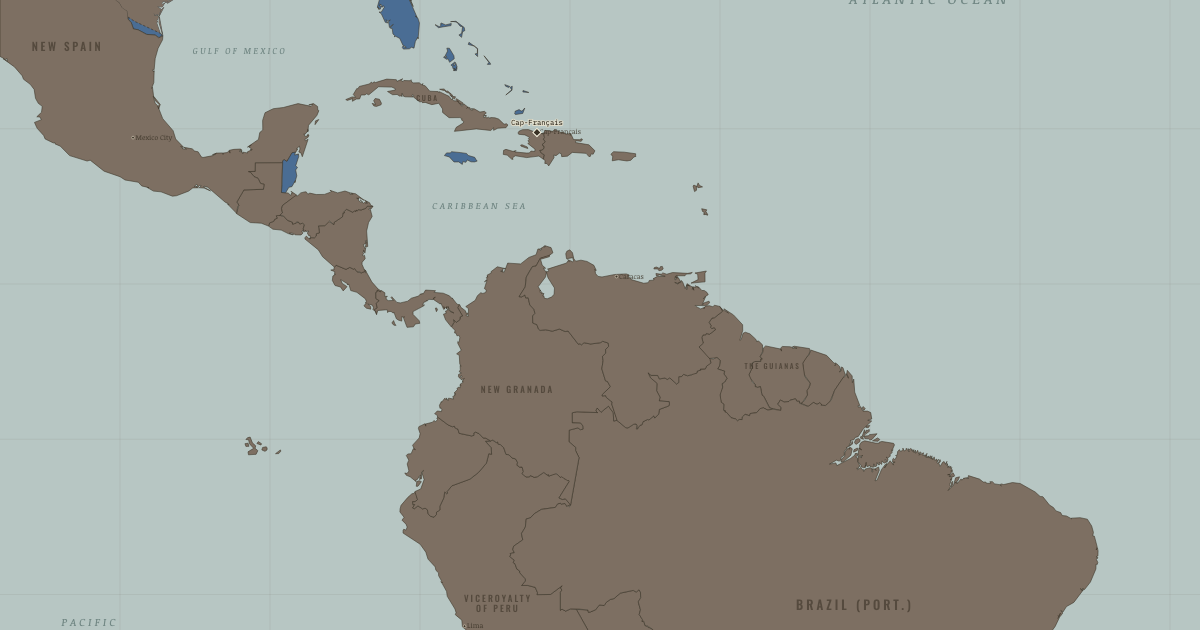
The colonial colors on the map describe a system built for extraction. European crowns claimed ports, mines, plantations and vast inland territories, though their control on the ground was often uneven. Potosí’s silver and Cap-Français’s sugar show how that system earned its money, and enslaved workers produced much of the Atlantic plantation wealth that flowed from it. Indigenous nations, meanwhile, still governed large areas that imperial treaties simply treated as land available for the taking.
THE SHORT ANSWER
- War debt in search of a taxpayer. Victory in 1763 left Britain with the world’s biggest empire and biggest debt, plus a new American frontier to garrison. Asking colonists to fund their own defense seemed reasonable in London. But the colonists had spent 150 years taxing themselves through their own assemblies — the mechanism (war → debt → taxation → representation crisis) is the age’s master pattern. Watch it detonate France in Chapter 3.
- An Enlightenment you could buy for a penny. Locke, Montesquieu and Rousseau supplied the theory, but the delivery system mattered more: colonial literacy was among the highest on earth, and printers like Franklin made “the rights of Englishmen” — then “the rights of man” — a mass possession. Revolutions need readers before they need soldiers.
- Empires of the enslaved. Roughly one in five people in British America was enslaved; in the sugar islands, nine in ten. The plantation complex paid for the navies and the pamphlets alike — which is why every revolution in this atlas will be forced, sooner or later, to say what it means by “all men.” Most will flinch. One, in Chapter 5, will not.
- A continent of prior owners. The 1763 Proclamation Line, drawn to keep settlers off Native land and the peace cheap, enraged colonial speculators (Washington among them). For the Six Nations, the Cherokee and dozens of other nations, the coming “liberty” would mean the removal of the one power restraining the settlers — an effect worth holding in mind through every chapter that follows.
THE TURN
Boston harbor, 16 December 1773. The tea itself was cheap — the Tea Act actually lowered the price. That was the point: accepting cheap taxed tea meant accepting the principle of the tax. Parliament answered defiance with collective punishment (the “Intolerable Acts”), turning a Boston quarrel into a continental cause. The lesson that opens the whole age: legitimacy, once questioned out loud, is astonishingly hard to re-impose at a distance.
WHAT IT CHANGED
A Continental Congress. Twelve colonies that had never cooperated on anything sent delegates to Philadelphia in 1774 — creating, before any battle, the institution that could speak for “America.” Revolutions are made of committees before they are made of armies.
France watches, and waits. Humiliated in 1763, France wants revenge on Britain and its ministers see it coming in America. The money and gunpowder that will flow to the rebels — and the debt that flows from that — connect Lexington to the Bastille as directly as any road on this map.
The idea travels with the sugar. Every ship between Nantes, Boston and Cap-Français carries print as well as cargo. Free people of color from Saint-Domingue will fight at Savannah in 1779; the men they served with will talk of rights. Ideas do not respect the color lines their authors drew.
THE FULL ANSWER, ARGUED
The sums were small, but the claimed rule was large. Parliament said it could legislate for the colonies in all cases; colonial opponents said taxes required consent through their own representatives. Both feared that compromise would set a precedent governing future decisions. War debt explains why London pressed the issue, while print and local assemblies explain why resistance spread. It was an economic dispute transformed into a crisis of legitimate authority.
AN INTERESTING FACT
Contemporaries never called it the “Boston Tea Party” — for half a century it was simply “the destruction of the tea,” and the festive name first appears in print in the 1820s, when the last participants were old men giving interviews. The cargo was precise: 342 chests, some 46 tons of East India Company tea, worth £9,659 by the company’s own claim. And the raiders were fastidious about everything except the tea — they swept the decks clean afterward, and replaced a padlock they had broken.
This is the study layer of Chapter 1 — The World of 1775 in The Age of Revolutions, 1775–1848; the full index of the atlas is here.
SEE IT MOVE ON THE INTERACTIVE MAP →New here? Chapters 1–2 of every atlas are free to sample, and the WW2 atlas is free in full. One membership opens all thirteen — the Cartographer’s Circle.
MORE QUESTIONS FROM THE AGE OF REVOLUTIONS
THE DISPATCH
One short letter when a new atlas opens — and the printable study guide for The Age of Revolutions is yours now, free.
NO TRACKING · YOUR ADDRESS IS USED FOR THE DISPATCH AND NOTHING ELSE · UNSUBSCRIBE ANYTIME