MAPS OF HISTORY · The Russian Revolution · ALL CHAPTERS · CHAPTER 4
CHAPTER 4 · OCTOBER 1917–JANUARY 1918 · NOV 1917
October
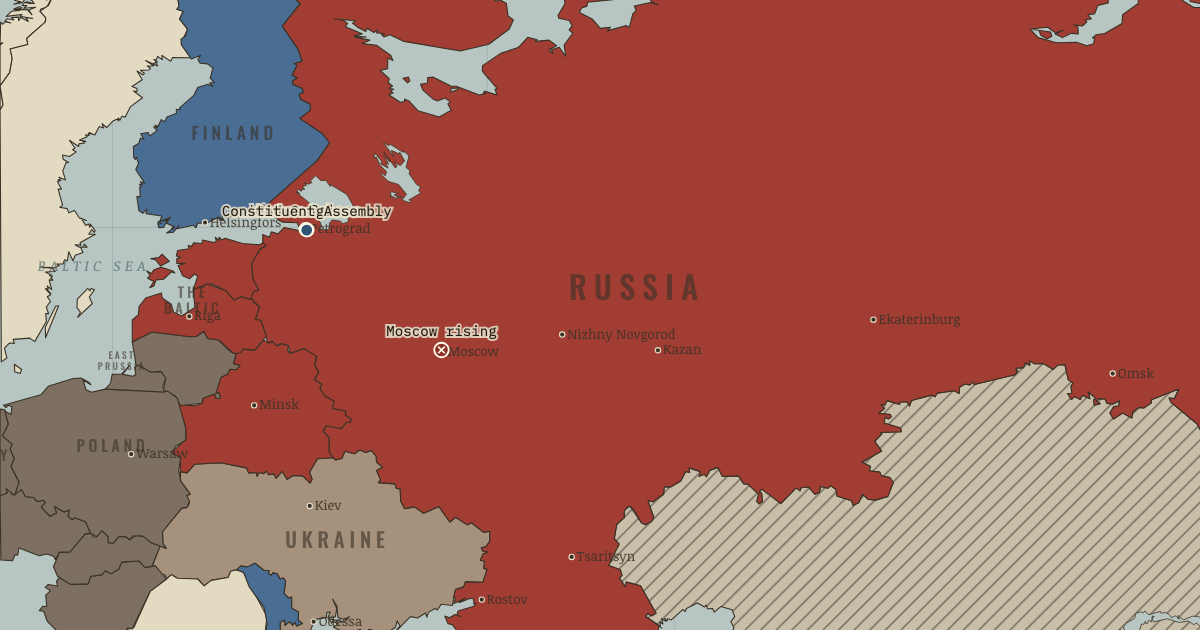
The map above is the world of NOV 1917 — October.
BRIEF EXPLANATION — THE ESSENTIAL ARGUMENT
The October Revolution succeeded because the state it seized had already been hollowed out, and because a single disciplined party understood how to take a modern capital. On the night of 24–25 October, Trotsky’s Military Revolutionary Committee occupied the bridges, telegraph, stations, banks and power plants of Petrograd, and the Winter Palace, seat of the Provisional Government, fell with little fighting because almost no one was willing to die for a government that had promised nothing anyone still wanted. Timing the seizure for the eve of the Congress of Soviets allowed the Bolsheviks to present it as the soviets assuming power rather than as one party taking it.
The new government immediately issued decrees on peace and land that answered the deepest popular demands, and that promise gave it real legitimacy. A harder test followed. Elections to a Constituent Assembly, scheduled before October, went ahead, and the Bolsheviks lost, with the peasant-based Socialist-Revolutionaries winning the largest share. When the Assembly met in January 1918, guards allowed it to sit for a single day and then closed it. That choice shut a democratic route and established that Bolshevik power would not depend on a national vote it could lose.
GUIDED EXPLANATION
The seizure of power in October looked less like a storming than a quiet occupation of the machinery of a modern state. Trotsky, chairing the Petrograd Soviet, built a Military Revolutionary Committee that won over the garrison’s key units and then took control of the bridges, telegraph, railway stations, banks and power stations on which the government depended. The Winter Palace fell through scattered entry and arrest rather than the heroic mass assault of later films, Kerensky had already fled, and few people were prepared to fight for his government. Power in 1917 had become so hollow that a determined committee with a few thousand armed men could lift it off the floor.
The genius of the operation lay in how it was presented. Because the seizure was timed for the eve of the Second Congress of Soviets, the Bolsheviks could offer it as power passing to the soviets rather than to a single party, which neutralized the many soldiers and workers who backed soviet authority in general but would not have marched for the Bolshevik Party by name. When the moderate socialists walked out of the Congress at Smolny in protest, they surrendered the mantle of soviet power to Lenin, and the Congress ratified the decrees on peace and land that gave the soldiers and peasants exactly what they had demanded. Legitimacy here depended less on what was done than on the name under which it was done.
One test of legitimacy still remained, and the regime failed it deliberately. The election to the Constituent Assembly, Russia’s first and last free national vote, had been arranged before October, and the Bolsheviks let it proceed and lost, since the Socialist-Revolutionaries drew the great peasant majority. When the Assembly met on 5 January 1918, Red Guards let it sit for one day and then dispersed it, and it never reconvened. This is the fork where a plausible democratic revolution became a one-party state, and it followed from Lenin’s whole approach, because he had insisted that the seizure come before the Congress and before the vote, so that power would be a fact the country was asked to accept rather than a question it was asked to decide. In a revolution, he understood, the calendar is a weapon.
DEEP EXPLANATION — EVIDENCE & INTERPRETATION
Why “coup” and “revolution” can both fit
By its mechanism October was a coup, because a disciplined party used armed committees to capture the institutions of the state in a single city. By its social context it was part of a revolution, because soldiers wanted peace, peasants were seizing land, workers supported soviet authority, and the Bolsheviks held majorities in the important urban soviets. Choosing only one of these labels throws away evidence. Calling it purely a popular revolution hides the party’s concentration of force and its later coercion, while calling it merely a coup hides why so little resistance appeared and why the first decrees resonated so widely. The distinction matters because it shapes how one reads the dictatorship that followed. If the soviet mandate is treated as central, the dispersal of the Constituent Assembly looks like a betrayal of the revolution; if the party’s seizure is treated as central, one-party rule appears as a logic present from the start. A layered answer keeps three questions separate: who wanted change, who organized the force that delivered it, and who kept the right to revoke the resulting power.
The Constituent Assembly as a fork
The election to the Constituent Assembly was imperfect, because the party lists had been drawn up before the Socialist-Revolutionaries split, political conditions were changing quickly, and the soviets claimed to embody a newer, class-based form of representation. None of those qualifications erases the result. The Bolsheviks lost a broad national vote, especially in the countryside, and then dissolved the elected body after a single sitting rather than share divided authority with it. Historians disagree about how workable parliamentary government could have been amid war and state collapse, but workability is not the same thing as choice, and the regime chose not to test a system in which it might be outvoted. That decision handed its opponents a powerful claim, that peaceful competition had been closed off by force, and it established a durable principle for Soviet rule, namely that legitimacy would be defined by the party’s own reading of revolutionary interest rather than by any institution capable of removing the party from office.
New here? Chapters 1–2 of every atlas are free to sample, and the WW2 atlas is free in full. One membership opens all thirteen — the Cartographer’s Circle.
THE SITES
ON THIS DAY
WHY IT HAPPENED
Organization beats numbers. The Bolsheviks were never a majority of Russians, but in October they were the best-organized force in the two cities that ran the state, with a clear plan and a single will. Trotsky’s Military Revolutionary Committee turned the garrison’s passivity into an instrument. Revolutions are won at decisive points by whoever is concentrated there. Not by whoever is popular in general.
The cover of the soviets. Seizing power in the name of the soviets, on the eve of their Congress, let a party coup wear the clothes of a mass mandate. It neutralized the many soldiers and workers who backed “soviet power” in the abstract but would not have marched for the Bolshevik Party by name. Legitimacy is often less about what is done than about the name under which it is done.
A government no one would defend. The mirror of February: as almost no one had died for the Tsar, almost no one died for Kerensky. Eight months of postponement had left the Provisional Government without a constituency willing to fight for it. The Winter Palace fell easily because there was nothing left inside worth defending.
Lenin’s insistence on timing. Lenin overrode cautious comrades who wanted to wait for the Congress or the Assembly, demanding the seizure come first, so power would be a fact the Congress merely blessed. Had they waited for the election they lost, October would have been impossible. He understood that in revolutions the calendar is a weapon.
THE TURN
The Winter Palace, night of 25 October/7 November 1917. The reality against the myth. There was no heroic storm. A few casualties, doors found open, a government arrested at a table. But the modesty of the event is exactly its lesson: state power in 1917 was so hollowed out that a determined committee with a few thousand armed men could pick it up off the floor. What made October world-historical was not the fighting but the claim staked that night. That this was Soviet power. And the willingness, three months later, to disperse an elected assembly rather than surrender it.
WHAT IT CHANGED
“Soviet power” — and the decrees that bought it. The first acts were the Decree on Peace (an immediate armistice) and the Decree on Land (abolishing gentry property, ratifying the peasant seizures). By promising the soldiers home and the peasants the land, the new regime instantly out-bid every rival. And committed itself to a peace it would have to buy at Brest-Litovsk at a terrible price.
The Constituent Assembly dispersed — democracy’s fork. Losing the only free election it ever allowed, the regime chose the party over the ballot. This is where a plausible democratic revolution became a one-party state. Every later Soviet claim to represent “the people” has to be read against this single day in January 1918.
The lines of civil war are drawn. A minority party ruling by decree, having dissolved parliament and signing away the west, handed its enemies. Officers, Cossacks, SRs, nationalists, the Allies. Both motive and pretext. Within months armies would be forming on every frontier. October did not end the struggle for Russia. It started it.
FIELD QUESTION — Was October a popular revolution or a coup — and does the distinction actually matter?
By mechanism it was a coup: a disciplined minority seized the state at gunpoint in a single city and then dispersed the parliament that a majority had elected. By content it rode a genuine mass tide. The soviets really had gone Bolshevik, the soldiers really did want peace, the peasants really were taking the land, and the regime really did promise them all three. Both are true, which is why the argument never ends. Does it matter? Enormously, for how you read everything after. If October expressed the people’s will, the party dictatorship that followed is a betrayal to explain. If it was a coup wearing a mass costume, that dictatorship is the seed visible from the first night. The honest historian holds both: a real revolutionary situation, seized by a party that then refused to let the revolution be counted.
AN INTERESTING FACT
The Winter Palace’s real siege began after it fell. Beneath it lay what was reputedly the largest wine cellar in the world, and for weeks Petrograd was convulsed by drunken looting as soldiers, sailors and passers-by fought over the Tsar’s vintages; guards posted on the cellars got drunk themselves. The Bolsheviks tried machine-guns, martial law and finally pumping the wine into the gutters — where crowds knelt to drink it out of the snow. The new regime’s first sustained security operation was directed not at counter-revolution but at a city-wide binge.
THE DISPATCH
One short letter when a new atlas opens — and the printable study guide for The Russian Revolution is yours now, free.
NO TRACKING · YOUR ADDRESS IS USED FOR THE DISPATCH AND NOTHING ELSE · UNSUBSCRIBE ANYTIME