MAPS OF HISTORY · Rome · ALL CHAPTERS · CHAPTER 10
CHAPTER 10 · 376–410 · AD 396
The Storm from the North
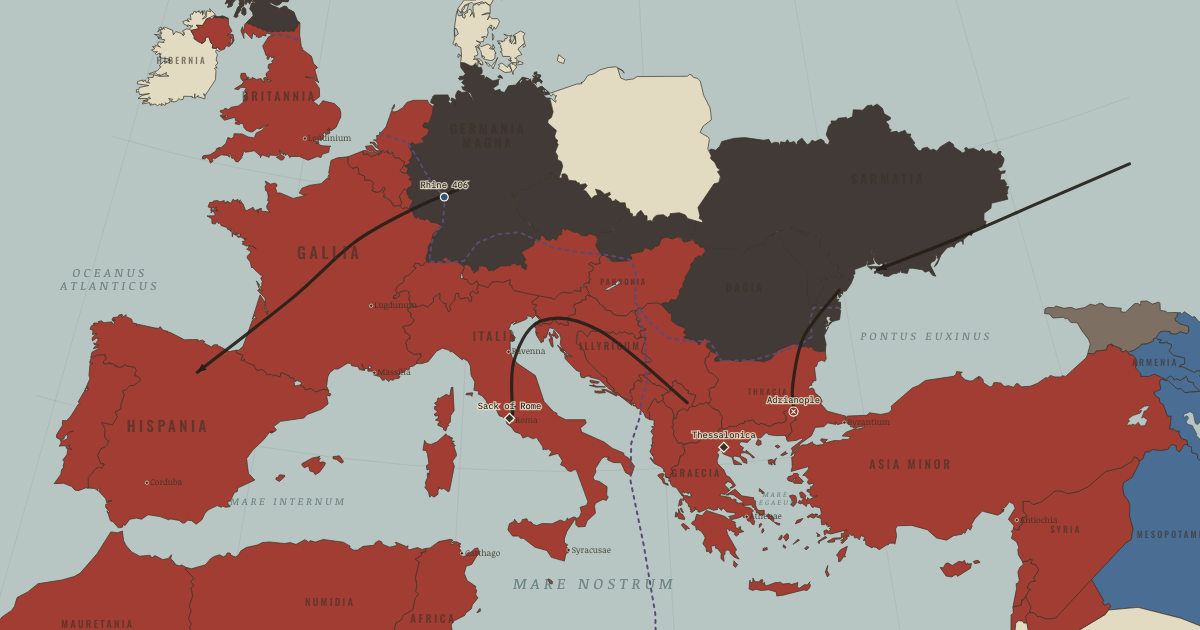
The map above is the world of AD 395 — East and West.
BRIEF EXPLANATION — THE ESSENTIAL ARGUMENT
The catastrophe that led to the sack of Rome began far outside the empire and was set in motion less by invasion than by a mishandled refugee crisis. The westward expansion of the Huns, mounted nomads from the steppe, shattered the Gothic peoples and drove many of them toward the Danube. In 376 Rome admitted a large body of these Goths as refugees and potential recruits, but corrupt officials then starved and exploited them until they rebelled. At Adrianople in 378 the Goths destroyed an entire eastern army and killed the emperor Valens, a defeat the empire could not simply make good.
Rome’s solution to that defeat planted the seeds of the next disaster. Lacking the manpower to defeat and absorb the Goths, it settled them inside the empire as foederati, armed allies who served under their own leaders rather than as ordinary subjects. Repeated civil wars kept draining troops away from the frontiers, and after the empire was permanently divided into east and west in 395, the Gothic leader Alaric spent years seeking land, pay and a recognised office from the weaker western court. That court met his demands with refusal, violence and mismanagement, and the long failure ended in 410 with the sack of Rome itself.
GUIDED EXPLANATION
The people who appeared on the Danube in 376 came as refugees rather than as an invading army, and that distinction is the key to everything that followed. The Huns had broken the Gothic world to the north, and a whole Gothic people, perhaps a hundred thousand strong, asked the eastern emperor Valens for admission to the empire. Valens saw future taxpayers and soldiers, and let them cross. But Roman officials embezzled the food meant to feed them and exploited the starving newcomers so ruthlessly that revolt followed. What should have been a policing problem became a catastrophe at Adrianople on 9 August 378. Valens attacked without waiting for the western army, and the Goths destroyed roughly two-thirds of his field force and killed him. A contemporary called it the worst defeat since Cannae, and this time there was no reservoir of Italian allies to refill the ranks.
The settlement that ended the war changed the empire more than the battle had. In 382 Theodosius agreed to let the Goths live inside the empire as foederati, allied soldiers who kept their own leaders rather than being dispersed and absorbed as earlier settlers had been. This was an affordable answer to a shortage of soldiers. But it meant that Rome now had armed peoples within its borders whose loyalty depended on a treaty, and treaties, unlike provinces, must be renegotiated again and again, usually under threat. The period also showed authority shifting in another direction. When Theodosius massacred thousands of citizens at Thessalonica in 390 after a riot, the bishop Ambrose forced the emperor to do public penance, the first time the church visibly compelled the Roman state to submit.
Beneath the drama lay a simple and worsening arithmetic of manpower. After Adrianople Rome needed Gothic soldiers but never fully turned Gothic communities into ordinary provincials, so it depended on federate troops who expected negotiated pay and status. Emperors, meanwhile, repeatedly put civil wars ahead of frontier defence, because they feared Roman rivals more immediately than distant invaders. Each internal campaign left a border thinner, and when troops pulled away for such a war, the Rhine was crossed at the end of 406. The western court then executed the general Stilicho in 408 and turned on federate families, which drove still more soldiers to Alaric. His forces sacked Rome for three days in 410. The material damage was smaller than later memory made it, but the blow to confidence was enormous, and it was the visible result of decades of fiscal, military and integration failures rather than one invasion breaking a healthy wall.
DEEP EXPLANATION — EVIDENCE & INTERPRETATION
How Refugees Became an Armed Polity
The people who crossed the Danube in 376 were not simply an invading army, since they had sought admission from an empire that had absorbed outsiders for centuries. What was different this time was the scale, the haste and the failure of administration. Rome let a very large group stay together, failed to disarm it fully, and then allowed officials to profit from its hunger, so rebellion was not automatic but was produced by misgovernment out of vulnerability. After the disaster at Adrianople, the shortage of soldiers narrowed Rome’s choices sharply. The settlement of 382 recognised Gothic forces under their own leaders in return for military service, and this foederati arrangement, rule by treaty rather than by ordinary provincial administration, could work, but every succession or unpaid obligation reopened the bargain. The hidden constraint was fiscal, because dispersing, feeding and integrating newcomers properly would have required resources the state was already spending on civil wars. Settling them cheaply postponed the cost and made each later negotiation more coercive than the last.
The Sack as Failed Bargaining
Alaric’s campaigns were not a straightforward march to destroy Rome, because for years what he sought was grain, land, payment and a recognised command within the imperial system. Those demands could threaten the court and express a wish to belong to it at the same time. The western leaders alternated between negotiating with him, delaying him and murdering the men who dealt with him. The strong defences of Ravenna reduced any pressure to compromise, since the emperor stayed physically safe even while Italy suffered. The execution of Stilicho removed an experienced broker, and violence against the families of federate soldiers only enlarged Alaric’s following. By 410 attacking Rome had become a bargaining instrument the court could no longer ignore. The sack was still an act of violence against the city’s inhabitants and should not be romanticised, yet its underlying mechanism was failed integration rather than any Gothic programme to abolish Rome, and Alaric’s successors went on seeking authority inside Roman forms.
New here? Chapters 1–2 of every atlas are free to sample, and the WW2 atlas is free in full. One membership opens all thirteen — the Cartographer’s Circle.
THE SITES
ON THIS DAY
WHY IT HAPPENED
An exogenous shock: the Huns. Nothing in Roman policy caused the Huns, and the strongest modern account (Heather’s) rests on that: the fourth-century empire was strained but stable until an outside force compressed the entire barbarian world against its borders within one generation. The 376 crossing, the 406 crossing, and Chapter 11’s Attila are one causal chain from the steppe. Against this, internalists note that earlier Rome absorbed Cimbri, Marcomanni, Goths — shocks reveal states’ conditions rather than create them. Hold both: an avalanche needs a slope and a trigger.
Adrianople’s real damage: the manpower ledger. The eastern field army lost at Adrianople was the empire’s strategic reserve, and — unlike the Republic of Cannae — the late empire had no citizen-militia base to regrow it: recruits were now bought, from taxes or from barbarians. The 382 federate treaty was thus not folly but arithmetic — Gothic spears were the only ones on sale. Every subsequent disaster follows the same equation: fewer taxpayers → cheaper army → barbarian soldiers → land concessions → fewer taxpayers. The fiscal death-spiral thesis of Chapter 11 begins its visible turns here.
Civil war remained the first priority. Count what the arrows on this map were doing before they turned on the frontier: Theodosius marched the eastern army west twice (388, 394) against Roman usurpers, gutting the Rhine and Danube garrisons; the 406 crossing succeeded because the border was a paper line; Stilicho’s Italy stripped Britain and Gaul to defend Italy — manufacturing the usurper Constantine III. The old lesson of 235 in its terminal form: Rome consistently preferred losing provinces to losing power struggles, until the provinces were gone. That is not a barbarian achievement; it is a Roman choice, made annually.
Integration refused. At every branching point — 376, 382, Alaric’s decade of offers — the cheapest stable outcome was full integration: make the Goths Romans, as Gauls and Spaniards and Illyrians had been made Romans for five centuries. It never happened: anti-barbarian court factions, religious difference (the Goths were Arian Christians), and the massacre of federate families in 408 kept them a people-in-arms inside the state. The Republic’s genius — turning the defeated into recruiters of loyalty — was the one Roman art the late empire forgot. When you judge Alaric at Rome’s gates, remember he spent fifteen years asking for a job.
THE TURN
Adrianople, 9 August 378. The military facts are grim but recoverable — Rome had lost whole armies before. What proved irreversible was the settlement: for the first time, a defeated-then-victorious foreign people was planted inside the frontier as a permanent armed polity under its own leaders, because Rome could no longer afford the alternative. The precedent priced every later crisis: why should Vandals, Sueves or Burgundians accept less than the Goths extracted? Ancient historians called Adrianople the beginning of the end and modern ones mostly demur — but as the moment the empire began paying rent on its own territory, the old verdict stands up disturbingly well.
WHAT IT CHANGED
The West inherits the exposed half. The 395 division gave the East the short, fortress-anchored frontier (Constantinople, the straits) and two-thirds of the revenue; the West got the Rhine, the upper Danube, Britain, and Africa’s grain as its single fiscal anchor. Study the dashed line on your map as a balance sheet, not a border: every subsequent western catastrophe — 406, 410, 439 — happens on the poor half’s books. Chapter 11 is that balance sheet running out.
410 as an idea. The sack changed little materially — the court sat safe in Ravenna; Alaric died within months, his Goths marching on to Gaul — but ideas are also infrastructure. Pagans blamed the abandoned gods; Augustine’s answer, that no earthly city is God’s city, became the frame through which Latin Christendom understood politics for a thousand years. And every European power that ever sacked or feared for a capital has reached for 410 since. Some events’ chief consequences are the sentences written about them.
Britain: the control experiment. The one province abandoned intact (410) rather than conquered shows what the Roman package — towns, villas, coinage, literacy — did when the state beneath it vanished: within two generations, all of it collapsed, more completely than anywhere the barbarians actually ruled. Archaeology (Ward-Perkins’ pottery and coin horizons) uses Britain as the measure of what Rome had actually been holding up. Keep it in mind when Chapter 12 asks whether “transformation” or “fall” is the honest word.
FIELD QUESTION — In 376 the Goths asked to join the empire; in 410 they sacked its capital. Locate the decisions in between that made the second event grow out of the first — and say which was the last real exit.
Chart the branching points. 376: admission without integration — Valens wanted soldiers cheap, so the Goths crossed as a people, not as recruits (contrast the old practice of dispersing settlers among provinces). The crossing itself was defensible; the corruption that starved them was not policy but was tolerated, and revolt followed. 378: Valens’ refusal to wait for the western army — pure contingency, a hinge that pride chose. 382: the federate treaty — rational given the losses, fatal as precedent. 395–408: the decade of refused deals with Alaric, when a generalship and land would have converted the Goths into what Gauls had become; the court chose neither war nor peace, then murdered Stilicho and the federates’ families, welding Gothic grievance into Gothic unity. Most historians place the last real exit at 397–408: integration was still purchasable, at a price wounded Roman pride — an empire now weaker than its self-image — would not pay. The transferable lesson is uncomfortable and precise: the price of absorbing outsiders only rises, and states that discover this too late pay in capitals.
AN INTERESTING FACT
Among the hostages the Goths carried out of Italy was the emperor’s own half-sister, Galla Placidia — and her afterlife rewrites the invasion story. In 414 she married the Gothic king Athaulf at Narbonne, in Roman dress, with a deposed Roman puppet-emperor singing the wedding hymn; Athaulf, a contemporary reports, had decided that Gothic arms should restore the Roman name rather than replace it. Widowed, ransomed back for 600,000 measures of grain, remarried to a Roman general, she ended as Augusta — regent of the Western empire for a dozen years and mother of its emperor: the captive of 410 governing what remained of the world that had failed to protect her.
THE DISPATCH
One short letter when a new atlas opens — and the printable study guide for Rome is yours now, free.
NO TRACKING · YOUR ADDRESS IS USED FOR THE DISPATCH AND NOTHING ELSE · UNSUBSCRIBE ANYTIME