MAPS OF HISTORY · The Age of Revolutions · ALL CHAPTERS · CHAPTER 4
CHAPTER 4 · 1792–1795 · AUG 1793
The Republic in the Balance
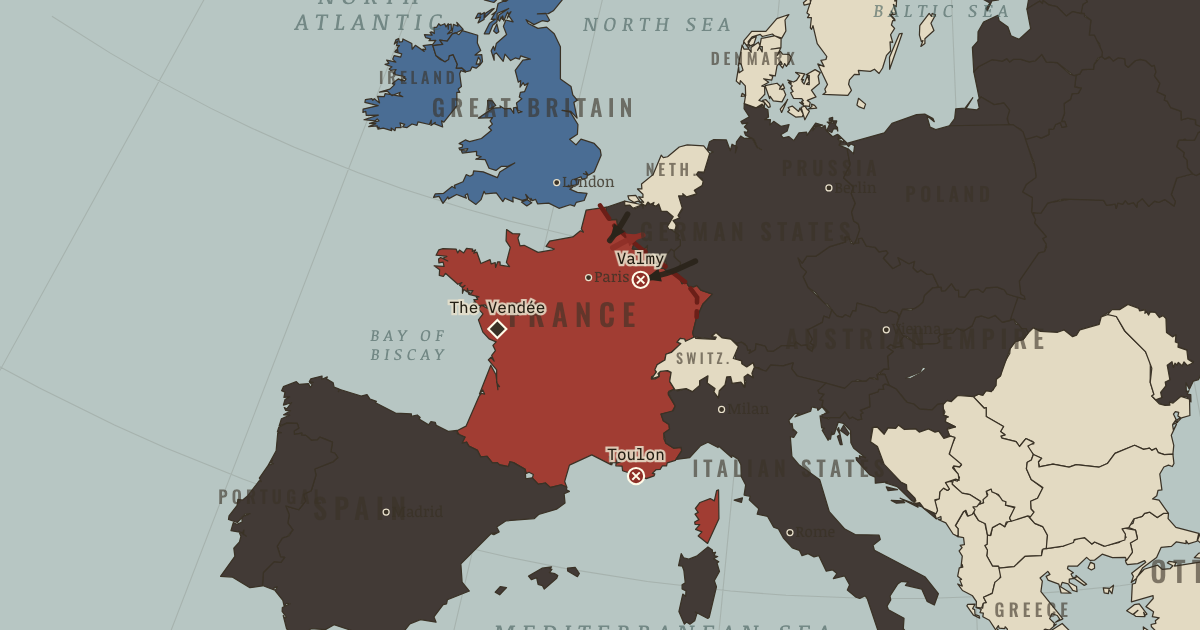
The map above is the world of FEB 1793 — The Republic against Europe.
BRIEF EXPLANATION — THE ESSENTIAL ARGUMENT
The French Republic faced invasion, civil war, inflation and political division in 1793. Mass conscription created a national army on a scale dynastic states struggled to match. Promotion by ability and centralized supply helped turn military crisis into victory.
The same emergency supported the Terror: revolutionary courts, executions, prison deaths and devastating repression in the Vendée. The danger was real, but emergency power developed its own momentum. Robespierre fell in July 1794 as deputies feared becoming his next targets. The Republic survived with lasting moral and political wounds.
GUIDED EXPLANATION
The young Republic’s first real test came at Valmy in September 1792, where French regulars and volunteers held their ground against a Prussian advance. The battle itself was limited, but it proved that a citizen army could stand against professional troops, and within days the new Convention abolished the monarchy; it executed Louis XVI early in 1793. By the middle of that year France was at war with much of Europe while facing revolt and economic collapse at home.
The levée en masse, or mass call-up, treated the population and economy as war resources. By 1794 France fielded roughly 750,000 troops. Emergency committees also regulated prices, requisitioned food and prosecuted suspected enemies. About 17,000 people were executed after legal sentence; many more died in prison, local reprisals and civil war. In the Vendée, resistance to conscription and attacks on the Church became a royalist war, and republican “infernal columns” devastated communities. Estimates of 170,000–250,000 deaths include many civilians and remain debated in detail. Military victory reduced the emergency, but executions accelerated during the Great Terror. Deputies overthrew Robespierre in Thermidor because no one trusted the machinery to stop before reaching them.
The map keeps the external fronts separate from the Vendée, but the government of 1793–94 experienced them as a single emergency, and that perception linked battlefield defeat, food shortage and political disloyalty in one category of threat. It also made limits almost impossible to enforce, because criticism could be read as sabotage while local violence could be justified as national defense. The victory at Fleurus in June 1794 improved France’s military position, yet the Terror did not slow with it. That lag is the revealing detail, since it shows an emergency institution running on fear and political momentum well after the pressure that created it had begun to ease.
DEEP EXPLANATION — EVIDENCE & INTERPRETATION
How emergency power becomes self-sustaining
War created genuine incentives for central control. Officials needed recruits, grain, weapons and rapid punishment of desertion or sabotage. Yet institutions built for emergency also produced careers, fears and evidence interpreted through their own assumptions. Local agents could label rivals as counter-revolutionaries; leaders read military setbacks as treason; each purge made survivors more likely to strike first. This feedback explains why the Terror cannot be reduced either to irrational bloodlust or to efficient defense. Some measures helped mobilization, while the Great Terror expanded after the strategic position had begun improving. Emergency was the origin, not a permanent justification. The absence of a trusted stopping rule made fear inside the government one of the system’s strongest drivers. The map records the result. Explanation must also keep institutions, material pressure and political choice visible, because none of those forces worked alone.
The Vendée: war, atrocity and memory
The Vendée rising joined opposition to conscription, defense of non-juring priests, local grievances and royalism. Republican forces faced armed resistance and sometimes brutal insurgent violence. Their response included village burning, summary killing and mass executions that struck civilians on a far greater scale. Historians debate terminology, especially claims of “genocide,” because intent, command and legal categories are contested. The uncertainty should not flatten the evidence. State forces deliberately devastated a region and killed noncombatants as part of pacification. The memorial discipline is to name documented acts, give ranges rather than false precision and avoid turning suffering into a score in a debate about whether the Revolution was good or bad. That distinction prevents a dramatic moment from becoming a single-cause story. Revolutionary outcomes emerged through interacting interests, constraints and decisions over time.
New here? Chapters 1–2 of every atlas are free to sample, and the WW2 atlas is free in full. One membership opens all thirteen — the Cartographer’s Circle.
THE SITES
ON THIS DAY
WHY IT HAPPENED
War radicalizes the revolution. Every defeat was read as treason (sometimes correctly — the commanding general defected in April 1793). Emergency justified centralization, centralization justified terror, and the guillotine became — in the Convention’s own logic — a weapon system of the war. Revolutions besieged from outside almost never stay liberal inside; you will see the mirror image when restored kings purge liberals in Chapter 11.
The Vendée: faith, conscription and vengeance. The trigger was the levée itself — western peasants refused to die for a Paris that had taken their priests. What began as riot became counter-revolutionary war, and the Republic’s response — the “infernal columns” of 1794 — was systematic devastation. Named soberly: 170,000–250,000 dead, most of them civilians of the region. It is the Revolution’s deepest wound and the Terror’s largest ledger entry.
An economy at bayonet-point. The assignat currency collapsed; the response was price controls enforced by death and requisition enforced by armies. Terror was, among other things, a wartime economic policy — which is why it ended within months of the military emergency ending.
THE TURN
Valmy, 20 September 1792. A cannonade, barely a battle: ~300 dead on both sides. But an army of citizens had stood where Europe’s professionals expected a mob to run, and Brunswick — outnumbered, sick, and far from supply — turned back. Goethe, present with the Prussians, called it the start of a new era in world history. He was right for the deep reason: Valmy proved a nation in arms could generate military power no dynasty could match. Everything from the levée to Austerlitz unfolds from that proof.
WHAT IT CHANGED
The nation-in-arms escapes its inventors. Mass conscription plus promotion by talent creates armies that win — and generals whose legitimacy comes from victory, not from the Republic. The most talented of them is currently siting cannon at Toulon (see the ✕ marker). The republic that armed the nation will be inherited by its best soldier.
Emancipation, at last and under pressure. In February 1794 the Convention abolishes slavery in all French colonies — ratifying what the self-freed of Saint-Domingue had already won and hoping to keep the colony French against Britain and Spain. Principle and desperation co-signed the decree; only one of them will survive Napoleon.
A template and a warning. For the next two centuries every revolutionary will study 1793 — total mobilization, committees of public safety, revolutionary tribunals — and every counter-revolutionary will point to it as where “rights of man” necessarily leads. Both readings are on the table for the rest of this atlas; test them against 1848.
FIELD QUESTION — Was the Terror the Revolution’s betrayal, or its self-defense? Choose, then argue the other side.
The Republic faced a real emergency, and centralized mobilization contributed to military survival. That supports the self-defense argument. The betrayal argument points to indiscriminate repression, the Vendée’s devastation and the Great Terror’s acceleration after immediate danger had eased. The best interpretation separates origin from development: emergency created the institutions, but fear and political incentives made them self-sustaining. Defensive purpose explains their rise; it does not justify every act or prove that terror was necessary to victory.
AN INTERESTING FACT
The Republic tried to restart time itself: from late 1793 France dated its acts from Year I of Liberty, with ten-day weeks that quietly abolished Sunday and twelve months renamed by the poet Fabre d’Églantine — Thermidor, “gift of heat,” is his coinage, which is why Robespierre’s fall bears that name; Fabre himself was guillotined before his calendar was a year old. Napoleon scrapped it on 1 January 1806. Its sibling reform outlived them all: the metre, defined as one ten-millionth of the distance from pole to equator and surveyed through the middle of the Terror, now measures nearly everything on earth.
THE DISPATCH
One short letter when a new atlas opens — and the printable study guide for The Age of Revolutions is yours now, free.
NO TRACKING · YOUR ADDRESS IS USED FOR THE DISPATCH AND NOTHING ELSE · UNSUBSCRIBE ANYTIME