MAPS OF HISTORY · The Road to War · ALL CHAPTERS · CHAPTER 8
CHAPTER 8 · 1939 · 1939
Prague, the Pact, Poland
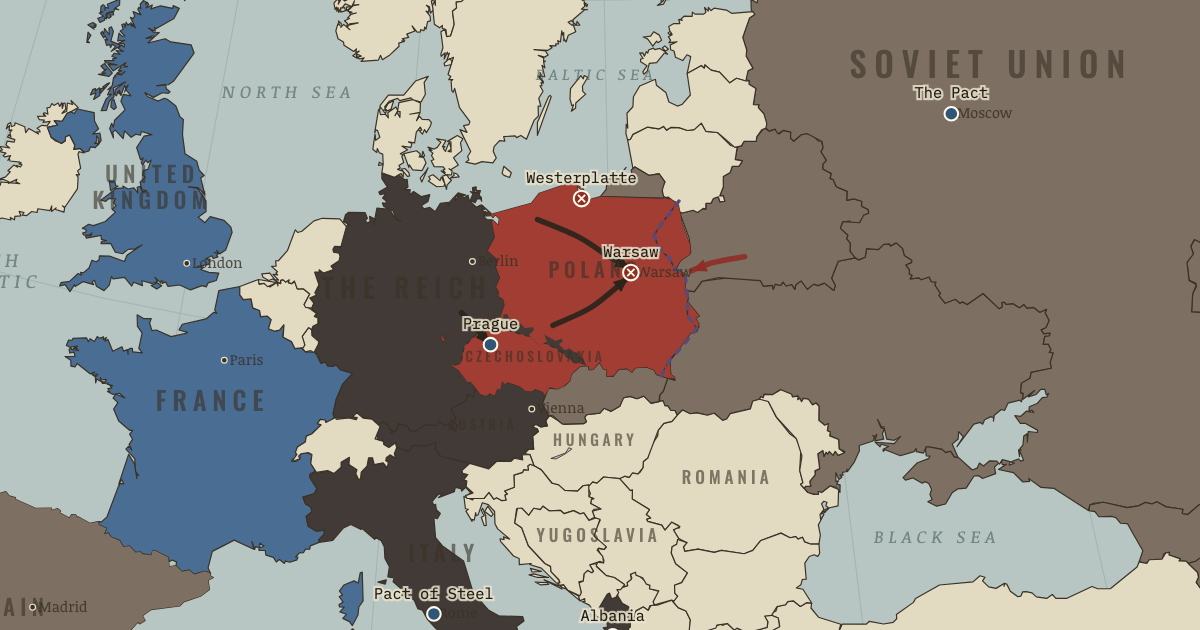
The map above is the world of SEP 1939 — The Pact, and Poland partitioned.
BRIEF EXPLANATION — THE ESSENTIAL ARGUMENT
The events of 1939 destroyed the assumption on which appeasement rested and then showed how little a guarantee is worth without the power to enforce it. When Germany occupied Prague in March, seizing a Czech population that was not German at all, it proved that Hitler’s aims reached far beyond correcting borders for ethnic Germans. Britain responded by guaranteeing Poland, yet it had no way to put an army on Polish soil, so the promise was a warning rather than a shield. Britain and France did open talks with the Soviet Union, the one power that could actually reach Poland, but those negotiations dragged on in mutual distrust.
While the West hesitated, Hitler removed his greatest fear, a war on two fronts at once, by striking a bargain with Stalin. The Nazi–Soviet Pact of August 1939 committed the two regimes not to fight each other and, in a secret protocol, carved eastern Europe into German and Soviet spheres. Germany invaded Poland on 1 September, and the Soviet Union invaded from the east on 17 September, so the country was crushed between them. Britain and France declared war but could do nothing to prevent the partition. Deterrence had shrunk into a commitment to fight after the aggression rather than a means of preventing it, which saved the guarantors’ honour but not Poland.
GUIDED EXPLANATION
Germany occupied Prague in March 1939, and the act was different in kind from everything before it. This was not the revision of a German-populated border but the outright seizure of a non-German state, which destroyed the claim that German policy sought only self-determination. Britain answered by guaranteeing Poland, even though it could not send an army there in time to matter. Italy, taking its cue, seized Albania and joined Germany in the Pact of Steel.
On 23 August, Germany and the Soviet Union signed a non-aggression pact whose secret protocol divided eastern Europe between them. Hitler could now attack without an immediate Soviet front to worry about. Germany invaded Poland on 1 September, and the Soviet Union struck from the east on 17 September. Britain and France declared war but provided almost no direct relief, and Poland was partitioned, though its government refused to surrender and Polish forces fought on abroad.
Prague destroyed the argument that German policy concerned only self-determination, and Britain’s guarantee was meant to rebuild deterrence, meaning a threat credible enough to prevent an attack before it begins. The guarantee could commit Britain to war, but it could not place troops in Poland ahead of an invasion. Talks with Moscow moved slowly and broke down partly over Poland’s refusal to admit Soviet forces, a refusal that later occupation would make entirely understandable. Stalin then chose a pact that bought him time and territory while steering German pressure westward. Historians debate whether his motive was mainly defensive or mainly expansionist, and the secret protocol and the annexations that followed suggest both were at work. For Hitler the immediate result was decisive, since the two-front danger vanished, Poland faced a coordinated partition, and the western Allies entered a war they were not yet ready to fight. The guarantee had become a tripwire rather than a shield.
DEEP EXPLANATION — EVIDENCE & INTERPRETATION
Why Stalin signed
The Nazi–Soviet Pact can be read as defensive time-buying, as territorial opportunism, or as both at once, and the evidence points to a combination. The Anglo-French talks were slow, conducted by low-ranking envoys, and stalled on Poland’s refusal to let Soviet forces onto its soil, a refusal made rational by earlier Soviet conduct and confirmed by the later occupation. Stalin expected an eventual war with Germany and gained from the pact a buffer of space, time to rearm, and territories once ruled by the Russian Empire. The secret protocol and the annexations that followed show that this security was pursued through expansion at the expense of neighbouring states. Hitler gained the more immediate advantage, which was the freedom to attack Poland without a Soviet front behind him. Ideological hostility did not prevent temporary cooperation, because both regimes ranked short-term strategic interest above doctrine. The pact demonstrates that shared enemies do not by themselves create alliances when distrust over means and postwar aims runs deeper than the common threat.
The guarantee as tripwire
Britain could not deliver enough force to Poland to stop an invasion, and France’s limited advance into the Saar did nothing to change the campaign, so the guarantee was weak as direct protection. Its purpose was also political, which was to tell Hitler that another unilateral expansion would bring a general war and to bind Britain itself after years of concession. That commitment mattered because Britain’s earlier threats had lacked credibility. It failed to deter Hitler, partly because Munich and the pact had encouraged him to doubt both the resolve and the effectiveness of the Western powers. The guarantee can therefore be judged both necessary and insufficient, since it ended appeasement as an open-ended policy yet arrived only after the strategic position had already worsened. Extended deterrence of this kind fails when the promised consequences become credible only after the protected state has already suffered the very act they were meant to prevent.
New here? Chapters 1–2 of every atlas are free to sample, and the WW2 atlas is free in full. One membership opens all thirteen — the Cartographer’s Circle.
THE SITES
ON THIS DAY
WHY IT HAPPENED
Prague converted the doubters. Every previous gamble had worn a costume of justice — plebiscites, minorities, treaty grievances. March 1939 came undressed. British opinion, press and backbench moved before the government did; even the arch-appeasers conceded the premise was dead. But conversion produced deterrence-on-credit: guarantees to Poland, Romania and Greece issued precisely because Britain now believed Hitler unlimited, yet backed by no deliverable force. The question of 1939 was whether promises without armies deter — Hitler answered it in September.
The pact was the cheapest insurance either dictator ever bought. For Hitler, the pact removed the two-front nightmare and (he calculated) would collapse British resolve — “our enemies are little worms, I saw them at Munich.” For Stalin, it bought territory the Tsars had lost, a buffer against the attack he expected eventually, and — the darkest reading — time while the capitalists exhausted each other. Each man believed he had made the other his tool. The historiographical fight is over Stalin’s alternative: Anglo-French talks in Moscow that August were real but slow, low-ranked, and wrecked on Poland’s refusal to admit the Red Army — a refusal 1940 would explain (see Katyń, Ch. 11). Collective security’s last chance died of everyone’s entirely rational distrust.
Danzig was pretext; the objective was erasure. The formal quarrel — the Free City of Danzig and an extraterritorial road across the Corridor — was designed to be unacceptable, then withdrawn from negotiation entirely: Hitler wanted the war Munich had denied him. His directive of April 1939 ordered the army ready “to destroy Polish military strength and create in the East a situation which satisfies the requirements of national defense” — not to adjust a border. The secret protocol’s line, and the occupation policies that began within days (the AB-Aktion murder of Polish elites, expulsions, the first ghettos), confirm the aim was the state’s existence, not its frontier.
Poland would not be a client. Warsaw’s agency deserves the map’s respect: offered satellite status in Hitler’s anti-Soviet schemes repeatedly in 1934–39, Poland refused — the only state in the region that declined both dictators in the same year, knowing the price. Beck’s foreign policy has been criticized (the seizure of Teschen from Czechoslovakia in 1938 spent moral capital Poland would need), but the fundamental choice of 1939 was to fight a hopeless war rather than hold a leash. Twenty percent of its population would not survive the consequence.
THE TURN
The Kremlin, 23 August 1939. Ideology said this handshake was impossible — which is exactly what made it the hinge of the year. The pact did three things at once: it made the war certain (Hitler’s last strategic anxiety dissolved; invasion was ordered within days), it made the war’s first phase unwinnable for Poland (no eastern front, no supply route, a fourth partition instead), and it re-taught every chancellery the decade’s coldest lesson — that between totalitarian powers, doctrine is costume and interest is skin. Historians still argue whether Stalin had a real alternative (the stalled Anglo-French mission) and whether the pact was defensive time-buying or expansionist opportunism; the secret protocol, denied by Moscow until 1989, weighs heavily for the second reading. Either way: no document in this atlas moved more borders with less warning.
WHAT IT CHANGED
Eastern Europe is partitioned by annex. The protocol’s spheres became facts within a year: eastern Poland absorbed after a staged plebiscite, the Baltic states garrisoned then annexed (June 1940), Bessarabia seized from Romania — watch the map’s next snapshots execute the schedule. Two of the era’s empires expanded in lockstep before they fought each other.
The war Britain and France declared, they did not fight. September’s Saar “offensive” advanced eight kilometres and withdrew; the promised bombing was leaflets. The Phoney War had reasons — French doctrine, British unreadiness — but its effect was to confirm Hitler’s contempt and to leave the initiative entirely his for the spring.
Japan is stunned out of the German orbit — briefly. Tokyo, fighting Soviet troops at Khalkhin Gol that very month (Ch. 10) under an Anti-Comintern Pact aimed at Moscow, learned of its ally’s Soviet pact from the newspapers. The cabinet fell; Japanese planners never fully trusted Berlin again — one reason they would refuse to join Barbarossa in 1941 and strike south instead.
FIELD QUESTION — Should Britain and France have guaranteed Poland — a promise they could not keep — or was the guarantee the necessary end of appeasement?
The critique is Taylor’s: the guarantee handed Warsaw the power to decide when Britain went to war, deterred nothing (Hitler doubted its sincerity, correctly as to capability), and may have stiffened Polish refusal to negotiate while foreclosing the Soviet alliance that alone could have made it real. The defense answers on different ground: by March 1939 the strategic question was no longer “can Poland be saved?” but “will Hitler’s next war be fought with or without allies, against a Britain committed or discredited?” The guarantee was less a military instrument than a public vow that the next aggression meant general war — a tripwire for British honor and, crucially, for Dominion and American opinion. Both readings can be true: the guarantee was simultaneously unkeepable as protection and indispensable as commitment. The seminar’s transferable problem — extended deterrence that outruns capability — did not retire in 1939; it moved to other maps.
AN INTERESTING FACT
Warsaw’s besieged radio station kept broadcasting a fragment of Chopin — the opening bars of the Military Polonaise — every thirty seconds through September 1939, as proof the capital still stood; when the music stopped on 28 September, listeners across Europe knew without an announcement. Polish forces never capitulated as a state: the government crossed into Romania and reconstituted in exile, the navy had already sailed for Britain under the Peking Plan, and by 1940 exiled Polish pilots would form Fighter Command’s highest-scoring squadron of the Battle of Britain, No. 303.
THE DISPATCH
One short letter when a new atlas opens — and the printable study guide for The Road to War is yours now, free.
NO TRACKING · YOUR ADDRESS IS USED FOR THE DISPATCH AND NOTHING ELSE · UNSUBSCRIBE ANYTIME