MAPS OF HISTORY · The Road to War · ALL CHAPTERS · CHAPTER 2
CHAPTER 2 · 1931–1933 · 1933
Mukden: The First Unpunished Gamble
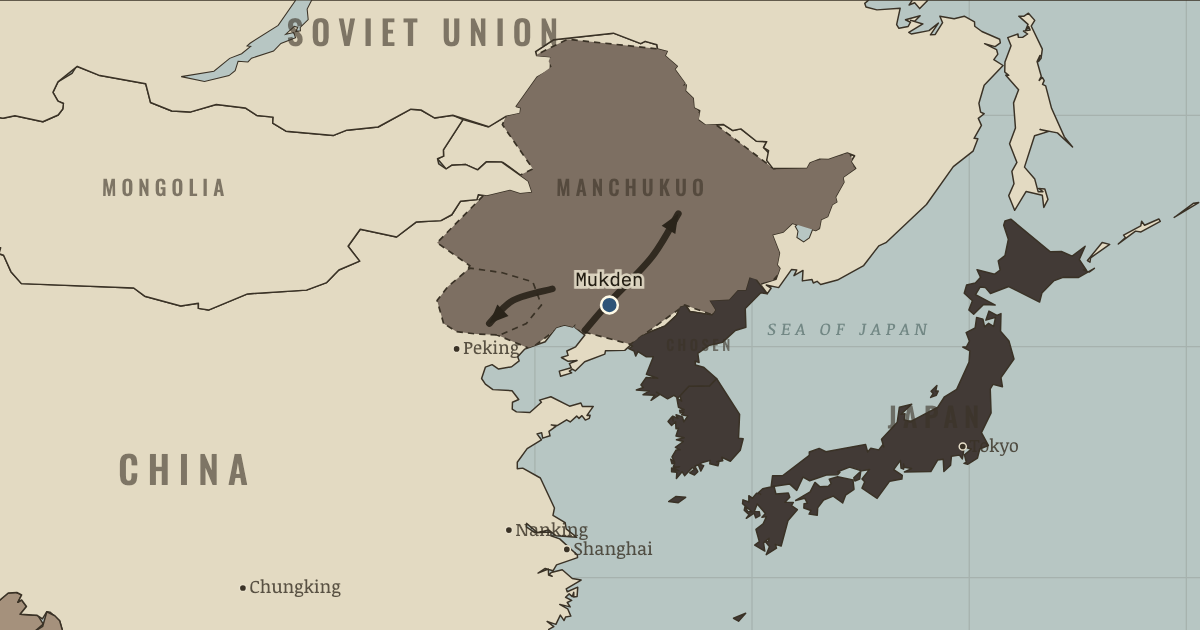
The map above is the world of MAR 1933 — Jehol taken; Japan quits the League.
BRIEF EXPLANATION — THE ESSENTIAL ARGUMENT
The decade’s central mechanism is on display in its first crisis, because Manchuria showed how a great power could take what the postwar order forbade and pay nothing for it. The seizure began not as national policy but as a conspiracy, when officers of Japan’s Kwantung Army, stationed to guard a railway concession, blew up a stretch of their own track near Mukden, blamed Chinese troops, and used the manufactured incident to overrun a territory three times the size of Japan. The civilian government in Tokyo repeatedly ordered restraint and was repeatedly ignored, because the army kept presenting each advance as an accomplished fact that ministers could only ratify after the event. China, too weak to win a general war, did what the new international system told it to do and appealed to the League of Nations.
The League’s response revealed the gap between judgment and enforcement that would recur throughout the decade. Its investigators correctly rejected Japan’s claim of self-defence and refused to recognise the puppet state of Manchukuo, yet the organisation imposed no sanction that Japan could feel. Japan simply walked out of the League and pushed on into the neighbouring province of Jehol. The lesson every later aggressor drew was procedural rather than moral, which was to move quickly, wrap the conquest in a plausible cover story, and force the other powers to choose between accepting the result and risking a war they did not want. A correct verdict without material consequences, the episode showed, changes nothing on the ground.
GUIDED EXPLANATION
On 18 September 1931 the Kwantung Army damaged its own railway near Mukden, blamed Chinese soldiers, and turned a trivial explosion into the pretext for a prepared campaign. The blast was so small that a train crossed the spot minutes later, but the military machine behind it was anything but improvised. Japanese forces drove north and took Manchuria within months, ignoring cabinet instructions to contain the fighting, because the officers on the spot were confident that success would be forgiven. Chiang Kai-shek, unwilling to fight a war he expected to lose, avoided general resistance and carried China’s case to the League instead.
Japan then dressed its conquest as a new nation, proclaiming Manchukuo under the last Qing emperor, Puyi, as its figurehead. The League’s Lytton Commission examined the claim, rejected it, and the Assembly adopted the report by 42 votes to 1, with Japan casting the single dissent. Because no effective sanctions followed, Japan left the organisation and annexed Jehol as well. What the map records here is the decade’s first successful fait accompli, a French phrase for an action completed before opponents can respond, laid before them only once the cost of reversing it has risen too high to bear.
The method worked against Japan’s own government as much as against China, and that is the deeper point. Each advance the Kwantung officers completed made Tokyo likelier to approve the next, while the murder of Prime Minister Inukai in 1932 warned civilians of the price of resistance. The League’s failure was not one of information, since Lytton established the facts precisely, but one of coordinated enforcement. The United States stood outside the League, Britain feared a war in Asia it could not afford, and every major economy was mired in depression. Japan still depended heavily on imported fuel and foreign credit, so earlier and firmer pressure might have strengthened its moderates, though historians disagree about how far it could have gone short of war. What everyone could see was that an accurate legal judgment, unbacked by cost, left the occupied land exactly where it was.
DEEP EXPLANATION — EVIDENCE & INTERPRETATION
Army autonomy and fait accompli
The Mukden Incident was not a plan executed on orders from Tokyo, and that fact explains much of what followed. Kwantung Army officers designed the sabotage themselves and advanced despite explicit civilian instructions to stop. Japan’s constitution and political customs gave the armed services unusual leverage, since an army minister could bring down a cabinet by resigning while a victorious field commander gained enormous public prestige. Each act of insubordination that went unpunished raised the cost of resisting the next, so ministers rarely faced a clean choice before action and instead faced pressure to endorse territory already occupied. This is government by fait accompli, a completed act laid before opponents once reversing it has grown too expensive, and it helps explain how a small conspiracy became lasting imperial policy. Responsibility still rests with the national leaders who kept accepting the results and declined to punish the men who produced them. The assassination of Prime Minister Inukai in 1932 narrowed civilian resistance further, so institutional weakness connected a handful of plotters to the strategy of a great power.
What the League could do
The Lytton Commission established the facts and rejected the fiction that Manchukuo was a spontaneous act of self-determination, and its slow, thorough inquiry is often cited as proof that the League itself was useless. The harder and more useful question is what the member governments were actually willing to supply. The League commanded no standing army, the United States had never joined it, Britain feared overstretch across its Asian empire, and every major economy was in the depths of depression. Sanctions with real force required coordination among powers unwilling to risk a naval war in the Pacific. Even so, Japan depended heavily on imported fuel and finance, and its domestic politics were not yet wholly in militarist hands, so credible pressure applied early might have strengthened the forces of restraint. Historians therefore debate how much was feasible, but the institutional lesson is not in doubt, because collective security functions only when members are prepared to turn a legal judgment into a material cost.
New here? Chapters 1–2 of every atlas are free to sample, and the WW2 atlas is free in full. One membership opens all thirteen — the Cartographer’s Circle.
THE SITES
WHY IT HAPPENED
A railway empire wanted a landward one. Japan had held southern Manchuria’s railway zone since defeating Russia in 1905, with the Kwantung Army there to guard it. The zone gave Japan coal, soy and iron — and a standing temptation: every officer posted there could see that the hinterland, run by the warlord Zhang Xueliang, was defended by troops distracted elsewhere. Ishiwara Kanji, the operation’s planner, preached that total war with America was inevitable and Manchuria’s resources were the precondition; the invasion was, in his mind, defensive procurement.
Tokyo could not discipline its own army. The government of Wakatsuki Reijirō learned of the plot beforehand and sent General Tatekawa to stop it; the conspirators dined him drunk and lit the fuse that night. Each subsequent escalation was presented to the cabinet as accomplished fact, and ministers who objected faced a stark arithmetic: the army could bring down any government by withdrawing its minister. In May 1932 naval officers assassinated Prime Minister Inukai in his residence — the last party politician to head a Japanese government before 1945. The gamble at Mukden was also a coup in slow motion.
China chose the courtroom over the battlefield. Chiang’s “first internal pacification, then external resistance” doctrine judged that fighting Japan in 1931 meant losing to Japan in 1931 — his best armies were mid-campaign against the communists. Non-resistance preserved the army and framed Japan as the unambiguous aggressor before world opinion, but it also taught the Kwantung Army that conquest was cheap, and it cost Chiang legitimacy at home that a decade of student protest would keep billing him for.
The League was built for a different quarrel. Geneva’s machinery assumed disputes between governments that both wanted settlement. It had no procedure for a member state whose army was off the leash, no force to send, and members — Britain above all — with Asian empires of their own, vulnerable navies, and Depression budgets. The Lytton Commission took a year to report because thoroughness was the only weapon available. Justice arrived, accurately and completely, after the conquest was finished.
THE TURN
Mukden, 18 September 1931. Thirty-one metres of railway track — damaged so lightly that a train passed minutes later — turn out to be the fulcrum of the decade. Not because Manchuria mattered most, but because of what everyone watching learned: the army learned that Tokyo would ratify whatever succeeded; Japan learned that the West would document but not act; and in Rome and Berlin, men planning their own revisions filed the lesson away. The 42–1 vote that answered it was the League’s high-water mark of honesty and the exact measure of its power.
WHAT IT CHANGED
A precedent priced at nothing. Manchuria established the procedure every later aggressor would follow: manufacture an incident, move fast, offer a fig leaf (a “new state,” a plebiscite), and let the powers choose between war and acquiescence. Mussolini studied the file carefully before Abyssinia.
Japan exits the system. Leaving the League in March 1933, Japan renounced the Washington naval limits by 1936 and drifted toward the anti-Comintern partnership with Germany (1936). The power that had risen inside the Anglo-American order now planned openly for a world of blocs.
Manchukuo becomes the laboratory. The puppet state grew into Japan’s settler colony and industrial arsenal — and the incubator of its worst institutions, from Unit 731’s biological-weapons compound to the opium monopoly that financed occupation. The men who ran it — among them Tōjō Hideki, its military police chief — would run the wider war.
FIELD QUESTION — Could the League realistically have stopped Japan in 1931–33 — and does “realistically” concede too much?
The case for futility is strong: the two powers with Pacific fleets, Britain and America (not even a member), would not risk war in the Depression’s worst winter, and sanctions without them were arithmetic without numbers. The case against futility is subtler: Japan in 1931 was internally divided, its civilian government desperate for external cover, its economy import-dependent — a credible oil or credit embargo might have armed Tokyo’s moderates rather than its radicals. The historiographical middle holds that the League’s members, not its machinery, failed: they chose to treat honesty (the Lytton Report) as a substitute for pressure rather than a basis for it. The Manchurian debate matters because it set the template — every argument for appeasing Hitler in 1936–38 had been rehearsed in 1932. Judge the first failure and you have judged them all.
AN INTERESTING FACT
Puyi, Manchukuo’s “Chief Executive” and later “Emperor,” had already been emperor of China twice — crowned at two, deposed at six in the 1911 revolution, restored for twelve days in 1917. Smuggled to Manchuria by the Japanese in the boot of a car in 1931, he reigned over his puppet state for thirteen years, served ten years in a Chinese prison after 1950, and finished his life as a gardener and archival clerk in Beijing, dying in 1967 — the only man to have been both Son of Heaven and a salaried municipal employee.
THE DISPATCH
One short letter when a new atlas opens — and the printable study guide for The Road to War is yours now, free.
NO TRACKING · YOUR ADDRESS IS USED FOR THE DISPATCH AND NOTHING ELSE · UNSUBSCRIBE ANYTIME