MAPS OF HISTORY · The Cold War · ALL CHAPTERS · CHAPTER 8
CHAPTER 8 · 1947–1979 · NOV 1975
The Third World Front
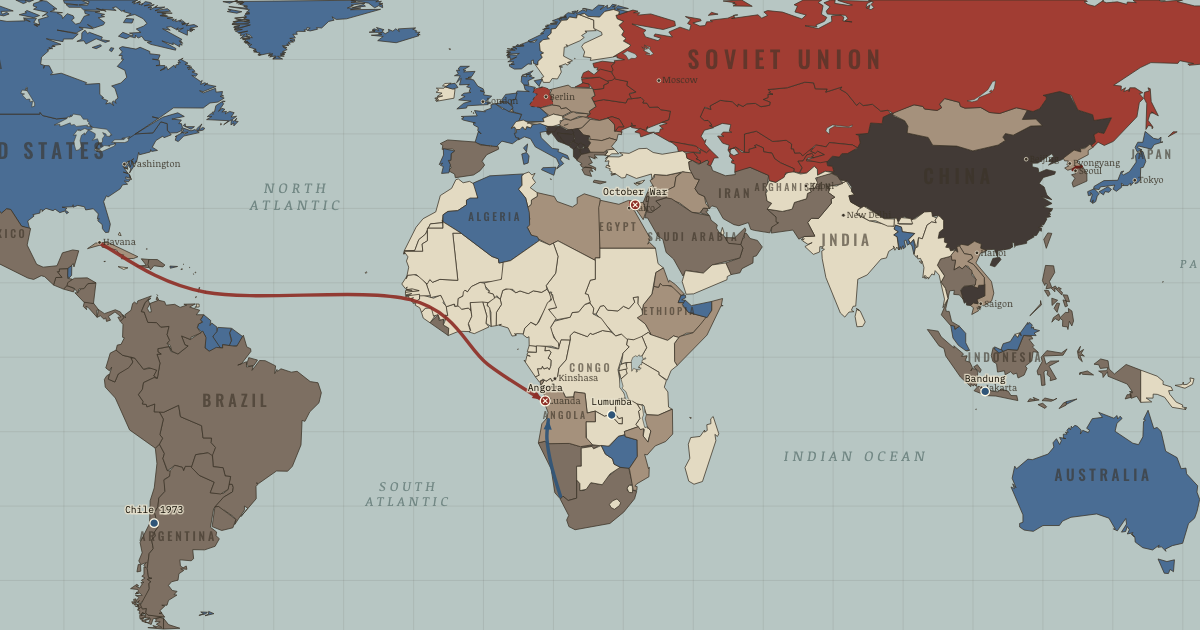
The map above is the world of NOV 1975 — The high-water mark.
BRIEF EXPLANATION — THE ESSENTIAL ARGUMENT
Decolonisation created dozens of new states between 1947 and 1975, and neither superpower could simply command them. Many accepted aid from both sides at once or joined the Non-Aligned Movement, using the rivalry as leverage even as outside intervention narrowed their real choices. The argument of this chapter is that the Third World acted as a set of players in the Cold War rather than a board on which the game was passively played.
The mechanisms varied from place to place. In the Congo the elected leader Lumumba was removed and murdered; in Chile an elected Marxist government fell to a US-backed coup; and in the Middle East and Angola, client pressure, resource politics and proxy war drew the great powers in. The communist-coloured map expanded through the 1970s, yet many of these new alignments brought Moscow costly subsidies and unwinnable wars rather than secure gains.
GUIDED EXPLANATION
Roughly ninety new states emerged from the collapse of Europe’s empires between 1947 and 1975. At Bandung in 1955 many of them rejected the demand that they enlist in one camp or the other, and the Non-Aligned Movement that grew out of it treated non-alignment as strategic flexibility rather than passive indifference. India, Egypt, Yugoslavia and others took aid and arms from both sides while guarding their independence, because playing the blocs against each other was the single form of leverage a poor state actually possessed.
Great-power intervention nonetheless carried grave consequences wherever it reached. In the Congo, Lumumba was removed and murdered once the crisis there became a Cold War contest; in Chile, a US-backed military coup destroyed an elected Marxist government in 1973; Egypt used the 1973 war and the diplomacy that followed to recover Sinai and move toward Washington; and in Angola a civil war turned international as South African forces, rival movements and Cuban troops arriving on Havana’s own initiative all converged. These cases restore local agency without denying unequal power, because clients could drag their patrons into danger while the most vulnerable leaders and civilians paid the highest price of all.
Empires fell for their own reasons. Bankruptcy, nationalism, the war’s shattering of white invincibility (Ch. 7’s Singapore lesson). But the Cold War changed how they fell: liberation movements shopped for patrons, and patrons’ rivalry converted local politics into proxy stakes. The tragedy ran both directions. Washington backed almost any anti-communist, however vicious (Mobutu, Pinochet, apartheid Pretoria), and Moscow’s “scientific socialism” wrecked half the economies it advised. The Cold War did not cause the Third World’s wars. It armed, funded and prolonged them.
The 1975–79 additions (Indochina, Angola, Mozambique, Ethiopia, Afghanistan, Nicaragua) convince Moscow the “correlation of forces” has turned. And every one of them becomes a subsidy sink and a guerrilla war. The US Congress, post-Vietnam, bars covert war in Angola (1976). Moscow reads restraint as retreat and overcommits. The high-water mark is also the overextension: within fifteen years, every tan state on this map except Cuba has left the column.
DEEP EXPLANATION — EVIDENCE & INTERPRETATION
Non-alignment as bargaining strategy
The label “Third World” can suggest passivity, but Bandung and the Non-Aligned Movement were deliberate projects to create room for independent action. Their leaders differed sharply in ideology and interest, and what joined them was a shared refusal of formal subordination together with support for decolonisation. Because each superpower feared losing influence to the other, these states could accept Soviet arms, American grain or Western credit without treating any single exchange as a permanent allegiance, and that freedom to shop was itself the source of their leverage. The tradeoff was dependence without guaranteed protection, since aid could build dams, universities and armies while the patrons attached conditions and, at times, backed coups against governments that crossed a perceived red line. Non-alignment worked best where a leader enjoyed several possible suppliers, solid internal legitimacy and valuable strategic resources, and it worked poorly where a state was internally divided or institutionally weak. The concept therefore describes neither complete autonomy nor disguised alignment, but an active and genuine strategy pursued inside a deeply unequal international system.
Why “chessboard” is an incomplete model
On a chessboard the pieces are moved entirely by outside players, and Cold War conflicts frequently ran in the opposite direction. Sadat launched the 1973 war partly to force diplomatic movement and then swung Egypt toward the United States. Castro committed Cuban forces to Angola with far more initiative than the image of an obedient Soviet proxy allows. Israel, Syria and other clients likewise created faits accomplis that their patrons then had to manage. Local actors chose their allies in order to pursue local struggles over state power, territory and security, and superpower money and weapons mainly lengthened those struggles and raised their destructive capacity. Agency was not distributed equally, since Washington, Moscow and the former colonial powers could withdraw support or impose economic costs that weaker states had no way to match, and the murders of Lumumba and Allende mark the deadly limits of independence. A layered explanation therefore has to hold two truths together at once: local actors shaped these conflicts, and external power decided who could survive them.
New here? Chapters 1–2 of every atlas are free to sample, and the WW2 atlas is free in full. One membership opens all thirteen — the Cartographer’s Circle.
THE SITES
ON THIS DAY
WHY IT HAPPENED
Decolonization and bipolarity, mutually radicalizing. Empires fell for their own reasons. Bankruptcy, nationalism, the war’s shattering of white invincibility (Ch. 7’s Singapore lesson). But the Cold War changed how they fell: liberation movements shopped for patrons, and patrons’ rivalry converted local politics into proxy stakes. The tragedy ran both directions. Washington backed almost any anti-communist, however vicious (Mobutu, Pinochet, apartheid Pretoria), and Moscow’s “scientific socialism” wrecked half the economies it advised. The Cold War did not cause the Third World’s wars. It armed, funded and prolonged them.
Non-alignment was a strategy, not a sentiment. India took Soviet steel mills and American wheat while lecturing both. Nasser took Soviet arms and hanged Egyptian communists. Tito collected Western loans against Soviet pressure. Playing the blocs was the one power available to poor states, and the skilled ones extracted dams, universities and armies from the auction. It had limits. Non-alignment could not stop coups or save Lumumba. But treat the Third World as chessboard and you will misread every move on this map: the pieces kept moving themselves.
Clients pulled patrons, not only the reverse. Sadat expelled 15,000 Soviet advisers in 1972, then attacked in 1973 partly to force both superpowers to take Egypt seriously. And afterward walked Egypt into the American column for a Sinai deal (watch the map flip in 1979). Castro sent troops to Angola before consulting Moscow. Israel, Syria, both Koreas, both Vietnams. All repeatedly presented their patrons with faits accomplis. The era looks bipolar from orbit. On the ground it is a bazaar of tails wagging dogs.
The oil weapon rewrites the ledger. The 1973 embargo and price shock. $3 to $12 a barrel. Ended the postwar boom, handed OPEC states sovereign power no colony ever had, and hit the oil-importing Third World hardest of all, driving the debt spiral of the 1980s. It also quietly propped the USSR (an oil exporter) for a decade. And its 1986 price collapse helps time the Soviet endgame. Follow oil through this era the way you followed it through 1941: it explains more than ideology.
THE TURN
October 1973 — the war that moved the pivot. Egypt’s canal crossing shatters Israeli invincibility in an afternoon. Israel’s counter-crossing nearly destroys Egypt’s Third Army. Washington’s nuclear alert (DEFCON III) answers a hinted Soviet intervention. Out of the near-catastrophe Kissinger builds step-by-step disengagement. And by decade’s end Egypt, the Arab world’s center of gravity and Moscow’s greatest Third World investment, has changed sides for American aid and the Sinai. The Cold War’s largest single defection is bought with diplomacy, not force: note the method as well as the prize.
WHAT IT CHANGED
Communism’s maximum map — and its hollowness. The 1975–79 additions (Indochina, Angola, Mozambique, Ethiopia, Afghanistan, Nicaragua) convince Moscow the “correlation of forces” has turned. And every one of them becomes a subsidy sink and a guerrilla war. The US Congress, post-Vietnam, bars covert war in Angola (1976). Moscow reads restraint as retreat and overcommits. The high-water mark is also the overextension: within fifteen years, every tan state on this map except Cuba has left the column.
The wounds that outlive the era. Mobutu’s Zaire, the Horn’s wars, Angola’s 27-year civil war, the Middle East’s garrison states, Latin America’s torture archives: much of what the 1990s called “failed states” and “ancient hatreds” was Cold War infrastructure. Armies built for patrons, borders held by aid, oppositions liquidated. When the subsidies stopped after 1991, the props fell. Reading those conflicts without this chapter is reading effects without causes.
Human rights enter the arsenal. Chile’s cruelty, broadcast, helped force the 1975 Helsinki Accords’ rights provisions and a US Congress that began conditioning aid. Carter made rights declaratory policy in 1977. Cynics noted the selectivity (allies’ crimes weighed lighter). Dissidents from Santiago to Moscow used the language anyway. The vocabulary that delegitimizes the Soviet bloc in the 1980s is field-tested on the West’s own clients first.
FIELD QUESTION — “The Third World was the Cold War’s chessboard.” Attack that sentence with evidence from this map.
Three moves. First, agency in the openings: Bandung, OPEC and the Non-Aligned Movement were initiatives no superpower wanted. The board organized itself. Second, agency in the crises: Sadat launched 1973 against Soviet advice. Castro’s Angola expedition ran ahead of Moscow. Both superpowers were repeatedly dragged by clients into confrontations they feared. Third, agency in the outcomes: the era’s biggest realignments. Egypt’s defection, the Sino-Soviet split, Iran’s revolution (which defected from both blocs at once). Were local choices that patrons could not prevent, only price. The honest residual: agency was asymmetric. Lumumba and Allende paid with their lives for moves great powers made cheaply. The board was real. So were the players standing on it. Precision about which was which, case by case, is the historian’s actual job.
AN INTERESTING FACT
Cuba filed its Atlantic expedition under history, not geopolitics: the intervention was code-named Operation Carlota, after an enslaved Yoruba woman who led an 1843 rebellion at the Triunvirato sugar mill in Matanzas — Havana casting the airlift as the slave trade’s descendants recrossing the ocean. The first special-forces companies flew in aging Bristol Britannia turboprops that hopped via Barbados and Guinea-Bissau; thousands more followed by sea on passenger ships. The campaign’s semi-official chronicler was Gabriel García Márquez, whose 1977 essay “Operation Carlota” remains the classic inside account.
THE DISPATCH
One short letter when a new atlas opens — and the printable study guide for The Cold War is yours now, free.
NO TRACKING · YOUR ADDRESS IS USED FOR THE DISPATCH AND NOTHING ELSE · UNSUBSCRIBE ANYTIME