MAPS OF HISTORY · The American Civil War · ALL CHAPTERS · CHAPTER 9
CHAPTER 9 · SEP–DEC 1864 · NOV 1864
The Ballot and the March
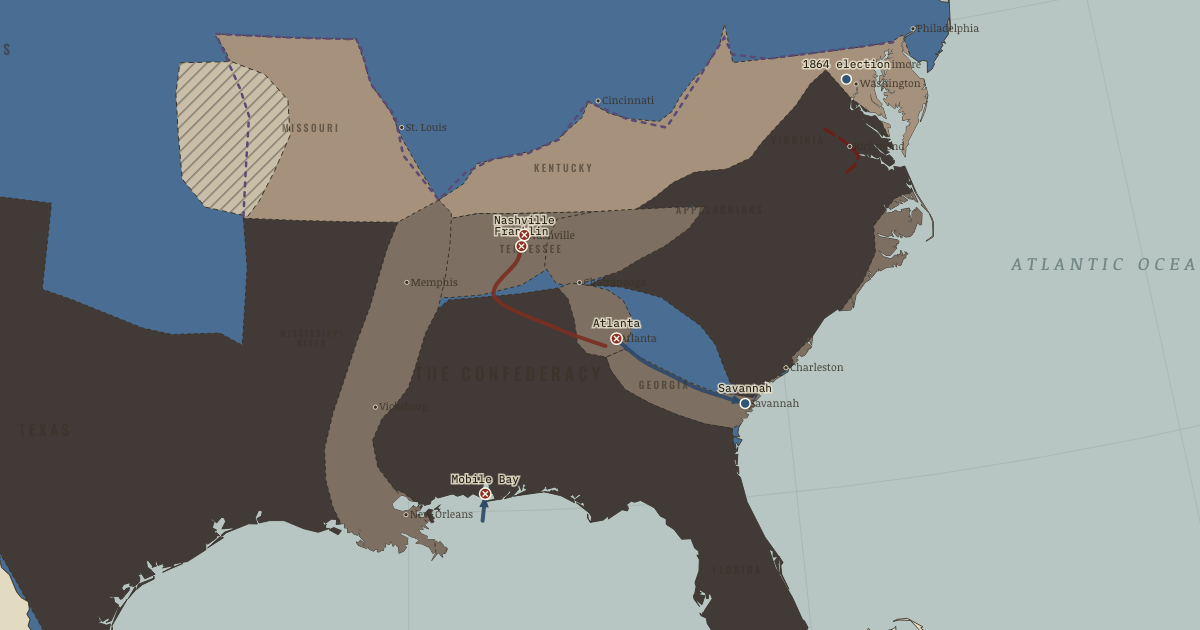
The map above is the world of DEC 1864 — The March to the Sea — and Nashville.
BRIEF EXPLANATION — THE ESSENTIAL ARGUMENT
The Confederacy’s last real chance of victory in 1864 lay not on any battlefield but at the Northern ballot box, and grasping that is the key to the year. By August, Lincoln himself expected he might lose re-election, since Confederate strategy depended on Northern war-weariness lasting until November. Then Mobile Bay closed, Atlanta fell, and Union success in the Shenandoah changed what voters expected, so Lincoln won 55 percent of the vote and ended the Confederacy’s best remaining hope for an armistice.
With the election settled, Sherman marched from Atlanta to Savannah, destroying railroads and war-supporting property while thousands of freedpeople followed his columns. Hood tried to reverse the board by invading Tennessee to draw Sherman back, but catastrophic attacks at Franklin and defeat at Nashville destroyed the Army of Tennessee as an effective force, leaving the Confederate territory on the map defended by little more than a claim.
GUIDED EXPLANATION
The election of 1864 functioned as a strategic deadline for both sides. The Democratic platform called the war a failure and demanded an armistice, and although McClellan personally rejected parts of it, an armistice with Confederate armies intact would in practice have meant independence, so Confederate survival until November might produce victory through Northern politics. Atlanta’s fall on 2 September gave voters the evidence they needed that Union armies were making progress. Soldiers voting in the field, who would themselves have to keep fighting, supported Lincoln by a wide margin.
Sherman then cut his supply line and marched across Georgia in a broad corridor, his forces living from the countryside and destroying the railroads, mills, cotton, and other property that sustained the Confederate war. The main design aimed at resources and morale, though civilians experienced dispossession, fear, and coercion, and specific acts of violence remain part of the record. For many enslaved people the same columns brought freedom. Hood’s counter-move into Tennessee failed disastrously at Franklin and Nashville, so that although Confederate territory remained on the map, its ability to defend that territory was collapsing.
Several mechanisms connected battlefield movement to the ballot, and following them shows why 1864 turned on morale as much as on ground. Farragut closed Mobile Bay in August, Sherman took Atlanta in September, and Sheridan defeated Early in the Shenandoah, and together these victories replaced an image of stalemate with evidence of progress. Lincoln won 55 percent of the popular vote and 212 electoral votes. No one can know exactly what a McClellan administration would have done, but an armistice with Confederate armies intact would have changed the bargaining position sharply. After the election, Sherman’s march tested whether Richmond could protect its interior or supply its remaining armies, and Hood’s attempt to force him back destroyed his own army instead, wrecking irreplaceable leadership at Franklin before Thomas broke it at Nashville. Military control and political legitimacy now reinforced each other, and the war’s outcome followed.
DEEP EXPLANATION — EVIDENCE & INTERPRETATION
Why an election became a front
After the defeats of 1863 the Confederacy could no longer expect to destroy the Union’s main military capacity, so it turned to the one target still within reach, which was the Northern electorate’s willingness to keep paying. Heavy Overland casualties, the draft, inflation, and apparent stalemate made that theory plausible in the summer of 1864. Atlanta mattered because it changed expectations, since voters did not need proof that the war was already over, only evidence that continued sacrifice could produce victory. The election’s counterfactual remains uncertain, because McClellan favored restoring the Union and might not have accepted Confederate independence, yet he ran on a peace platform, and an armistice would have stopped the armies while the Confederacy still existed. Lincoln’s victory removed that opening and strengthened the path to the Thirteenth Amendment. Democratic legitimacy thus functioned as a form of military capacity, since public consent determined how long material superiority could stay in the field.
Law, effect, and experience on the March
A fair interpretation of Sherman’s march separates three questions that are easily confused. First, Union policy under the Lieber Code permitted the destruction of property that supported enemy war-making, while violence against civilians remained forbidden. Second, the march was effective, since it damaged railroads and stores, demonstrated the Confederacy’s inability to protect its interior, and increased the desertion pressure that came from soldiers’ hungry families. Third, lawful design and strategic effect do not by themselves determine how the march was experienced. For white Georgians, foraging and destruction meant fear, hunger, humiliation, and loss, with disputed incidents that broad summaries cannot erase, while for enslaved people the same advance could mean liberation, dangerous flight, and uncertain protection. Historians therefore resist labels that end inquiry, since “atrocity” can flatten real distinctions in conduct while “humane shortening” can turn suffering into an abstraction. The campaign’s meaning changed across the color line and between headquarters orders and local encounters.
New here? Chapters 1–2 of every atlas are free to sample, and the WW2 atlas is free in full. One membership opens all thirteen — the Cartographer’s Circle.
THE SITES
ON THIS DAY
WHY IT HAPPENED
Why the election was the real front. The Confederacy’s theory after Gettysburg was explicit in Richmond’s papers: hold everywhere until November, bleed every assault, and let Northern war-weariness elect a peace. It nearly worked. Gold at 285, draft riots a year old, 55,000 Overland casualties on the front pages. Atlanta’s fall broke the theory not by killing an army but by proving the war was being WON. Morale in a democracy is a strategic commodity, and Sherman had just minted it.
The march as calculated demonstration. Sherman’s targets were chosen to answer one question in every Southern mind: can the Confederacy protect anything? Sixty thousand men strolling through the Confederacy’s heartland unopposed answered it. He called it “statesmanship”: making “old and young, rich and poor, feel the hard hand of war” so that they would remember what rebellion costs. Terror of property, mercy of persons. Judge the formula honestly in both halves.
Hood’s inversion. Hood reasoned that following Sherman meant impotence, so he would reverse the board: take Nashville, threaten the Ohio, force Sherman home. The premise required beating Thomas with a smaller, worse-supplied army in winter. Hope substituting for calculation. Franklin was the result of frustration at a missed maneuver the day before. Nashville was the only battle of the war that destroyed an army as a functioning organization. Desperation is not audacity, though it wears the same uniform.
THE TURN
8 November 1864 — the Union votes. Had McClellan won, armistice talks. However he personally wavered. Would have stopped the armies with the Confederacy intact and slavery negotiable. Every European chancellery read it that way. Lincoln’s re-election closed the last exit short of unconditional victory and, with it, guaranteed the Thirteenth Amendment (passed by the lame-duck House in January, with the President twisting arms for votes). The war’s true turning points are 1863’s twin blows and this ballot. The battles of 1865 execute what November decided.
WHAT IT CHANGED
The Confederacy’s interior collapses. After the march, Confederate soldiers’ letters change: desertion becomes an epidemic driven by letters FROM home. Armies can survive defeat, but not their families’ hunger. By spring Lee is losing a regiment a night from the Petersburg lines. Wars of national will end when the nation, not the army, breaks.
Savannah, and the sea reached. Hardee’s 10,000 defenders slip across the river rather than be trapped, and Sherman takes the city intact on 21 December. The Christmas-gift telegram closes the campaign having cost him fewer than 2,200 casualties for 300 miles of the Confederacy’s interior. Resupplied by the fleet, he turns north toward the Carolinas and a junction with Grant. The last geometry of the war, next chapter. On the map, the charcoal east of the Mississippi is now an archipelago: patches of claim with no army between them.
Forty acres — a promise made in passing. In January 1865, to deal with the freedpeople following his army, Sherman’s Field Order No. 15 set aside the sea islands and a coastal strip for Black settlement in forty-acre plots. It was military improvisation, later revoked by Andrew Johnson. But it entered memory as the measure of what emancipation might have materially meant. Hold it for Chapter 11.
FIELD QUESTION — Sherman’s march is still argued over: atrocity, or the most humane way to shorten a war? Set the terms of a fair verdict.
First separate categories: by the laws of war then emerging (Lieber’s 1863 code, which Sherman knew), destroying war-sustaining property was lawful. Violence against persons was not. And the march’s record is heavy on the first and, by the standards of any war, remarkably light on the second (Columbia’s burning in February remains the genuinely contested case). Second, compare against the real alternative: not peace, but more Franklins. Frontal war into 1866. Third, count the uncounted: for the enslaved, the march was liberation arriving in person. For white Georgia it was ruin and humiliation remembered for a century as wanton. A fair verdict holds all three: lawful in design, effective in fact, merciless in intent toward property. And experienced utterly differently on the two sides of the color line it cut across. Beware any account that gives you only one of those sentences.
AN INTERESTING FACT
Field Order No. 15 was not a general’s brainstorm — it was minuted testimony. Four days before issuing it, Sherman and Secretary of War Stanton sat down in Savannah with twenty Black ministers and lay leaders and asked them, question by recorded question, what their people needed — almost certainly the first time the United States government formally consulted Black Southerners about their own future. Their spokesman, Garrison Frazier — a 67-year-old Baptist minister who had bought freedom for himself and his wife with $1,000 in gold and silver — answered without hesitating: “The way we can best take care of ourselves is to have land, and turn it and till it by our own labor.” The forty acres were, nearly verbatim, what the freedpeople had asked for.
THE DISPATCH
One short letter when a new atlas opens — and the printable study guide for The American Civil War is yours now, free.
NO TRACKING · YOUR ADDRESS IS USED FOR THE DISPATCH AND NOTHING ELSE · UNSUBSCRIBE ANYTIME