MAPS OF HISTORY · The American Civil War · ALL CHAPTERS · CHAPTER 12
EPILOGUE · MEMORY AND MEANING · DEC 1865
Memory and Meaning
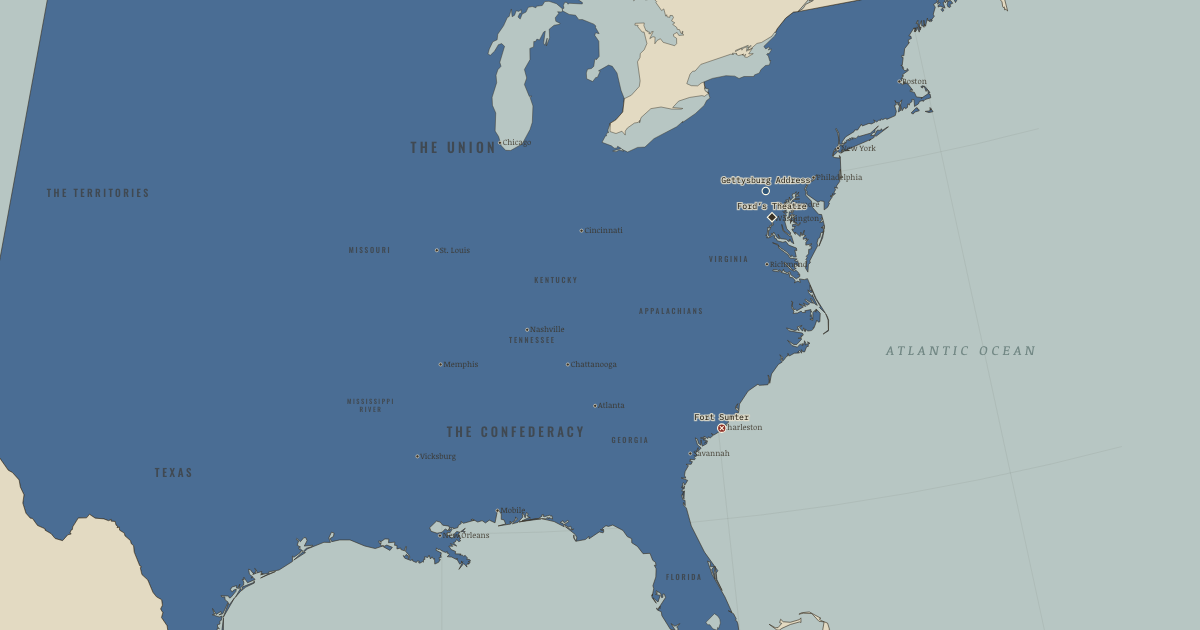
The map above is the world of DEC 1865 — The Thirteenth Amendment.
BRIEF EXPLANATION — THE ESSENTIAL ARGUMENT
The war’s cost is the place to begin any honest reckoning with its meaning. The traditional count of the dead was about 620,000, while demographic research now suggests roughly 750,000, and real uncertainty still surrounds the figure. Disease killed more soldiers than battle did, and the deaths of Black civilians during displacement and liberation were never fully counted. What that price bought was clear: the Union was preserved and slavery abolished.
Memory afterward tried to separate the soldiers’ valor from the cause they served. The Lost Cause interpretation minimized slavery and portrayed Reconstruction as oppression, and monuments and textbooks carried that account through the decades of segregation. The evidence from secession and wartime policy restores slavery to the center of the story without denying individual grief or courage, and this atlas holds both together.
GUIDED EXPLANATION
The human ledger of the war is uncertain, and its uncertainty is part of the evidence. Muster-roll totals produced the older estimate of about 620,000 military deaths, while demographic work comparing census survival rates suggests something closer to 750,000. Disease, poor sanitation, and crowded camps killed more soldiers than weapons did. Civilian losses, especially among displaced and formerly enslaved people, are far less complete. These numbers are not decoration, because they set the cost beside the outcomes: the Union survived, slavery ended, and the content of citizenship remained contested.
The war was then fought a second time in memory. Lost Cause writers presented an honorable conflict over states’ rights, reduced the importance of slavery, and condemned Reconstruction, and white reconciliation made that story attractive because it could honor soldiers on both sides without confronting Black rights. Many Confederate monuments rose during the era of segregation, when public memory was doing the work of present politics. Mourning the Confederate dead is a different act from endorsing the Confederate cause, and the evidence permits both sober respect for suffering and a clear judgment about what secession defended.
Lincoln’s Gettysburg Address offers a different chain of meaning from the one the Lost Cause built. It tied the survival of the Union to government by the people and described emancipation as part of a “new birth of freedom,” and the Thirteenth Amendment made abolition permanent in December 1865 while the Fourteenth and Fifteenth later defined the citizenship and voting the battlefield alone could not secure. Memory changed because later generations chose different parts of that settlement, so that veterans’ reconciliation could heal real grief while leaving Black Americans out of the reunion, and textbooks and monuments could honor individual sacrifice while teaching a false account of secession’s cause. The final map therefore settles only two questions: the Union remained one nation, and legal human property ended. It cannot show whether constitutional citizenship became lived equality, and that unfinished question links the war’s memory directly to Reconstruction and to the civil-rights struggle that followed.
DEEP EXPLANATION — EVIDENCE & INTERPRETATION
What the death estimates can support
The traditional figure of 620,000 was assembled from military records that were incomplete, especially for Confederate forces. J. David Hacker’s demographic method compared census survival patterns and produced an estimate near 750,000, usually expressed as a range rather than an exact count. Each method has its constraints, since records omit people while census inference depends on assumptions about migration and expected mortality. The deaths of Black civilians in camps, in flight, from disease, and in wartime disruption are especially hard to quantify. The responsible conclusion is not to choose the larger number because it feels more serious, but to report the method and the uncertainty while recognizing that either estimate represents an extraordinary share of a population of about 31 million. Quantification changes interpretation only when its limits travel with it, and the missing names and categories are themselves part of the historical evidence rather than noise to be discarded.
How the Lost Cause did political work
Lost Cause interpretation grew through memoirs, veterans’ groups, monuments, textbook campaigns, and national reunion. It emphasized military valor and local loyalty, treated slavery as secondary, and described Reconstruction governments as corrupt alien rule. This story met several needs at once, since former Confederates could preserve their honor, white Northerners could celebrate reunion, and segregationists could portray Black political participation as a historic mistake. The dates of the monuments matter, because many were installed during disfranchisement and again during the civil-rights conflict rather than immediately after bereavement. That pattern does not assign a single motive to every donor or community, since memorials can carry grief, civic identity, and political assertion at the same time. Historical criticism asks which claims survive the primary evidence, and the secession declarations and the Confederacy’s own constitutional choices make slavery central. Recognizing that does not deny courage or mourning; it keeps those human experiences from being used to erase the cause they served.
New here? Chapters 1–2 of every atlas are free to sample, and the WW2 atlas is free in full. One membership opens all thirteen — the Cartographer’s Circle.
THE SITES
ON THIS DAY
WHY IT HAPPENED
Why the Lost Cause won the memory war for so long. Reconciliation between white North and South was purchased by dropping the war’s racial meaning: reunion literature, joint veterans’ encampments and Wilson-era histories all found it easier to honor mutual valor than to say what the valor had been for. Add who wrote the textbooks (the United Daughters of the Confederacy vetted them across the South) and who was disfranchised while they were written, and the outcome needs no conspiracy. Memory follows power unless deliberately checked by evidence.
What the numbers do to interpretation. 750,000 dead reframes moral judgments: it is the strongest argument of the war’s critics (could compensated emancipation have been cheaper than Shiloh times forty?. Lincoln proposed it. The South refused it even in 1862), and the strongest argument of its defenders (a price that scale is only paid for something that could be won no other way). Keep the number attached to every abstraction in this atlas. It is what “hard war” and “unconditional” cost in circles of mourning.
The war as the modern state’s forge. Income tax, national currency and banking, conscription, the Homestead and Morrill Acts, the transcontinental railroad chartered mid-war. The United States that emerges is a continental nation-state with an activist government, singular noun (“the United States IS”). The war settled a constitutional argument and built, almost inadvertently, the machinery every later reform would use.
THE TURN
Gettysburg, 19 November 1863. Choose the war’s meaning-hinge, not its military one: in redefining the war as a proposition about equality being tested, Lincoln bound the Union cause to the Declaration rather than merely the Constitution. Making emancipation not a war measure but the war’s point, and handing every later generation the standard (“unfinished work”) by which to judge the peace. Wars are won on maps. What they MEAN is won in words, and these 272 have outlasted every gun on this atlas.
WHAT IT CHANGED
What stayed settled. No state has attempted secession since. The Thirteenth Amendment has never been seriously challenged. “the Union” stopped being a debating point and became the weather. Constitutional questions truly closed by force are rare in history. This atlas shows the price of closing one.
What stayed open. Citizenship’s content. The vote, the school, the jury, the deed. Remained contested from Colfax to Selma along precisely the lines this map drew. Read any twentieth-century civil-rights map beside this one: the geography rhymes, county by county. That planned atlas is this one’s sequel in spirit.
Your map, your questions. Switch to Free Explore: scrub 1861–65 and trace one thing all the way through. The Mississippi closing like a zipper, the tan border belt that never flips, the hatched guerrilla country that no army ever pacified, Charleston harbor from Sumter’s first shell to the flag re-raised over it on 14 April 1865 (the day of Ford’s Theatre. This war ends on coincidences no novelist would risk). Every color change is a hundred books. Pick one.
FIELD QUESTION — Was the Civil War “irrepressible” — or a failure of politics that better statesmen could have avoided?
Take the avoidable case seriously: wars require decisions, and you can name each one (Kansas–Nebraska, Dred Scott, secession itself, Sumter) and imagine it otherwise. A generation of “blundering” historians did. Then test the counterfactuals against the structure: every compromise on offer. Crittenden, compensated emancipation, extended lines. Required one section to accept slavery’s eventual death or the other to accept its permanence, which is not a middle but a winner. Peaceable exits existed only if four million people remained property indefinitely. That is a price, not a solution, and the enslaved themselves. Running, resisting, and finally soldiering. Were actors who foreclosed it. The mature answer: the CONFLICT was irrepressible because it was zero-sum at its core. The WAR’s timing, length and horror were contingent on choices this atlas has charted. Distinguishing a conflict from its war. What had to happen from what was chosen. Is perhaps the discipline this entire subject exists to teach.
AN INTERESTING FACT
The war’s pension ledger closed within living memory: Irene Triplett — daughter of Mose Triplett, a North Carolinian who deserted the Confederate army and re-enlisted in Union blue — was still drawing her father’s pension of $73.13 a month when she died in 2020, a century and a half after Appomattox. The last old soldiers tell a memory-war story of their own: the last verified Union veteran, Albert Woolson, died in 1956, while every man afterward celebrated as the “last Confederate veteran” has failed documentary checking — Walter Williams, feted nationally and mourned by presidential proclamation in 1959, appears in the 1860 census as a five-year-old. Even the war’s endings needed embellishing.
THE DISPATCH
One short letter when a new atlas opens — and the printable study guide for The American Civil War is yours now, free.
NO TRACKING · YOUR ADDRESS IS USED FOR THE DISPATCH AND NOTHING ELSE · UNSUBSCRIBE ANYTIME