MAPS OF HISTORY · The Decolonization of Africa · ALL CHAPTERS · CHAPTER 3
CHAPTER 3 · 1947–1957 · MAR 1957
Ghana — The Model
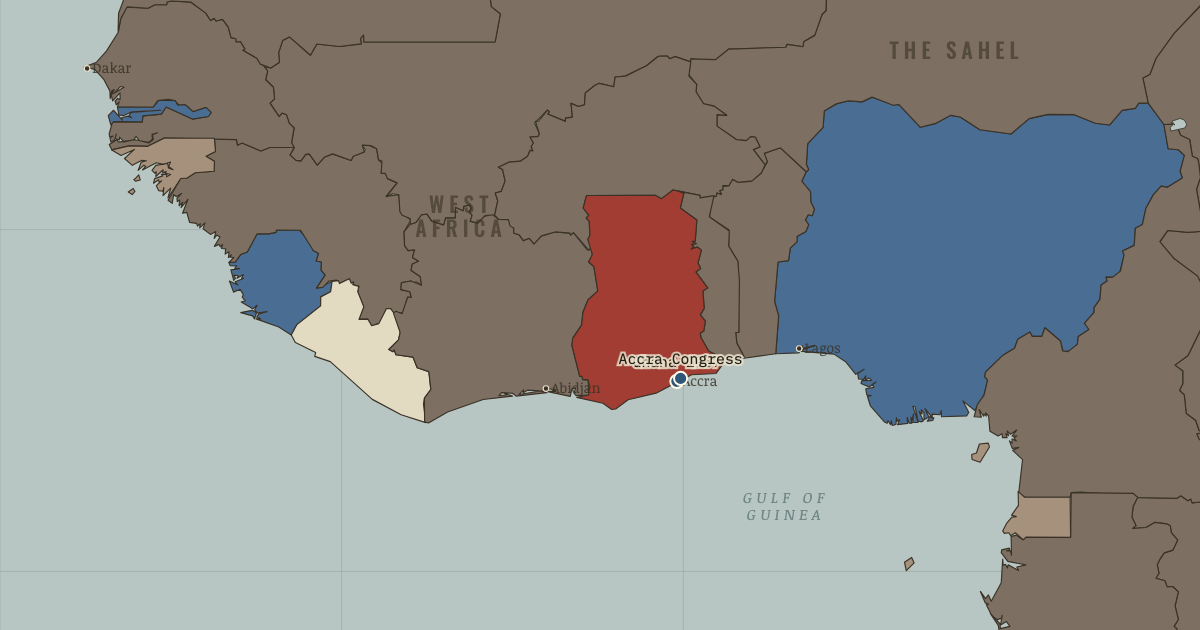
The map above is the world of MAR 1957 — Ghana — the door opens.
BRIEF EXPLANATION — THE ESSENTIAL ARGUMENT
Ghana matters out of all proportion to its size because it was the first colony south of the Sahara to win its freedom, and it did so in a way the rest of the continent could copy. At midnight on 6 March 1957 the Gold Coast became Ghana under Kwame Nkrumah, who had risen from a prison cell to prime minister in a handful of years. His achievement rested on a new kind of politics: the Convention People’s Party turned nationalism from the polite petitioning of educated elites into a mass movement rooted in market women, war veterans, clerks and the young. Once the party won elections by overwhelming margins, keeping its leader in jail became impossible, and Britain chose to hand over power rather than fight an unwinnable resistance.
Ghana became a model for two further reasons, one hopeful and one cautionary. Its independence was negotiated rather than won by war, its cocoa exports gave the new state real revenue, and Nkrumah insisted that Ghana’s freedom meant little until the whole continent was free, which made Accra the headquarters of African liberation. The same story exposed a problem that would recur everywhere. A movement superbly built for seizing power could, once in office, grow centralized and intolerant of dissent, and an economy resting on a single crop stayed hostage to a price set abroad. Ghana pioneered both the triumph and the disappointment of independence.
GUIDED EXPLANATION
The Gold Coast reached independence first because of how Nkrumah organized, not because of any special favour. Earlier nationalists had worked through small circles of lawyers and respectful constitutional petitions, whereas Nkrumah built a disciplined mass party with local branches, its own newspapers and youth wings, and a talent for public spectacle. Its method, which he called Positive Action, combined strikes, boycotts and non-violent defiance on Gandhi’s pattern, and it made the colony expensive to govern while proving at the ballot box that the party spoke for the country. When Britain jailed him in 1950, his party’s landslide the following year forced the governor to release him to form a government.
Britain conceded because the arithmetic favoured concession. The Gold Coast was prosperous, relatively literate and small, with almost no white settlers demanding continued minority rule, which made it the cheapest possible place to show that an orderly handover could work; after the humiliation of Suez, a cooperative Ghana tied to the Commonwealth looked worth more than a war. Cocoa revenue made sovereignty appear self-financing, yet that same dependence on one export left the country exposed when prices later fell. Nkrumah, meanwhile, began restricting the opposition and building toward one-party rule. Independence solved the problem of foreign rule, but it did not by itself solve economic dependence or supply the habits of institutional restraint.
Nkrumah’s decisive innovation was organizational. Earlier nationalists (the lawyer-led UGCC he broke from) petitioned politely. Nkrumah built a disciplined mass movement with branches, newspapers, youth wings and a genius for spectacle. It could mobilize hundreds of thousands and make the colony ungovernable without violence. This machine, copied across the continent, is why independence movements suddenly had irresistible weight.
Ghana’s formula. Mass party, jailed leader, negotiated handover, midnight flag. Was studied and copied from Lagos to Nairobi to Lusaka. Nkrumah made Accra the headquarters of African liberation, bankrolling the 1958 All-African Peoples’ Conference (the marker) where a young Lumumba and others learned the trade. The door, once open, could not be closed.
DEEP EXPLANATION — EVIDENCE & INTERPRETATION
From Elite Petition to Mass Movement
The decisive innovation in Ghana was organizational rather than ideological. Earlier Gold Coast nationalists had operated through educated elites and constitutional petitions that colonial governments could safely ignore, while Nkrumah created a party capable of mobilizing social groups well beyond that narrow circle. Positive Action joined strikes, boycotts and civil disobedience to full participation in elections, and this combination made simple repression ineffective. Imprisoning Nkrumah only enlarged his standing, and the party’s 1951 victory demonstrated to the colonial administration that he commanded a constituency it could neither govern around nor wish away. The episode illustrates a wider truth about this era, that nationalism became irresistible when its ideas were fused to durable organization. Britain’s own calculation still counted, since officials judged that a gradual, negotiated transfer would preserve trade and avoid a costly conflict, especially where no large settler population stood in the way. Ghana’s independence was therefore a negotiated outcome produced by mass pressure, electoral proof and a shifting imperial sense of cost, rather than a gift bestowed or a victory seized in battle.
Why the Tools of Liberation Did Not Guarantee Freedom
A liberation party is designed to unite its supporters against a single clear opponent, whereas a democratic government must manage disagreement among its own citizens once that opponent has gone, and these are genuinely different tasks. The centralized discipline that let the CPP force constitutional change later made ordinary dissent look like disloyalty to the national project. Falling cocoa prices and ambitious spending on development intensified the strain, and Nkrumah responded with preventive detention and eventually a one-party state, before the army overthrew him in 1966. Historians still weigh how much of this owed to external economic pressure, how much to real security threats, and how much to his own authoritarian choices. The transferable point is not that failure was destined. It is that independence removed the foreign ruler while leaving in place commodity dependence, a state apparatus built for control, and few checks on executive power. Ghana pioneered both political liberation and the long postcolonial argument about how quickly the drive for unity turns into coercion.
New here? Chapters 1–2 of every atlas are free to sample, and the WW2 atlas is free in full. One membership opens all thirteen — the Cartographer’s Circle.
THE SITES
ON THIS DAY
WHY IT HAPPENED
The invention of the mass party. Nkrumah’s decisive innovation was organizational. Earlier nationalists (the lawyer-led UGCC he broke from) petitioned politely. Nkrumah built a disciplined mass movement with branches, newspapers, youth wings and a genius for spectacle. It could mobilize hundreds of thousands and make the colony ungovernable without violence. This machine, copied across the continent, is why independence movements suddenly had irresistible weight.
“Positive Action” and prison as credential. Borrowing from Gandhi, Nkrumah met colonial power with strikes, boycotts and calculated civil disobedience. Costly to suppress, impossible to answer with reform alone. His 1950 imprisonment made him a martyr and his 1951 landslide made him unavoidable. Britain freed him to govern because the alternative was permanent unrest. Jail became a qualification, not a disqualification. A pattern from Kenyatta to Mandela.
Why Britain conceded the model. The Gold Coast was prosperous, literate and relatively small, with few white settlers to defend. The cheapest possible place to prove that “orderly” decolonization could work. After the humiliation of Suez, Macmillan’s Britain judged that granting independence to a friendly Ghana, tied to the Commonwealth and sterling, protected more interests than a war would. Ghana was a controlled experiment the empire chose to pass.
Cocoa: an economy that could pay. The Gold Coast was the world’s leading cocoa producer, which gave the new state real revenue and made independence appear self-financing. But it also chained Ghana to one crop at a price set in London and New York. When cocoa prices later collapsed, so did the model’s economic promise. The dependency the colony was born with outlived the flag.
THE TURN
Accra, midnight, 6 March 1957. The Union Jack comes down, the new flag rises, and Nkrumah declares Ghana free. “forever.” The moment is engineered as a continental broadcast: he immediately reframes it as a down-payment on the liberation of all Africa, funds movements across the continent, and hosts the pan-African conferences that follow. One small colony’s midnight becomes the proof of concept and the rallying cry for every colony still waiting. After Accra, the question everywhere is no longer whether, but when.
WHAT IT CHANGED
The template goes continental. Ghana’s formula. Mass party, jailed leader, negotiated handover, midnight flag. Was studied and copied from Lagos to Nairobi to Lusaka. Nkrumah made Accra the headquarters of African liberation, bankrolling the 1958 All-African Peoples’ Conference (the marker) where a young Lumumba and others learned the trade. The door, once open, could not be closed.
And so do the warning signs. Within a few years Nkrumah had banned opposition, jailed rivals under a Preventive Detention Act, and declared a one-party state with himself as “Osagyefo,” redeemer. When cocoa prices fell, the economy foundered. In 1966 the army overthrew him (Chapter 7). Ghana pioneered both the triumph and the disappointment. A warning printed in the same type as the model.
Pan-Africanism versus the nation-state. Nkrumah wanted a United States of Africa and argued that small separate states would stay economically dependent. “neo-colonial.” Most other leaders, jealous of their new sovereignty, preferred the nation-state and the borders they had inherited. That argument, joined here, is settled against Nkrumah at the OAU’s founding. And it is worth asking who was right.
FIELD QUESTION — Ghana reached independence peacefully and prosperous, the envied model. Why did the model prove so much harder to sustain than to achieve?
Independence removed the colonizer but not the structures colonialism left: an economy pinned to a single export at prices set abroad, a state apparatus built to extract rather than develop, borders enclosing peoples with no shared history, and institutions with shallow roots. Nkrumah’s mass party was superb for winning power and poor for the patient, pluralist work of governing. Facing real economic shocks (collapsing cocoa prices) and real opposition, it slid toward one-party rule and cult, then a coup. The deeper lesson, visible right across this atlas, is that political independence is the easier half. The flag can be won in a decade, but building states, economies and institutions capable of delivering on independence’s promise is the work of generations, and colonialism deliberately left almost none of the foundations.
AN INTERESTING FACT
Ghana’s flag — red, gold, green, one black star — was the work of Theodosia Okoh, a teacher and artist, and the star is a deliberate quotation: it honours the Black Star Line, the shipping company Marcus Garvey founded in 1919 to reconnect Africa with its diaspora, and it still names the national football team, the Black Stars. Among the guests at the midnight ceremony stood both Richard Nixon and Martin Luther King Jr., who flew home to preach that “Ghana tells us that the forces of the universe are on the side of justice.”
THE DISPATCH
One short letter when a new atlas opens — and the printable study guide for The Decolonization of Africa is yours now, free.
NO TRACKING · YOUR ADDRESS IS USED FOR THE DISPATCH AND NOTHING ELSE · UNSUBSCRIBE ANYTIME