MAPS OF HISTORY · The Decolonization of Africa · ALL CHAPTERS · CHAPTER 12
EPILOGUE · THE LEDGER OF FREEDOM · JUL 1994
What Independence Achieved, and Could Not
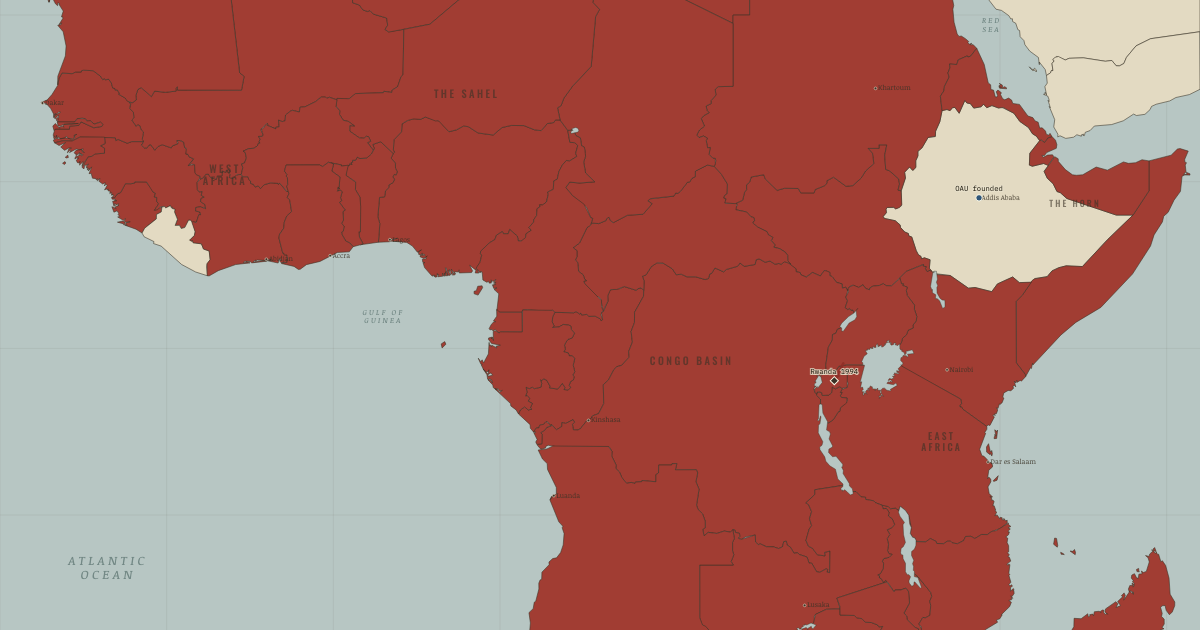
The map above is the world of APR 1994 — South Africa votes — the map completes.
BRIEF EXPLANATION — THE ESSENTIAL ARGUMENT
By 1994 the political decolonization of Africa was complete, and the map recorded a transformation from a continent ruled almost entirely from Europe into a continent of sovereign states under majority government. The achievements were real and are easily forgotten. Across most of Africa, self-rule was accompanied by the expansion of schooling and universities, the building of health systems, and rising life expectancy, all from a colonial baseline that had invested almost nothing in African welfare. The gains varied from place to place, and later crises reversed some of them, but the simple fact of ending foreign rule and its daily indignities was itself an enormous human gain.
What independence could not do is equally real, and honesty requires naming both sides of the ledger. The economies stayed colonial in shape, dependent on a few commodities at prices set abroad, and the debt crisis and structural-adjustment programmes of the 1980s cut into the very spending that had driven the early progress. The frozen borders held, but the cycle of coups spun on and one-party states too often hardened into personal rule. In the same weeks that South Africa voted its way to freedom, genocide in Rwanda killed some 800,000 people, overwhelmingly Tutsi, while the world did nothing. That atrocity must be remembered soberly and never folded into a scorecard. Decolonization was a successful liberation and, at the same time, an unfinished project of building accountable states and more independent economies.
GUIDED EXPLANATION
The completed map answers one question without ambiguity, which is that colonial and settler rule did not survive. Across much of the continent, governments expanded schools, universities, health care and African participation in public life from a very low colonial starting point, and life expectancy rose substantially by 1990, though any continent-wide figure depends on the dates and measures chosen. Political dignity and control over national decisions were gains in their own right, and measured against the foreign rule, racial hierarchy and extraction of 1945, the transformation is profound. The pessimism that writes the whole era off as failure answers a question the people who lived through it would not recognize.
The limits were structural and political in equal measure. Many economies still leaned on a handful of exports, and the debt and structural-adjustment programmes of the 1980s forced cuts to public spending. Colonial states had concentrated coercive power, and some liberation parties or soldiers turned that machinery toward one-party or personal rule. Rwanda stands as the darkest counterpoint, where the genocide of 1994 murdered about 800,000 people while international actors failed to intervene, and where the RPF’s advance finally ended the killing; its causes, and the Congo wars that followed, demand treatment of their own. Weighed honestly, decolonization was a genuine liberation and, simultaneously, the unfinished work of building accountable states and more independent economies.
It is easy, amid the disappointments, to forget the gains. Independence brought, across most of the continent, dramatic rises in life expectancy (roughly ten added years by 1990), mass expansion of literacy and schooling, the building of universities and health systems from a colonial near-vacuum, and the dignity and agency of self-government. Measured against the extractive, under-invested colonial baseline of 1945, these are transformative human gains. The denominator matters, and the honest ledger starts here.
In the same weeks the map completed in red, some 800,000 Rwandans were murdered in a hundred days while the world looked away. It is named here soberly and only once: as the era’s darkest hour and the proof that liberation from colonialism did not immunize the continent against catastrophe. Often catastrophe with colonial roots (the Belgians’ racial classification of Hutu and Tutsi among them). Its full account, and the Congo wars that followed, belong to the planned atlas of conflict and intervention. Remember the dead of Rwanda.
DEEP EXPLANATION — EVIDENCE & INTERPRETATION
Why the Chosen Baseline Decides the Verdict
Calling decolonization a success or a failure requires stating the comparison being made, because the answer changes entirely with the baseline. Measured against the hopes of rapid prosperity, stable democracy and continental unity, the record holds severe disappointments. Measured against the foreign rule, racial hierarchy, restricted education and extractive government of 1945, the achievement is profound. A fair assessment also separates political sovereignty from later development outcomes, since independence leaders inherited borders and commodity economies they did not design, yet still made their own choices about repression, public investment and corruption. External responsibility and local agency therefore coexist rather than cancelling each other out. The useful method is a layered ledger: identify what liberation directly achieved, then the constraints inherited from colonialism and the international economy, and finally the choices made within those constraints. This approach avoids both colonial nostalgia, which treats later problems as proof that empire should have continued, and a romantic nationalism that treats the raising of a flag as sufficient evidence that liberation’s promises were kept.
Rwanda at the Edge of This Atlas
From April to July 1994, extremist leaders and militias organized a genocide against the Tutsi, and many Hutu who opposed the killing were murdered as well. About 800,000 people were killed, though estimates vary. Colonial rule had hardened social categories through racial theories and the administration of identity, yet that inheritance alone does not explain the genocide, which also required postcolonial political choices, civil war, propaganda, careful organization and international failure. The Rwandan Patriotic Front’s military advance ended the killing and produced a new government, while the regional wars that followed demand analysis well beyond this atlas’s frame of decolonization. Rwanda appears here because it coincided exactly with South Africa’s democratic transition and so prevents any simple triumphal ending. It must not be used to cancel the achievement of independence, nor to supply dramatic contrast at the victims’ expense. Remembering it properly requires precision, restraint, and a refusal to turn atrocity into a lesson scored against another country’s freedom.
New here? Chapters 1–2 of every atlas are free to sample, and the WW2 atlas is free in full. One membership opens all thirteen — the Cartographer’s Circle.
THE SITES
WHY IT HAPPENED
The real achievements, named. It is easy, amid the disappointments, to forget the gains. Independence brought, across most of the continent, dramatic rises in life expectancy (roughly ten added years by 1990), mass expansion of literacy and schooling, the building of universities and health systems from a colonial near-vacuum, and the dignity and agency of self-government. Measured against the extractive, under-invested colonial baseline of 1945, these are transformative human gains. The denominator matters, and the honest ledger starts here.
The limits colonialism built in. Independence could not quickly undo what it inherited: economies pinned to single commodities and foreign prices, no industrial base, arbitrary borders, tiny educated classes, states built to extract rather than serve. The 1980s debt crisis and IMF structural adjustment. Cuts to the very health and education spending that had driven the early gains. Rolled back much progress. Much of what “independence failed to deliver” was structurally foreclosed by how colonies had been built and how the global economy was arranged.
The coup cycle and the strongmen. The frozen borders prevented inter-state war but not internal breakdown: waves of coups, the calcification of liberation movements into one-party and one-man rule, and Cold War patrons propping up “their” dictators (Mobutu the emblem) all followed from weak institutions, winner-take-all politics, and economies too fragile to sustain pluralism. The gap between the promise of 1960 and the rule of the strongman is the era’s central disappointment. And its causes are structural as much as personal.
THE TURN
Pretoria, 10 May 1994 — the ledger’s closing entry. Mandela’s inauguration completes the map and closes the era this atlas covers: a continent that in 1945 was almost wholly ruled from Europe now governs itself entirely. It is the right place to weigh the whole account. Neither the triumphalism that ignores the coups, wars and unmet promises, nor the pessimism that forgets the fifteen added years of life, the schools and universities, and the simple, vast fact of self-rule. Both are true at once. The Union Buildings ceremony is not the end of Africa’s story. It is the end of the beginning. The completion of liberation, and the opening of the far longer question of what free nations do with their freedom.
WHAT IT CHANGED
Rwanda, April 1994 — the darkest counterpoint. In the same weeks the map completed in red, some 800,000 Rwandans were murdered in a hundred days while the world looked away. It is named here soberly and only once: as the era’s darkest hour and the proof that liberation from colonialism did not immunize the continent against catastrophe. Often catastrophe with colonial roots (the Belgians’ racial classification of Hutu and Tutsi among them). Its full account, and the Congo wars that followed, belong to the planned atlas of conflict and intervention. Remember the dead of Rwanda.
Afro-pessimism versus the democratic wave. The 1990s brought a fashionable Afro-pessimism. The continent written off as a hopeless case. It was always too simple. The same decade saw a genuine democratic wave: one-party states falling to multiparty elections across the continent, the end of apartheid, the winding-down of the Cold War proxy wars in Angola and Mozambique. The record is neither triumph nor tragedy but a hard, mixed, ongoing struggle. And judging it requires holding both the gains and the failures in view at once.
Your map, your questions. Switch to Free Explore: scrub the whole timeline and watch fifty years of liberation compress into the rise of a single colour. Click any country and trace its own road. Ghana’s pioneering hope, Algeria’s terrible war, the Congo’s tragedy, South Africa’s long-deferred dawn. Every colour change on this map is a nation’s whole history. Pick one, and follow it.
FIELD QUESTION — Was the decolonization of Africa a success or a failure — and why is the way you frame that question as important as the answer?
The honest answer is that it was a profound success at its own core task and a disappointment against the hopes it raised. And that the two verdicts are not contradictory. As liberation, it succeeded completely: within fifty years a continent almost wholly ruled from Europe governed itself, and the human gains of self-rule (life expectancy up roughly a decade, mass education, the end of colonial dispossession and daily racial subjection) are enormous and real. As a promise of development, prosperity and stable democracy, it fell short. Undone by colonial economic structures it could not quickly escape, arbitrary borders, shallow institutions, Cold War interference, a debt crisis, and its own leaders’ failures. But the framing matters as much as the answer: to ask “success or failure?” against a standard of instant Western-style prosperity is to import the colonizer’s condescension and ignore the extractive ruin colonialism actually left. To ask it against the baseline of 1945. Foreign rule, no schools, no votes, extraction. Is to see an epochal liberation with a hard, unfinished aftermath. The deepest lesson of the whole atlas is that winning the flag was the achievable, decades-long first act. Building nations, economies and institutions worthy of the freedom is the far longer work that colonialism deliberately left undone. And that work, judged fairly, is still under way.
AN INTERESTING FACT
The flag raised over the Union Buildings on 10 May 1994 was never meant to last. A public competition had drawn around seven thousand designs and produced no winner, so the state herald, Frederick Brownell, sketched the converging-Y — separate streams merging into a single road ahead — and it was adopted only weeks before the election as an explicitly interim flag. South Africans simply kept it: the 1996 constitution made the stopgap permanent, and the emergency design is now among the most recognized flags on earth.
THE DISPATCH
One short letter when a new atlas opens — and the printable study guide for The Decolonization of Africa is yours now, free.
NO TRACKING · YOUR ADDRESS IS USED FOR THE DISPATCH AND NOTHING ELSE · UNSUBSCRIBE ANYTIME